
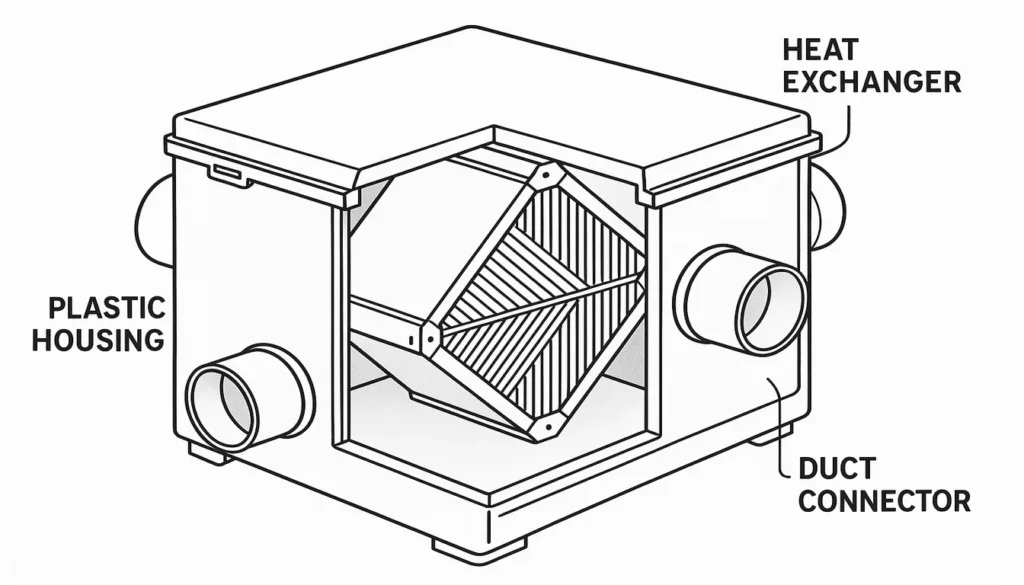
- Redondo o rectangular.
- Engineering-grade plastics such as PP, ABS, and PS are selected for their thermal resistance, dimensional stability, and chemical compatibility.
- Injection molding enables tight tolerances and consistent geometry essential for air-sealing performance in heat recovery ventilators.
- Snap-fit joints and ultrasonic welding dramatically cut assembly time without fasteners or adhesives.
Why Do Plastic Components Define Modern HRV Performance?
Heat recovery ventilators have quietly transformed how buildings manage indoor air quality. At their core, these systems transfer thermal energy between outgoing stale air and incoming fresh air, recovering up to 85% of the heat that would otherwise be lost. What makes this possible at scale—and at an affordable price point—is the strategic use of engineered plastic components throughout the unit.
| Property | Engineering Plastic | Sheet Metal |
|---|---|---|
| Thermal conductivity | 0.1–0.4 W/m·K (low bridging) | 16–50 W/m·K (high bridging) |
| Corrosion resistance | Excellent in condensate | Requires coating/galvanizing |
| Part integration | Snap features, channels in one shot | Multiple stampings + assembly |
| Weight (casing half) | 0.8–1.4 kg typical | 2.5–4 kg typical |
Metal housings were once the standard, but they introduced thermal bridging, added significant weight, and complicated manufacturing. Today, polymer science has advanced to the point where carefully selected plastics outperform metals in many of the roles inside an HRV. They offer lower thermal conductivity (reducing heat loss through the casing), superior corrosion resistance in humid condensate environments, and far greater design freedom for integrating snap features, ribbing, and duct interfaces directly into molded parts.
The transition to plastic-dominant HRV construction is not just a cost decision. It reflects a genuine engineering advantage: plastics allow complex, multi-functional geometries that would require multiple metal stampings plus assembly labor. A single injection-molded housing half can incorporate drain channels, snap-lock latches, louver mounting points, and filter-track guides in one shot. That integration directly reduces part count, leak points, and installation time.
“Engineering-grade plastics reduce thermal bridging in HRV housings compared to sheet-metal alternatives, improving overall system efficiency.”True
Engineering-grade polymers like polypropylene and ABS have thermal conductivity of 0.1–0.4 W/m·K, compared to 16–50 W/m·K for steel. This significantly reduces heat loss through the casing and improves overall HRV efficiency.
“Plastic HRV housings are always less durable than metal ones.”False
In reality, UV-stabilized and flame-retardant polymer formulations used in modern HRVs meet or exceed the service life of galvanized steel in humid condensate environments, with superior corrosion resistance.
From the outer casing to the microscopic seal gaskets around the heat exchanger core, plastic components influence every metric that matters: airflow resistance, condensate drainage, acoustic performance, and long-term dimensional stability. Understanding which components exist, which materials are chosen, and how they are made unlocks the engineering logic behind modern HRV design.
What Are the Key Plastic Components Inside an HRV Unit?
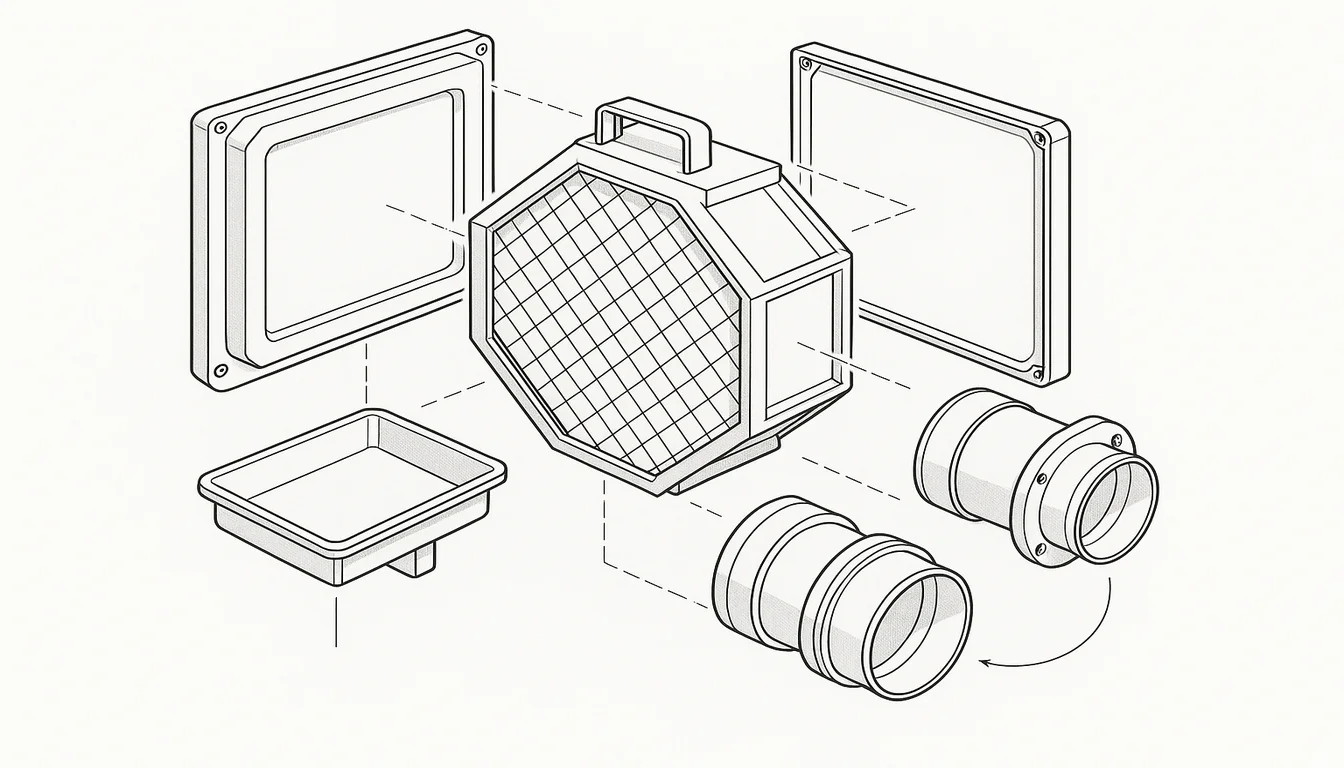
A residential or light-commercial HRV contains a surprisingly large number of distinct plastic parts. Breaking them into functional groups makes the system far easier to understand.
Housing Panels and Casing
The outer shell protects internal components from mechanical damage, moisture, and rodents. HRV casings are typically produced as two or four injection-molded panels that snap or screw together. Wall thickness is carefully engineered—thick enough for rigidity, thin enough to avoid sink marks and to keep cycle times short. Internal ribbing patterns provide stiffness without adding mass. Casing panels often incorporate pre-formed knockout holes for duct penetrations, accepting standard round duct diameters without field cutting.
| Component | Typical Material | Function |
|---|---|---|
| Housing panels | PP copolymer or ABS | Structural enclosure, duct knockouts |
| Core frame | HIPS or ABS | Plate alignment, ±0.3 mm tolerance |
| Drain pan | PP homopolymer | Condensate collection and drainage |
Heat Exchanger Core Frame
The core frame holds the enthalpy or sensible heat exchanger media—typically corrugated polystyrene or aluminum foil plates—in precise alignment. Misalignment reduces contact area and bypass leakage degrades the heat-transfer efficiency rating. Polystyrene or ABS frames are common because they can be molded to tolerances under ±0.3 mm across their full span, maintaining plate spacing without creep under operating temperatures (typically −30 °C to +60 °C).
Drain Pan
Condensate from warm moist exhaust air collects in a drain pan below the core. The pan must resist prolonged water exposure without warping or crazing. Polypropylene homopolymer is the preferred material: it is chemically inert to the mild acids that form in condensate, dimensionally stable, and naturally hydrophobic, which prevents biological fouling from adhering to its surface. The drain pan integrates a sloped floor and a port for the condensate drain tube, again all formed in a single molding cycle.
Duct Connectors and Spigots
Round or rectangular TPE / EPDM1 attach the HRV to the building’s ductwork for supply, exhaust, fresh-air intake, and stale-air discharge. They are among the most mechanically stressed plastic parts in the unit, since installation crews apply torque and bending loads when pushing flexible ducts onto spigots. High-impact ABS or glass-filled PP provides the strength needed without cracking. Many spigots also integrate barbed retention rings and rubber gasket seats, all molded in place.
Filter Frames and Grilles
Most HRVs include washable filter media held in rigid plastic frames. The frames must maintain flatness to ensure full perimeter sealing against the filter track, preventing bypass of unfiltered air. Thin-wall ABS frames with living-hinge latch features allow tool-free removal for regular cleaning—a major user-experience consideration in maintenance-sensitive residential installations.
| Component | Material | Key Design Feature |
|---|---|---|
| Duct spigots | High-impact ABS or glass-filled PP | Barbed retention rings, gasket seat |
| Filter frames | Thin-wall ABS | Living-hinge latch, tool-free removal |
| Damper bushings | Acetal (POM) | Low friction, wear-resistant pivot |
Bypass Damper and Actuator Components
Some HRVs include an economizer bypass that routes incoming air around the heat exchanger during mild weather. The damper blade and pivot bushings are plastic to eliminate metal-on-metal wear and the associated acoustic clicking during actuation. Acetal (POM) is often specified for bushing surfaces due to its low coefficient of friction and excellent wear resistance.
Which Engineering Plastics Work Best for HRV Applications?
Material selection in HRV components is never arbitrary. Each polymer family offers a distinct property profile that maps onto specific functional requirements inside the ventilator. A housing panel faces different stresses than a drain pan, and a damper bushing faces different stresses than a duct spigot. Matching the polymer to the duty cycle—temperature range, chemical exposure, mechanical load, and regulatory requirements—is a fundamental step in HRV product development.
| Stress Type | Temperature Range | Recommended Grade |
|---|---|---|
| Cold-climate impact | −30 °C to +5 °C | PP copolymer or rubber-toughened ABS |
| Thermal cycling fatigue | −30 °C to +60 °C | PP copolymer, annual freeze-thaw rated |
| Continuous condensate | +10 °C to +40 °C | PP homopolymer (chemically inert) |
The temperature range inside an HRV spans from the outdoor air intake temperature (as low as −30 °C in northern climates) to the warm humid exhaust stream temperature (up to 60 °C in summer). Most commodity plastics, including standard HDPE and standard HIPS grades, maintain acceptable properties within this range, but the freeze-thaw cycles experienced annually in cold climates impose fatigue loading on snap features and sealed joints that must be factored into material selection. Co-polymer grades of PP and rubber-toughened ABS outperform their standard counterparts specifically in low-temperature impact scenarios.
Regulatory compliance adds another layer to material selection. UL 94 flammability ratings, RoHS restrictions on hazardous substances, and REACH regulations on chemical additives all constrain which plastics and which additive packages can be used in HRV components shipped to regulated markets. Compounders who supply HRV manufacturers maintain compliance documentation for each material lot, and responsible OEMs audit their supply chains to ensure material traceability from pellet to finished part.
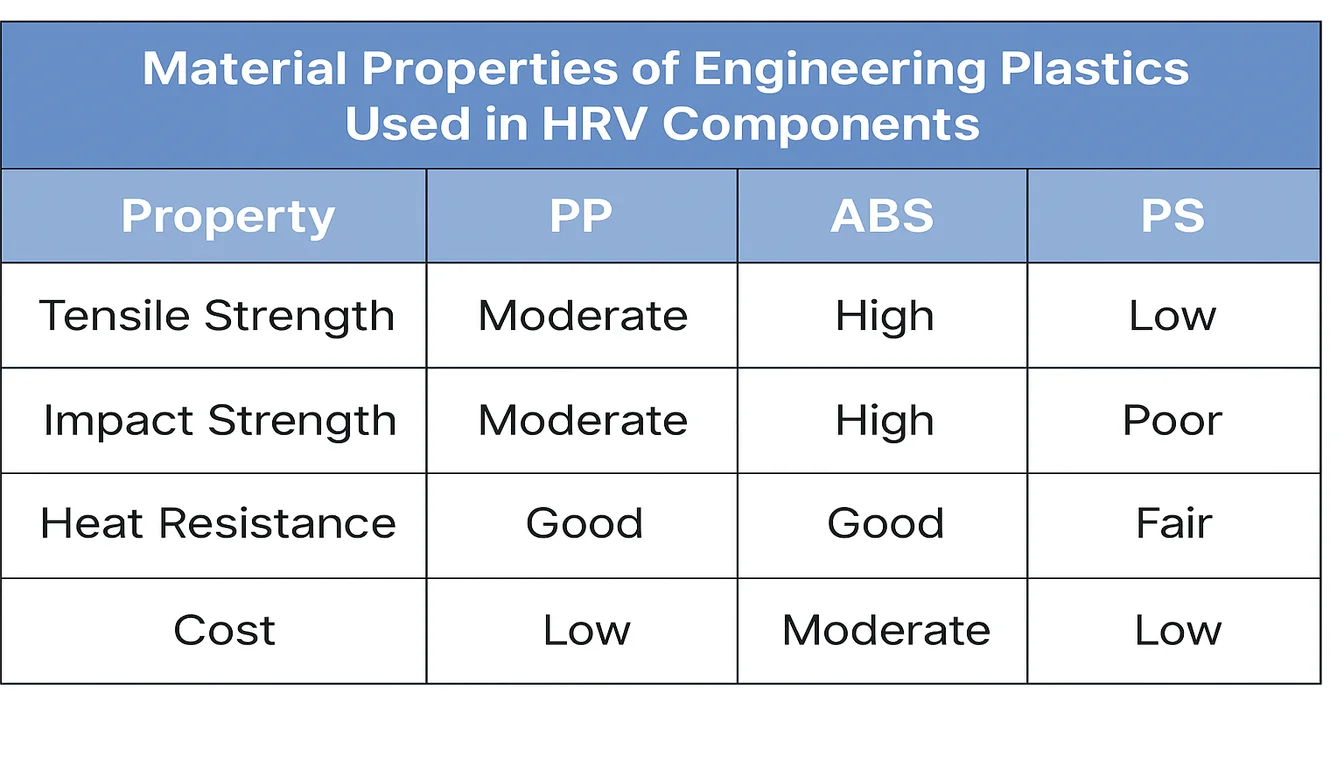
| Material | Key Properties | Primary HRV Use | Weakness |
|---|---|---|---|
| PP Homopolymer | Chemical resistance, fatigue resistance, low density | Drain pans, condensate tubing, snap-fit latches | Lower impact at cold temperatures |
| PP Copolymer | Improved low-temp impact vs. homopolymer | Exterior casing panels in cold-climate HRVs | Slightly reduced stiffness |
| ABS | High impact, excellent surface finish, easy to paint | Duct spigots, filter frames, covers | Poor UV and chemical resistance vs. PP |
| PS (HIPS) | Rigid, dimensionally stable, low cost | Heat exchanger core frames and plates | Brittle at low temperatures |
| POM (Acetal) | Very low friction, fatigue resistance | Damper pivot bushings, slide tracks | Higher cost, difficult to bond |
| TPE / EPDM | 0.5–1.5 s | Gaskets, flexible boot connectors | Requires co-molding or separate assembly |
One of the most important—and often misunderstood—trade-offs in HRV material selection is between stiffness and impact resistance. A core frame must be rigid to maintain plate spacing under the differential pressure generated by the fans, but brittle if dropped during installation. Blending HIPS with a small percentage of rubber-phase modifier is a common solution: it raises impact strength without significantly degrading the dimensional stability needed for core alignment.
Flame retardancy is another critical factor. Residential building codes in North America and Europe require HRV casings to meet UL 94 V-0 or V-2 ratings for fire performance. Achieving these ratings with polypropylene typically requires adding halogen-free mineral flame retardants such as aluminum trihydrate (ATH) or magnesium hydroxide. The addition of these fillers increases material density and reduces mold flow slightly, which must be compensated for in gate location and injection pressure programming.
“Polypropylene homopolymer is preferred for HRV drain pans due to its inherent chemical resistance to condensate acids and its low surface energy, which resists biological fouling.”True
PP homopolymer’s non-polar molecular structure provides excellent resistance to weak organic acids found in HVAC condensate, while its smooth surface minimizes biofilm adhesion—two critical requirements for long-term drain pan reliability.
“All HRV plastic components are made from the same material.”False
In practice, a single HRV unit may incorporate five or more distinct polymer grades, each optimized for its specific functional role—from flame-retardant ABS in housings to soft-touch TPE in gaskets and high-heat PP in drain pans.
How Are HRV Plastic Components Injection Molded?
Injection molding is the dominant manufacturing process for HRV plastic parts because it delivers the tight tolerances, surface quality, and per-part economics that volume production demands. The process involves melting plastic pellets in a heated barrel, then injecting the melt under high pressure into a temperature-controlled steel mold, where it cools and solidifies into the finished part shape.
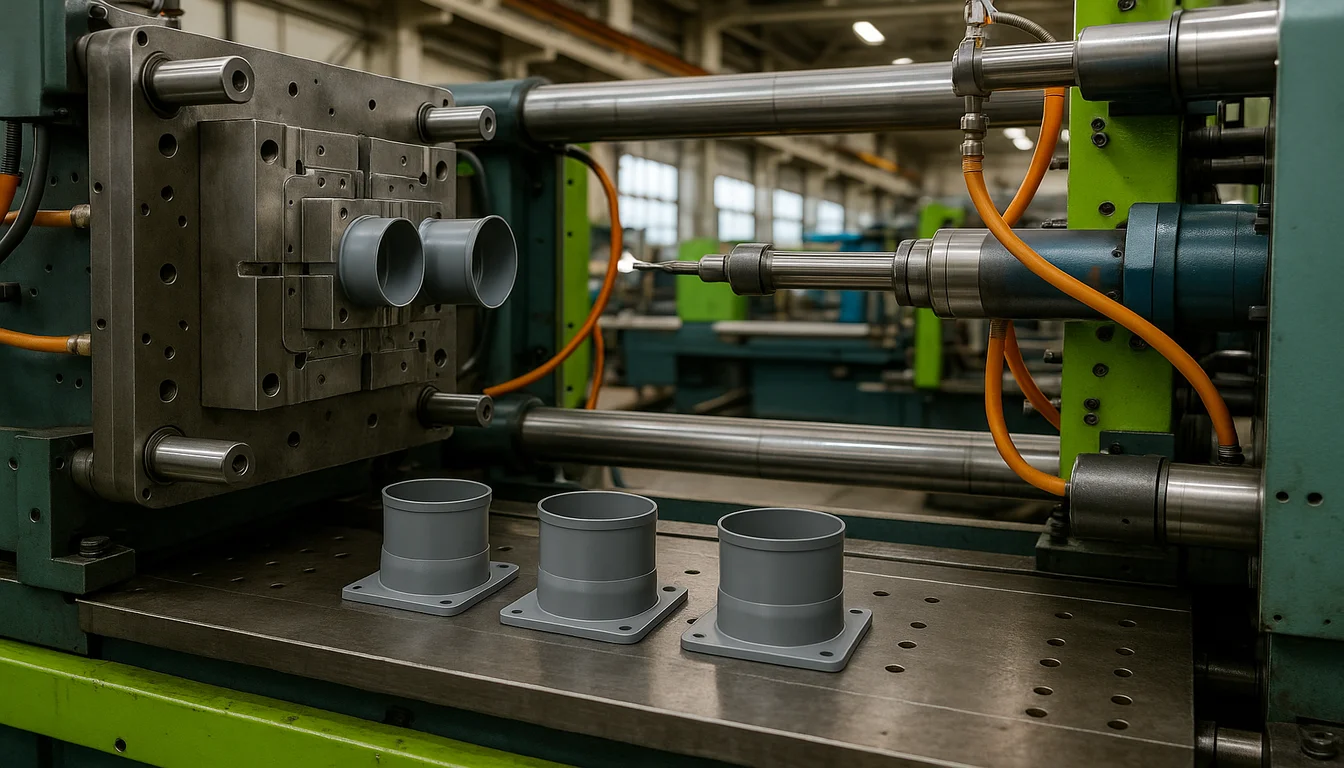
For HRV components specifically, several process parameters are especially critical. Wall thickness uniformity matters enormously for casing panels: variations beyond ±10% of nominal wall thickness create residual stress gradients that cause warpage after ejection. Warped panels won’t seal properly at their mating edges, leading to air bypass that directly degrades heat recovery efficiency. Mold designers address this by placing gates at thicker sections and using balanced runner systems to ensure simultaneous fill of all panel regions.
Draft angles—the slight taper applied to all vertical walls—must be generous enough to allow clean ejection without surface drag marks, yet not so large that they compromise the part’s functional sealing surfaces. For HRV housing panels, typical draft angles run from 0.5° on mating flange surfaces to 2°–3° on decorative exterior faces.
| Parameter | Typical Value | Design Requirement |
|---|---|---|
| Wall thickness tolerance | ±10% of nominal | Prevents warpage and air bypass |
| Draft angle (mating flange) | 0.5° | Maintains sealing surface geometry |
| Draft angle (exterior face) | 2°–3° | Clean ejection without drag marks |
| Bore concentricity (spigot) | ±0.2 mm | Even gasket compression around duct |
The injection molding2 of duct spigots presents a particular challenge: the internal bore must be concentric and round to accept round duct with an even compression against the gasket seat. Side-actions (sliding mold cores that retract before ejection) are commonly used to form the barbed inner bore profile, adding cost to the tooling but enabling the undercut geometry that holds flexible duct securely without clamps.
Cycle times for typical HRV components run from 25 seconds for small filter-frame clips to over 90 seconds for large, thick-walled casing halves. Mold cooling accounts for 60–70% of the total cycle time, which drives mold designers toward conformal cooling channels—channels that follow the contour of the part surface—to maximize heat extraction uniformity and minimize cycle time.
How Do Snap-Fit and Ultrasonic Welding Reduce HRV Assembly Time?
Once individual plastic components are molded, they must be assembled into the complete HRV unit. Two joining technologies dominate modern HRV production: snap-fit joints and ultrasonic welding. Both are enabled specifically by the design freedom of injection molding and the elastic or fusible properties of engineering plastics.
Snap-Fit Design
| HRV Component | Cycle Time | Cooling Share |
|---|---|---|
| Filter-frame clip | 25–35 s | ~60% of cycle |
| Drain pan | 45–65 s | ~65% of cycle |
| Housing casing half | 75–90 s | ~70% of cycle |
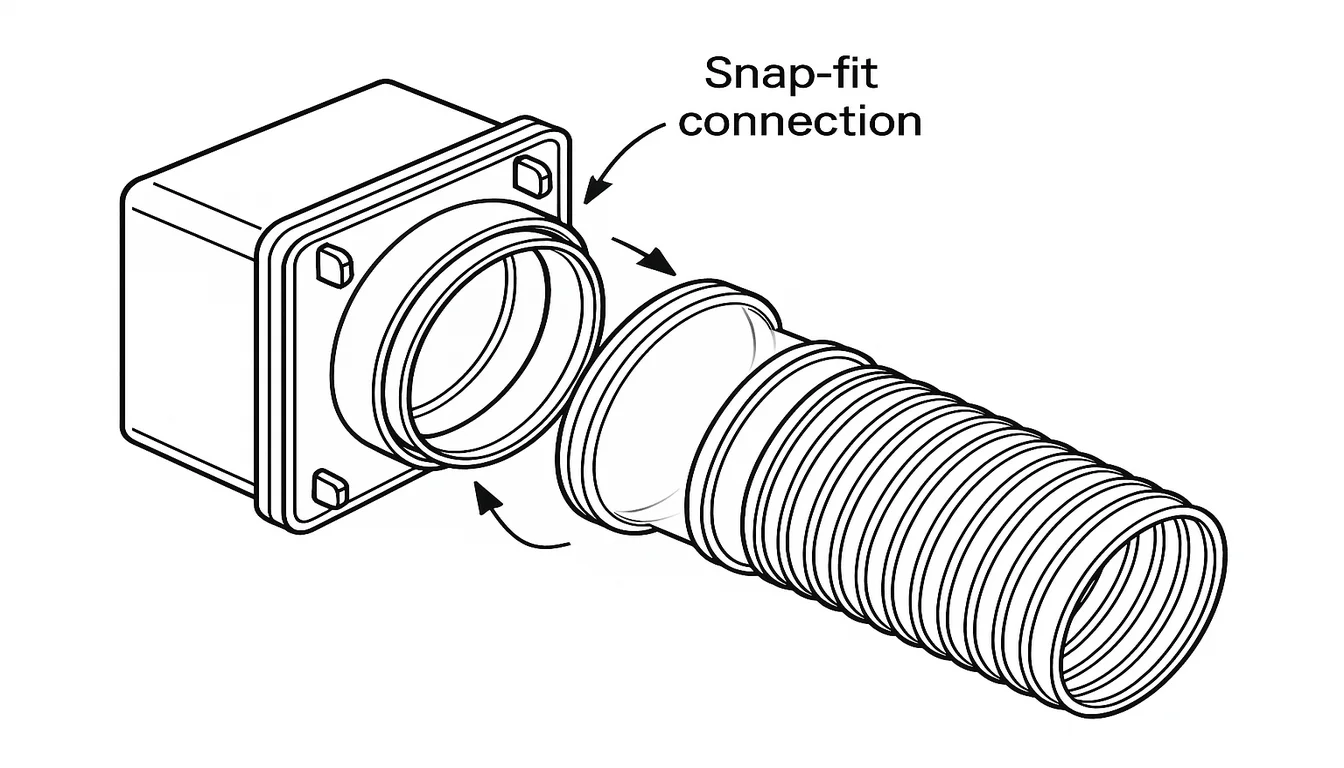
Snap-fit joints use a cantilevered or annular flexible beam that deflects during assembly and springs back to lock two parts together. In HRVs, snap-fits appear on filter access doors, bypass damper retainers, and casing panel latches. A well-designed snap-fit allows hundreds of engagement-disengagement cycles without fatigue failure—critical for the filter frames that homeowners remove monthly for cleaning.
Designing reliable snap-fits in polypropylene requires careful calculation of the beam’s strain during deflection. The maximum allowable strain for PP is roughly 2–4% before permanent deformation occurs. Finite element analysis is routinely used during mold development to optimize beam length, thickness taper, and deflection angle so that the snap engages with a satisfying tactile click at an insertion force under 20 N, while generating a retention force above 50 N.
Ultrasonic Welding
For permanent joints that must be airtight—such as the bond between a core frame sub-assembly and its drain pan—ultrasonic welding is preferred. A sonotrode (vibrating horn) applies high-frequency mechanical vibration (typically 20–40 kHz) to the joint interface, generating friction heat that melts a precisely sized energy director feature. The molten plastic flows under clamping pressure, solidifying into a molecular bond that matches or exceeds the parent material strength.
Ultrasonic welding is fast (typical weld times of 0.5–1.5 seconds), clean (no adhesives, no VOC emissions), and reproducible. Modern ultrasonic welding machines servo-control both time and energy deposition, producing process data logs that quality systems can use for statistical process control. This traceability is increasingly important as HRV manufacturers seek certifications such as ENERGY STAR, Passivhaus component approval, or CSA Group listing, all of which require documented manufacturing process controls.
| Parameter | Typical Value | Significance |
|---|---|---|
| Frequency | 20–40 kHz | Generates friction heat at energy director |
| Weld time | 0.5–1.5 s | Descubre cómo los componentes plásticos moldeados por inyección definen el rendimiento de los HRV. Guía experta sobre materiales, diseño y fabricación para ventiladores de recuperación de calor. |
| Joint strength | ≥ parent material | Molecular bond, no mechanical fasteners |
The flexibility of the seals3 and flexible hose boots used at duct connection points complements these rigid-joining techniques. Where snap-fits lock rigid panels and ultrasonic welding bonds structural frames, elastomeric seals accommodate dimensional variation and vibration without transmitting stress to the rigid plastic housing. Together, these joining and sealing strategies give HRV manufacturers a complete toolkit for assembling complex multi-component units with zero fasteners in many sub-assemblies.
| Joining Method | Application in HRV | Key Advantage |
|---|---|---|
| Snap-fit | Filter doors, casing latches | Tool-free, repeated disassembly |
| Ultrasonic weld | Core frame to drain pan | Permanent airtight bond, no VOCs |
| Elastomeric seal | Duct boot connections | Accommodates vibration and tolerance |
Summary?
HRV plastic components are not a compromise—they are an engineered advantage. From the chemical inertness of polypropylene drain pans to the dimensional precision of HIPS core frames, from the impact resilience of ABS duct spigots to the friction-free surfaces of acetal damper bushings, every material choice in a modern HRV reflects deliberate optimization for a specific operating condition. Injection molding ties it all together, enabling the complex geometries—integrated channels, snap features, precision bores—that make high-efficiency heat recovery ventilation practical and affordable at scale.
Manufacturers who invest in proper material selection, mold design, and assembly process controls will produce HRV units that maintain their rated efficiency across 20+ years of service. Those that cut corners on plastic component quality will see field failures: warped panels that bypass air, cracked spigots that leak, and fatigued snap-fits that allow filter bypass. The plastic components inside an HRV are, in every sense, the system.
Frequently Asked Questions?
What plastics are used in HRV components?
The most common engineering plastics in HRV units are polypropylene (PP) for drain pans and snap-fit parts, ABS for housings and duct connectors, high-impact polystyrene (HIPS) for heat exchanger core frames, acetal (POM) for low-friction bushings, and TPE or EPDM elastomers for seals and gaskets.
How long do HRV plastic components last?
Well-engineered HRV plastic components are designed for service lives of 15–25 years. UV-stabilized and flame-retardant polymer formulations resist the temperature cycling, humidity, and condensate exposure inherent to HRV operation. Gaskets and seals are typically the shortest-lived parts and may require replacement at 10–15 years.
Can HRV plastic parts be recycled?
Yes. Most HRV housing panels, frames, and drain pans are made from thermoplastics (PP, ABS, PS) that can be reground and recycled. Mixed-material assemblies—such as ultrasonic-welded joints or over-molded TPE seals—require separation before recycling. Some manufacturers are now designing for disassembly with reversible snap-fits to facilitate end-of-life material recovery.
Why are HRV core frames made from polystyrene instead of metal?
Polystyrene (HIPS) provides the dimensional stability needed to maintain precise plate spacing in the heat exchanger core while having much lower thermal conductivity than metal. Lower conductivity means the core frame itself does not act as a thermal bridge that bypasses the heat exchanger, protecting efficiency. Metal frames would also be vulnerable to corrosion in condensate-laden environments.
What is the role of injection molding in HRV manufacturing?
Injection molding produces HRV plastic parts with tight tolerances (±0.3 mm or better), complex integrated features, and consistent quality across large production volumes. It enables the snap-fit features, drain channels, filter tracks, and duct interfaces that make modern HRV units compact, efficient, and easy to install and maintain.
-
Duct connectors are plastic fittings that link ventilation ducts to HRV units, ensuring airtight airflow transfer. ↩
-
Injection molding is a manufacturing process where molten plastic is injected into a mold cavity to form precise components. ↩
-
Seals refer to flexible polymer gaskets and hoses that prevent air and moisture leakage in HVAC assemblies. ↩





