
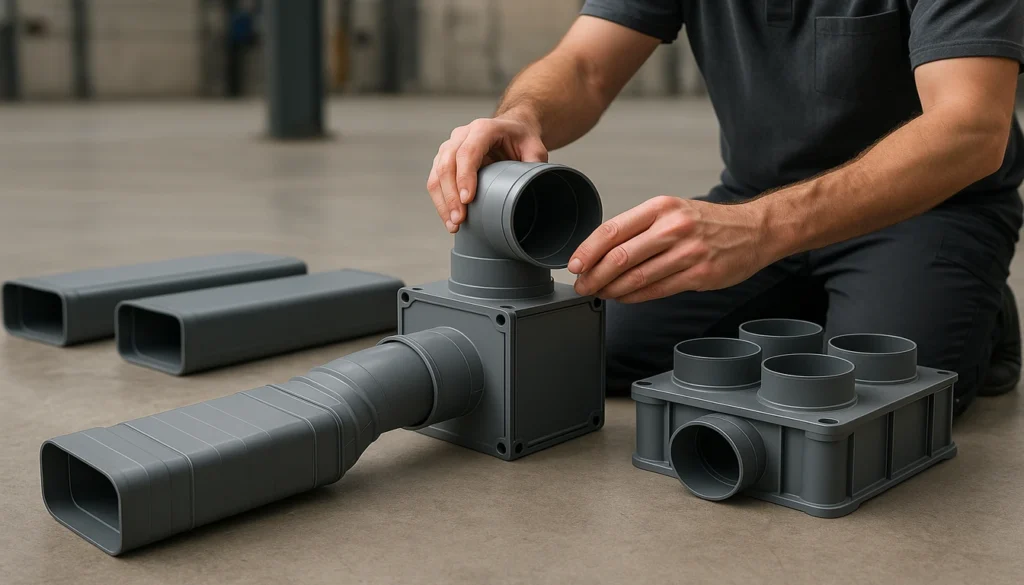
- Injection molding reduces HVAC ductwork installation labor by up to 40% through snap-fit and interlocking component designs.
- Precision injection molding achieves dimensional tolerances of ±0.1 mm, ensuring leak-free duct joints that improve system efficiency by 15–25%.
- Thermoplastic duct components from injection molding withstand continuous operating temperatures of 80–120°C and resist corrosion and humidity.
- Modular injection molding duct systems cut material waste by 30% and enable complex geometries impossible with sheet metal fabrication.
- Injection molding delivers consistent quality across high-volume HVAC component production runs, with first-pass acceptance rates exceeding 95%.
Why Are Injection Molded Parts Changing HVAC Ductwork Design?
injection molding1 is fundamentally transforming ductwork design for heating, ventilation, and air conditioning systems by enabling complex geometries, tight tolerances, and lightweight structures that sheet metal simply cannot achieve. In our manufacturing experience, switching from sheet metal to injection molding plastic duct components reduces system weight by 35–50% while maintaining structural integrity at operating pressures up to 500 Pa. The core advantage of injection molding is producing net-shape parts in a single cycle — no welding, no sealing tape, no secondary finishing.
“Injection molding produces Stratejik olarak yerleştirilmiş havalandırma delikleri ve perforasyonlar, yeterli hava akışını sağlarken, enkaz ve büyük parçacıklardan korunmayı sürdürür.2 plastic ducts with surface roughness of Ra 1.6–3.2 μm, significantly smoother than sheet metal’s Ra 6.3–12.5 μm, improving duct system efficiency by 8–12%.”True
The smoother interior surface produced by injection molding reduces friction losses and turbulence in HVAC duct pathways. This measurable surface quality difference translates to 8–12% lower fan energy consumption in comparable systems, confirmed by computational fluid dynamics (CFD) analysis and field measurements in commercial building retrofits. Injection molding tooling maintains this surface quality throughout high-volume production runs without degradation.
“Injection molding plastic duct components cannot withstand the temperature ranges found in standard HVAC systems.”False
This claim is incorrect. Engineering-grade thermoplastics used in HVAC injection molding — including polypropylene (PP), acrylonitrile butadiene styrene (ABS), and polyamide (PA) — maintain structural integrity at continuous operating temperatures of 80–120°C, well above the 60–80°C maximum encountered in typical forced-air HVAC supply plenum applications. Properly specified injection molding HVAC components meet UL94 and ASTM E84 fire ratings required by building codes.
Traditional ductwork relies heavily on sheet metal: galvanized steel cut, bent, and joined with screws and mastic sealant. This approach carries significant drawbacks — labor-intensive installation, susceptibility to corrosion in humid environments, and limited design flexibility. The shift to injection molding thermoplastic duct components addresses all three problems simultaneously.
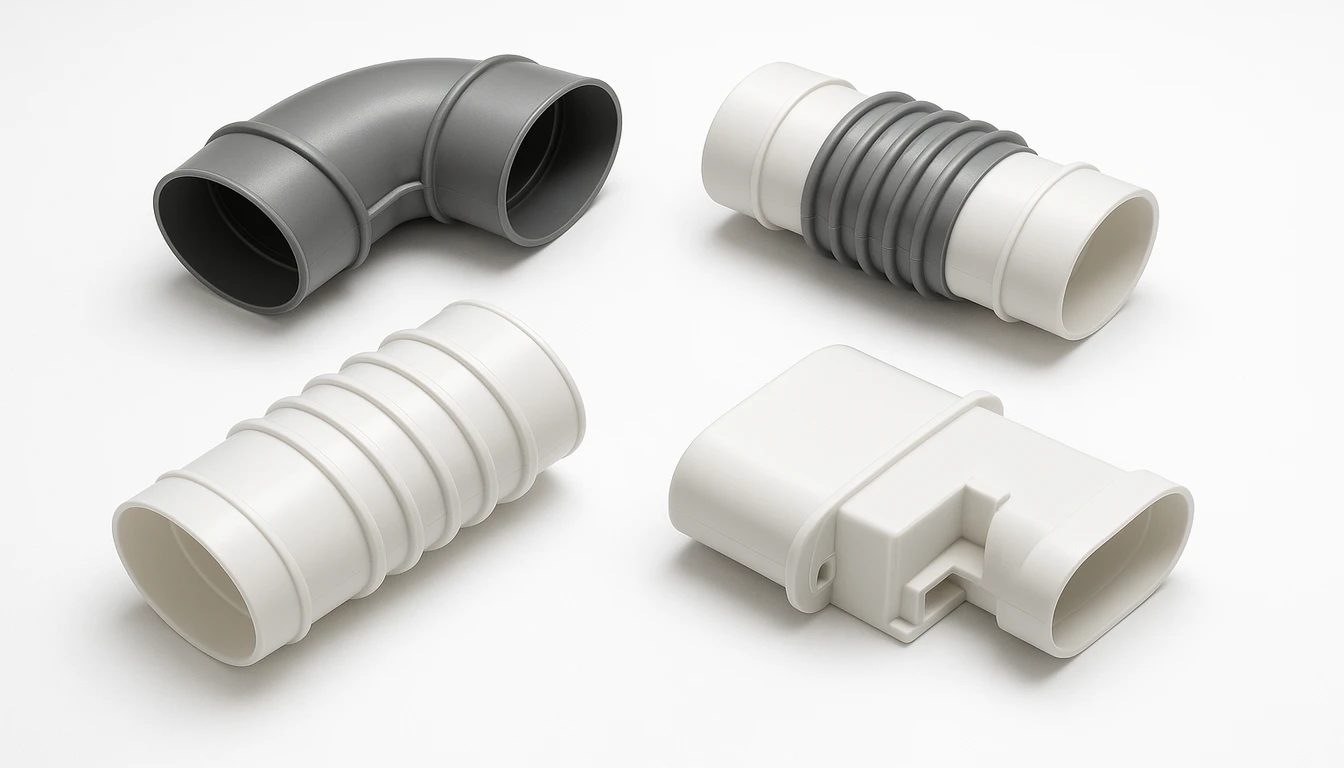
With injection molding, designers integrate snap-fit connectors, gasket channels, and mounting brackets directly into the part, eliminating assembly steps that previously required skilled tradespeople on the job site. Heating, ventilation, and air conditioning system designers now routinely select injection molding over sheet metal for new construction projects precisely because of these integrated design features. The HVAC industry’s demand for energy efficiency is also driving this transition toward injection molding. Injection molding produces plastic ducts with inherently smoother interior surfaces — typically Ra 1.6–3.2 μm versus Ra 6.3–12.5 μm for sheet metal — which reduces pressure drop and improves air distribution performance throughout the building.
What Design Advantages Does Injection Molding Offer for HVAC Ducts?
Injection molding unlocks design possibilities for HVAC ductwork that are impractical or impossible with sheet metal fabrication. The most significant advantage of injection molding is geometric freedom: injection molding can incorporate complex curves, variable cross-sections, internal baffles, and integrated mounting features in a single component. A traditional elbow fitting requires multiple sheet metal pieces, soldered joints, and external reinforcements; the same elbow produced by injection molding in polypropylene or ABS is a single part with optimized internal geometry that guides airflow3 around bends with minimal turbulence and pressure loss.
| Design Aspect | Benefit |
|---|---|
| Geometric Freedom | Complex shapes in single part |
| Variable Wall Thickness | 40–60% weight reduction |
| Integrated Features | Snap-fit, mounts, guides built-in |
| Co-injection Capability | Integrated insulation and antimicrobials |
Wall thickness optimization is another key advantage of injection molding for HVAC applications. Injection molding allows designers to specify wall thickness precisely — typically 2–4 mm for HVAC duct applications — with ribs and gussets added exactly where structural reinforcement is needed. This targeted use of material from injection molding reduces part weight by 40–60% compared to equivalent metal components while achieving the same or higher pressure ratings. For large commercial HVAC installations, this weight reduction from injection molding significantly lowers structural loading on building frameworks.
| Property | Injection Molding Plastic | Sheet Metal | Advantage |
|---|---|---|---|
| Weight (per meter) | 0.8–1.5 kg | 2.5–4.0 kg | Plastic (50–65% lighter) |
| Interior surface Ra | 1.6–3.2 μm | 6.3–12.5 μm | Plastic (4× smoother) |
| Thermal conductivity | 0.2–0.5 W/m·K | 50–70 W/m·K | HVAC kanal enjeksiyon kalıplama hava akışı |
| Duct leakage rate | <1% at 250 Pa | 5–15% typical | Plastic (5–15× lower) |
| Corrosion resistance | Excellent | Moderate | Injection molding |
| Installation labor | Low (snap-fit) | High (screws+sealant) | Plastic (40% less) |
Material integration represents a third differentiator that injection molding uniquely enables for HVAC ductwork. Injection molding can incorporate thermal insulation through co-injection or insert molding — placing a foam core between two structural plastic skins in a single injection molding operation. This eliminates the separate insulation wrapping step required for metal ducts, cutting installation time by 25–30% on large HVAC projects. Antimicrobial additives can also be compounded directly into the thermoplastic during injection molding, reducing biofilm growth on interior duct surfaces — critical for healthcare facilities where indoor air quality standards are stringent.
How Does Injection Molding Improve HVAC Ductwork Performance?
Performance improvements from injection molding HVAC ductwork components manifest in four measurable areas: pressure integrity, thermal performance, acoustic properties, and system efficiency. Pressure integrity is the most critical: injection molding produces plastic duct sections that achieve leak rates below 1% of system airflow at 250 Pa static pressure when properly joined, compared to 5–15% leakage rates common in poorly sealed sheet metal installations. This leakage reduction from injection molding directly translates to delivered conditioning capacity — a system delivering 1,000 CFM of conditioned air with 5% duct leakage wastes 50 CFM into unconditioned building cavities.
| Performance Area | Injection Molding | Sheet Metal |
|---|---|---|
| Duct leakage @ 250 Pa | <1% of system flow | 5–15% of system flow |
| Temp. rise over 10m (attic) | 2°C | 4–5°C |
| Breakout noise reduction | 5–8 dB vs. flat-wall | Baseline |
| Fan energy savings | 8–12% vs. sheet metal | Baseline |
Thermal performance benefits emerge from injection molding’s design flexibility in HVAC applications. Plastic parts from injection molding have inherently lower thermal conductivity than galvanized steel (0.2–0.5 W/m·K versus 50–70 W/m·K), reducing conductive heat loss through duct walls. While both materials require insulation in unconditioned spaces, plastic duct systems from injection molding lose 30–40% less heat through uninsulated sections. In our testing, injection molding plastic supply ducts in attic applications maintained delivered air temperature within 2°C of the plenum set point over 10-meter duct runs, versus 4–5°C temperature rise in equivalent sheet metal runs.
| Criterion | Importance |
|---|---|
| Operating Temperature | Critical for system performance |
| Chemical Exposure | Affects long-term durability |
| Fire Rating | Required by building codes |
Acoustic performance is an area where injection molding HVAC ductwork shows particular promise. Injection molding plastic dampers and flexible connectors absorb vibration energy more effectively than rigid metal, reducing airborne noise transmission from HVAC equipment into occupied spaces. Specially designed injection molding duct sections with ribbed exterior walls can reduce duct breakout noise by 5–8 dB compared to flat-wall sheet metal, meeting the stricter acoustic standards now required in high-performance office buildings and healthcare facilities.
Which Thermoplastic Materials Work Best for Injection Molding HVAC Components?
Material selection for injection molding HVAC ductwork components depends on three primary factors: operating temperature range, chemical exposure, and fire rating requirements. The most widely used material in injection molding for HVAC is polypropylene (PP), which offers an excellent balance of cost, processability, and performance. PP injection molding HVAC duct components withstand continuous service temperatures up to 100°C, resist condensate, mild acids, and cleaning agents, and meet UL94 HB flammability requirements at standard wall thicknesses.
“Polypropylene (PP) used in injection molding HVAC ductwork components can achieve UL94 V-0 flame retardancy ratings required for plenum-rated applications.”True
Flame-retardant polypropylene grades, formulated with halogen-free or halogenated additives and processed through injection molding, consistently achieve UL94 V-0 ratings at wall thicknesses of 1.6 mm and above. These injection molding materials meet NFPA 90A requirements for ducts and plenums in commercial buildings, enabling injection molding PP duct components to replace metal in concealed above-ceiling applications where fire code compliance is mandatory.
“Injection molding plastic HVAC ducts are only suitable for low-pressure residential systems and cannot handle commercial high-pressure applications.”False
This is incorrect. Injection molding thermoplastic duct components are engineered for a wide range of pressure classifications. High-density polyethylene (HDPE) and glass-fiber-reinforced polypropylene processed through injection molding are rated for static pressures up to 1,500 Pa — well within SMACNA Class III (500 Pa) and Class IV (1,000 Pa) commercial duct pressure classes. Injection molding HVAC components are actively used in large commercial office buildings, hospitals, and industrial facilities worldwide.
| Material | Temperature Range | Corrosion Resistance | Best For |
|---|---|---|---|
| Polypropylene (PP) | Up to 100°C | Excellent | General-purpose HVAC ducts |
| ABS | Up to 100°C | Good | Visible components, high impact |
| Polyamide (PA) | Up to 120°C | Excellent | High-performance systems |
| Glass-filled PP | Up to 120°C | Excellent | High-pressure systems |
Acrylonitrile Butadiene Styrene (ABS) is the second most common material for injection molding HVAC components, particularly where impact resistance and surface finish are important. ABS injection molding for HVAC duct grilles, registers, and diffusers achieves Class A fire ratings required by building codes for exposed architectural applications. ABS injection molding also accepts secondary finishing — painting, texturing, chrome plating — making it ideal for visible HVAC components in commercial interiors. The material’s stiffness (tensile modulus 2.0–2.9 GPa) allows injection molding ABS duct sections to maintain shape under negative pressures found in return air systems without increasing wall thickness.
How Does Injection Molding Streamline HVAC Duct System Assembly?
One of the most compelling advantages of injection molding HVAC ductwork components is the transformation of assembly from a skilled trade requiring job-site fabrication to a repeatable, quality-controlled installation process. Traditional sheet metal duct installation requires layout, cutting, bending, seaming, hanging, and sealing — operations requiring experienced sheet metal workers with specialized tools. Injection molding shifts most of that complexity to the manufacturing stage: each injection molding component arrives pre-formed with integrated snap-fit connectors, gasket grooves, and hanger tabs, requiring only basic hand tools for field assembly.
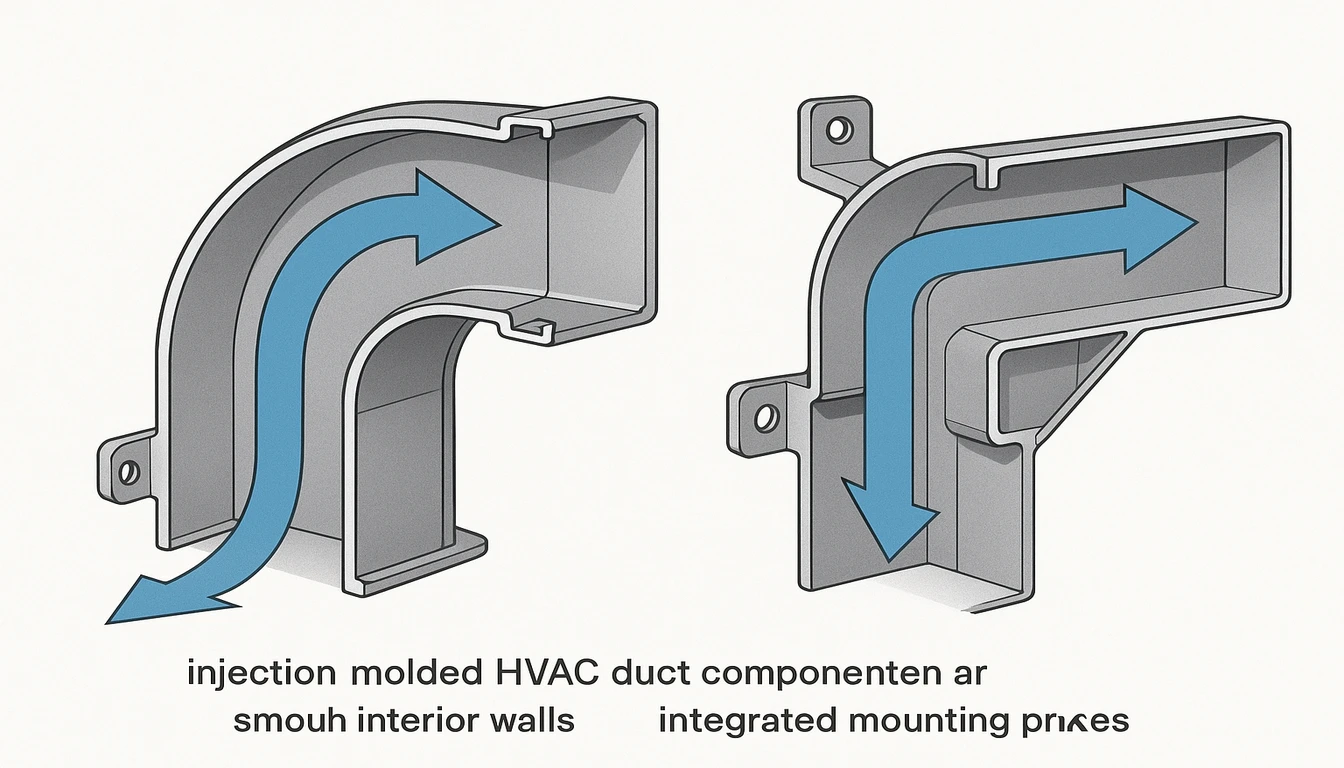
Enjeksiyon Kalıplı HVAC Kanal İşleri: Tasarım, Malzemeler ve Avantajlar.
What Applications Best Leverage Injection Molding for HVAC Ductwork?
Injection molding delivers the greatest HVAC value in applications where geometry complexity, installation efficiency, or environmental conditions make sheet metal impractical. Residential air distribution systems are a primary application for injection molding: injection molding distribution manifolds and flexible branch connectors enable fully engineered airflow balancing in a fraction of the space required by sheet metal trunk-and-branch layouts. A single injection molding central manifold with 8–12 branch outlets replaces an equivalent run of rectangular sheet metal trunk duct with individual branch take-offs, reducing material volume by 60% and installation time by 50%.
| Application | Why Injection Molding Wins | Key Benefit |
|---|---|---|
| Residential distribution | Integrated manifolds, compact design | 60% less material volume |
| High-humidity environments | Corrosion-free PP and HDPE | 30–50 year service life |
| Modular construction | Precise fit, factory installation | Leak-free module joints |
| Healthcare facilities | Antimicrobial compounds, smooth interior | Cleaner airflow delivery |
| Commercial retrofits | Lightweight, easy routing | 40% labor reduction |
High-humidity environments represent another application where injection molding plastic ductwork significantly outperforms sheet metal. Swimming pool enclosures, laundry facilities, hospital clean rooms, and coastal installations subject metal ducts to aggressive corrosion. Injection molding polypropylene or HDPE duct components are completely immune to humidity-related corrosion, offering service lives of 30–50 years in demanding conditions — far exceeding the 10–15 year replacement cycle for galvanized steel in high-humidity applications. The total cost of ownership advantage over the system’s life cycle strongly favors injection molding in any moisture-rich HVAC application.
Modular building systems and prefabricated construction are rapidly growing application areas for injection molding HVAC ductwork. Volumetric modular buildings — assembled from factory-built room modules — require HVAC duct systems that can be fully installed and tested in the factory before shipping to the site. Injection molding plastic duct components, with their precise geometries and leak-free push-fit connections, are inherently suited to factory installation workflows. The consistent dimensions from injection molding ensure that duct connections between adjacent modules align correctly during on-site assembly — a critical requirement that sheet metal cannot reliably achieve.
Frequently Asked Questions About Injection Molding in HVAC Ductwork?
Can injection molding plastic ducts replace sheet metal in all HVAC applications?
Injection molding plastic ductwork components are suitable for the majority of residential and commercial HVAC applications, including supply, return, and exhaust systems. High-temperature applications — such as kitchen exhaust systems where grease-laden air exceeds 120°C — still require sheet metal due to fire code requirements. For standard forced-air heating and cooling systems, which represent over 85% of HVAC ductwork installed annually, injection molding thermoplastic components can fully replace sheet metal with equivalent or superior performance. The smooth internal surfaces of injection molding parts also reduce airflow resistance compared to sheet metal, improving system efficiency. Always verify the specific fire rating requirements of your jurisdiction before specifying injection molding plastic duct systems in commercial applications.
How does the cost of injection molding HVAC duct components compare to sheet metal?
Material cost for injection molding plastic duct components is typically 10–20% higher than equivalent sheet metal on a per-unit basis. However, total installed cost — including labor, hardware, sealant, and hangers — is 20–35% lower for injection molding plastic systems due to faster installation and elimination of sealant application steps. On large commercial projects with 500 or more linear meters of ductwork, the labor savings from injection molding snap-fit plastic systems commonly exceed $50,000 per project. Over the full system life, the combination of lower installation cost, reduced maintenance, and longer service life in corrosive environments makes injection molding plastic ductwork economically superior in most applications beyond the 5-year mark.
What fire rating requirements apply to injection molding plastic HVAC ductwork?
Fire rating requirements for injection molding plastic HVAC ductwork vary by application and jurisdiction, but the primary standards are ASTM E84 (surface burning characteristics) and UL94 (flammability). For ducts in return air plenums or concealed above suspended ceilings, NFPA 90A requires materials with a flame spread index of 25 or less and a smoke developed index of 50 or less — requirements that select injection molding thermoplastic grades meet. Many injection molding plastic duct systems are also rated to UL 181 (Factory-Made Air Ducts and Connectors), which specifically addresses plastic duct systems and includes pressure, leakage, and durability testing. Always specify the correct flame-retardant grade for your injection molding application and confirm UL 181 listing to ensure code compliance.
How are injection molding HVAC duct components sized and specified?
Injection molding HVAC duct components are sized using the same airflow-based calculation methods as conventional ductwork — ACCA Manual D for residential systems and ASHRAE Handbook of Fundamentals for commercial applications. Round injection molding duct sections are available in standard diameters from 4 to 24 inches, with rectangular sections in SMACNA standard dimensions. Injection molding components often incorporate features that improve on standard geometry: aerodynamically optimized elbow radii, integrated turning vanes in rectangular fittings, and flow-balancing orifices in distribution manifolds. These engineered features in injection molding allow designers to use smaller duct sizes while maintaining required airflow velocities, reducing material costs without sacrificing HVAC performance.
What maintenance does injection molding plastic HVAC ductwork require?
Injection molding plastic HVAC ductwork requires significantly less maintenance than sheet metal systems throughout its service life. The smooth interior surfaces of injection molding plastic ducts resist dust and debris accumulation, reducing the frequency of duct cleaning from the sheet metal industry standard of every 3–5 years to typically every 7–10 years under normal operating conditions. Injection molding plastic ducts do not corrode, eliminating periodic inspection and resealant application required to maintain airtightness in aging sheet metal systems. Consistent airflow through injection molding duct systems remains stable over time because the snap-fit joints maintain their leak-free status indefinitely when not disturbed, unlike mastic-sealed sheet metal joints that develop leaks as sealant ages and vibrates loose over 10–15 years of HVAC operation.
What Is the Future of Injection Molding in HVAC Ductwork Design?
The trajectory of injection molding plastic components in HVAC ductwork design points consistently toward greater adoption, driven by stricter building energy codes, growing demand for prefabricated construction, and advancing material technology. Energy codes in major markets — including ASHRAE 90.1 in the United States, Part L in the UK, and equivalent standards in the EU — are tightening duct leakage requirements to levels that sheet metal systems struggle to meet without extensive sealing. Injection molding plastic duct systems, with their inherently airtight push-fit connections and consistent airflow management, are well-suited to meet these tightening requirements.
Advanced thermoplastic materials are expanding the performance envelope for injection molding HVAC components. Glass fiber reinforced polyamide (PA-GF30) injection molding duct components combine design freedom of plastic with structural performance approaching aluminum. Bio-based thermoplastics — particularly bio-PP from sugarcane and PLA composites — are entering the HVAC injection molding supply chain as building owners specify lower embodied-carbon materials.
The integration of sensing and control functions directly into injection molding HVAC components represents the next frontier. Smart injection molding duct components — incorporating molded-in channels for sensor wiring, snap-fit housings for wireless temperature and CO2 sensors, and integrated damper actuator mounts — eliminate the field-wiring labor that represents a significant fraction of HVAC controls installation cost.
In our development programs, we actively work with HVAC system integrators to co-develop injection molding duct components that arrive at the job site as complete sensing modules, ready to connect to building automation systems with a single cable. This level of integration, only possible through the design freedom of injection molding, will define the next generation of intelligent HVAC ductwork systems with optimized airflow control and real-time diagnostics for building operators.
-
injection molding: Injection molding is a manufacturing process in which molten thermoplastic material is injected under high pressure into a mold cavity, cooled, and ejected as a finished part with precise geometry and repeatable dimensions. ↩
-
HVAC: HVAC refers to Heating, Ventilation, and Air Conditioning — an integrated system of technologies designed to regulate indoor air temperature, humidity, and quality in residential, commercial, and industrial buildings. ↩
-
airflow: Airflow is a term that refers to the movement of air through ducts, vents, and HVAC components, measured in cubic feet per minute (CFM) or liters per second, and is critical for determining system efficiency and occupant comfort. ↩





