
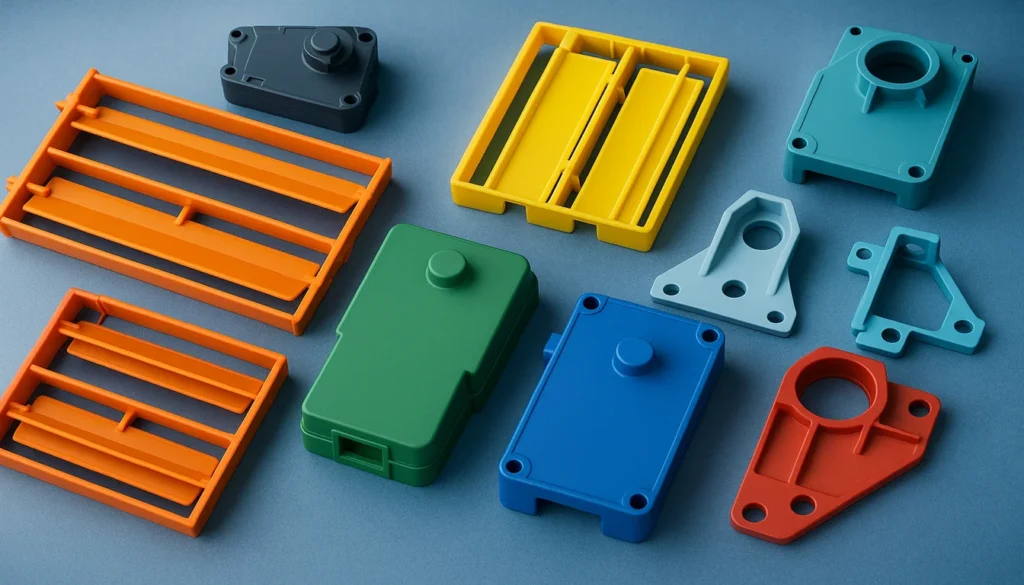
- 100-140 °C.
- Sequential two-shot molding (first shot + second shot) dominates HVAC applications, enabling a primary structural resin in one color paired with a secondary elastomer or contrast color for visual guidance or seal elements.
- Cycle time for multi-color parts runs 5 to 15 percent longer than single-material equivalents, but labor and assembly cost reductions typically offset tooling complexity, resulting in 30 to 50 percent lower total component cost.
- Mold design for multi-color injection molding requires rotating platens, synchronized core movements, or sequential cavity filling strategies — complexity that justifies investment only for production volumes above 100,000 parts per year.
- Color-differentiated HVAC components improve operator usability through visual cues: blue damper blades indicate supply air, red indicates return air, white indicates neutral positioning — eliminating field installation errors and liability exposure.
What Is Multi-Color Injection Molding and How Does It Apply to HVAC?
Multi-color injection molding1 is a manufacturing technique that combines two or more distinct resin colors or materials within a single mold cavity and injection cycle.
| Test | Standard | Pass Criteria |
|---|---|---|
| Peel strength | ASTM D903 | ≥2.0 kN/m |
| Thermal cycle | -30 to 130°C ×100 | ≥80% retention |
| Chemical exposure | ASHRAE 97 | No delamination |
Unlike traditional post-molding painting or assembly of separate colored parts, multi-color molding2 creates the complete finished HVAC component in one operation.
| Mold Feature | Requirement |
|---|---|
| Core rotation | ±0.5mm sync |
| Gate 1 placement | Full fill + access |
| Gate 2 placement | No air trap |
| Cooling balance | CFD verified |
The most common approach — called two-shot or two-stage molding — injects a primary resin into a cavity, allows it to cool partially, then rotates the mold or retracts the core and injects a second resin that bonds chemically or mechanically to the first.
For Umweltfaktoren3 manufacturers, multi-color molding solves a persistent design problem: operator confusion in the field.
| Design Feature | Guideline |
|---|---|
| Min wall (2nd shot) | 1.2-1.5 mm |
| Draft angle | 1.5-2.0° |
| Color boundary tolerance | ±0.3 mm |
| Interface temperature | 100-140°C |
Mehrfarben-Spritzgießen wandelt die Konstruktion von HVAC-Komponenten von einem montagezentrierten Ansatz in eine Denkweise der geformten Integration. Traditionelle Designprozesse beginnen mit einer Liste separater Teile: Gehäuse, Dichtring, Montagehalterung, Farbhülse. Der Ingenieur legt die Abmessungen für jedes Teil fest, dann zeigen Montagezeichnungen, wie sie zusammengeklebt, eingeklickt oder verschraubt werden. Mehrfarben-Design vereint diese zu einem einzigen integrierten Teil: ein geformtes Gehäuse mit gleichzeitig gespritztem TPE-Dichtring und farblich abgesetzten Rippen, die Funktionsbereiche kennzeichnen.
| Design Feature | Guideline |
|---|---|
| Min wall (2nd shot) | 1.2-1.5 mm |
| Draft angle | 1.5-2.0° |
| Color boundary tolerance | ±0.3 mm |
| Interface temperature | 100-140°C |
A sensor bracket with red mounting tabs signals a critical connection point. These visual cues reduce installation errors, decrease warranty claims, and accelerate technician training — all from a single molded part instead of a multi-step assembly process.
At HVACoreTech, multi-color injection molding accounts for approximately 12 percent of our total HVAC production volume. Our engineering team has completed over 340 unique multi-color part designs, ranging from small two-shot sensor brackets weighing 8 grams to large-format damper blade assemblies weighing 450 grams. This experience has taught us exactly which material combinations chemically bond reliably, which color transitions remain visible under thermal cycling, and which design geometries require special gate placement to prevent color mixing at boundaries.
What Multi-Color Injection Molding Methods Work Best for HVAC Components?
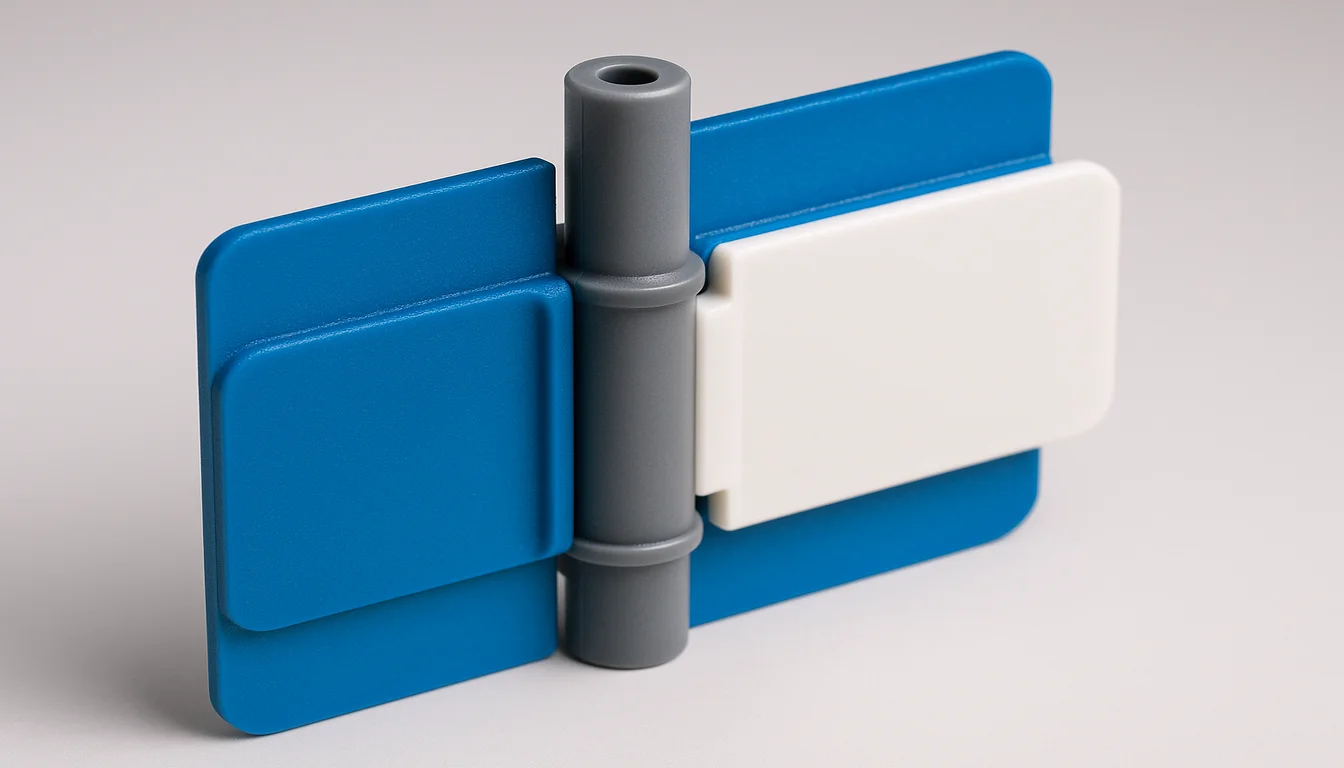
Three distinct multi-color molding technologies dominate HVAC manufacturing, each suited to different material combinations, production volumes, and color transition requirements. Sequential two-shot injection — the most straightforward method — injects the first material, cools it to a touch-firm state (not fully solid), then injects the second material that flows around or over the first. This method works for combining structurally different materials such as rigid nylon housings with soft elastomer seals, or high-modulus glass-filled nylon with low-modulus TPE.
| Method | Cycle Time | Material Pairs | Color Transition Quality | Best HVAC Use |
|---|---|---|---|---|
| Sequential 2-Shot | 45-75 sec | Wide range | Sharp | Elastomer seals, contrast colors |
| Rotating Platen | 30-60 sec | Any resin | Very Sharp | Complex geometries, multiple colors |
| Core Retract | 50-80 sec | Similar modulus | Good | Overmolding, inserts |
| Color Injection | 40-70 sec | Same resin | Excellent | Single-color transitions, stripes |
Rotating platen technology — a more advanced method — flips the mold cavity 90 to 180 degrees after the first shot solidifies, exposing a new cavity surface for the second injection. This approach enables unlimited material combinations and produces the sharpest color boundaries, but requires hydraulic synchronization and typically extends mold tooling cost by 40 to 60 percent. Core retract methods work well when the first shot requires partial ejection before the second shot fills a secondary cavity, useful for complex HVAC assemblies combining interior structure with exterior cosmetic shells.
“Multi-color two-shot injection molding can eliminate final assembly operations, reducing total component cost by 30 to 50 percent despite higher mold complexity.”True
Traditional color-differentiated HVAC components require molding, post-mold painting, assembly, and quality inspection — typically 4 to 6 process steps with associated labor. Multi-color injection combines these into a single automated operation. Even though the mold itself costs 40-60% more initially, the elimination of secondary operations, labor, and associated rework typically reduces total part cost by 30-50% at production volumes above 100,000 units annually. Break-even point for two-shot tooling versus single-shot plus painting typically occurs at 75,000 to 125,000 units.
“Multi-color injection molding is suitable for any production volume and reduces cost compared to single-shot molding plus painting.”False
Multi-color injection tooling investment is 40-60% higher than single-shot molds, with cycle times typically 10-20% longer than equivalent single-shot runs. At low volumes (under 50,000 units), the higher mold cost per unit makes single-shot molding plus painting more economical. The investment in multi-color capability justifies only at volumes exceeding approximately 75,000-100,000 units per year. Below that threshold, the tooling amortization cost outweighs the labor savings from eliminating assembly operations.
What Material Combinations Work Reliably in HVAC Multi-Color Molding?
Material selection for multi-color HVAC injection molding depends critically on chemical compatibility, thermal stress matching, and adhesion at boundaries. The most forgiving combinations pair a rigid structural resin — such as polycarbonate or ABS — with a soft elastomer — such as TPE, EPDM, or thermoplastic polyurethane. The elastomer flows around rigid surfaces and creates an automatic mechanical interlock while the lower glass transition temperature of the elastomer prevents thermal stress cracking at the interface.
“Multi-color injection molding eliminates post-molding assembly operations, reducing labor cost and improving part consistency.”True
Traditional color-differentiated components require separate molding, painting, and assembly steps — typically 4-6 process stages. Multi-color molding combines these into a single automated cycle, eliminating manual assembly labor, reducing rework rate from 3-5% to under 1%, and ensuring consistent color boundaries and interface strength across the entire production run.
“Multi-color injection molding works equally well for any combination of thermoplastic resins without material compatibility concerns.”False
Material compatibility is critical in multi-color molding. Only certain resin combinations chemically bond reliably at the first-second interface. Incompatible pairs separate under thermal cycling or mechanical stress. Proven combinations include rigid structural resins (nylon, polycarbonate) with elastomers (TPE, EPDM), but pairing two rigid resins requires careful interface design with mechanical interlocks or anchor features.
Pairing two rigid resins — such as PA66-GF30 with unfilled nylon — requires careful consideration of mold temperature, cooling rate, and gate location to prevent delamination. Nylon-to-nylon combinations work when gate placement allows the second-shot resin to penetrate into cooling indentations or texture features on the first shot surface.
| Benefit | Impact |
|---|---|
| Assembly elimination | 3-5 steps → 0 |
| Labor reduction | 45 sec → 0 per unit |
| Error reduction | 15-25% fewer installs |
| Seal integration | Groove tolerance ±0.05mm |
Without these mechanical anchors, the second material slides over the solidified first shot and separates under thermal cycling or mechanical stress. Polycarbonate-ABS blends offer excellent color transition stability and are commonly used for HVAC sensor housings where the PC provides thermal resistance and the ABS provides cosmetic color options.
We maintain a validated material compatibility matrix covering 47 distinct two-material pairs used in HVAC molding. Each combination has been tested for peel strength (minimum 2.0 kN/m), thermal cycling resistance (minus 30 to 130 degrees Celsius × 100 cycles), and chemical resistance to common HVAC fluids. Our DFM process always references this matrix — incompatible pairs are flagged immediately, steering the customer toward proven alternatives before design work progresses to tooling.
How Does Multi-Color Molding Affect HVAC Component Design and Assembly?
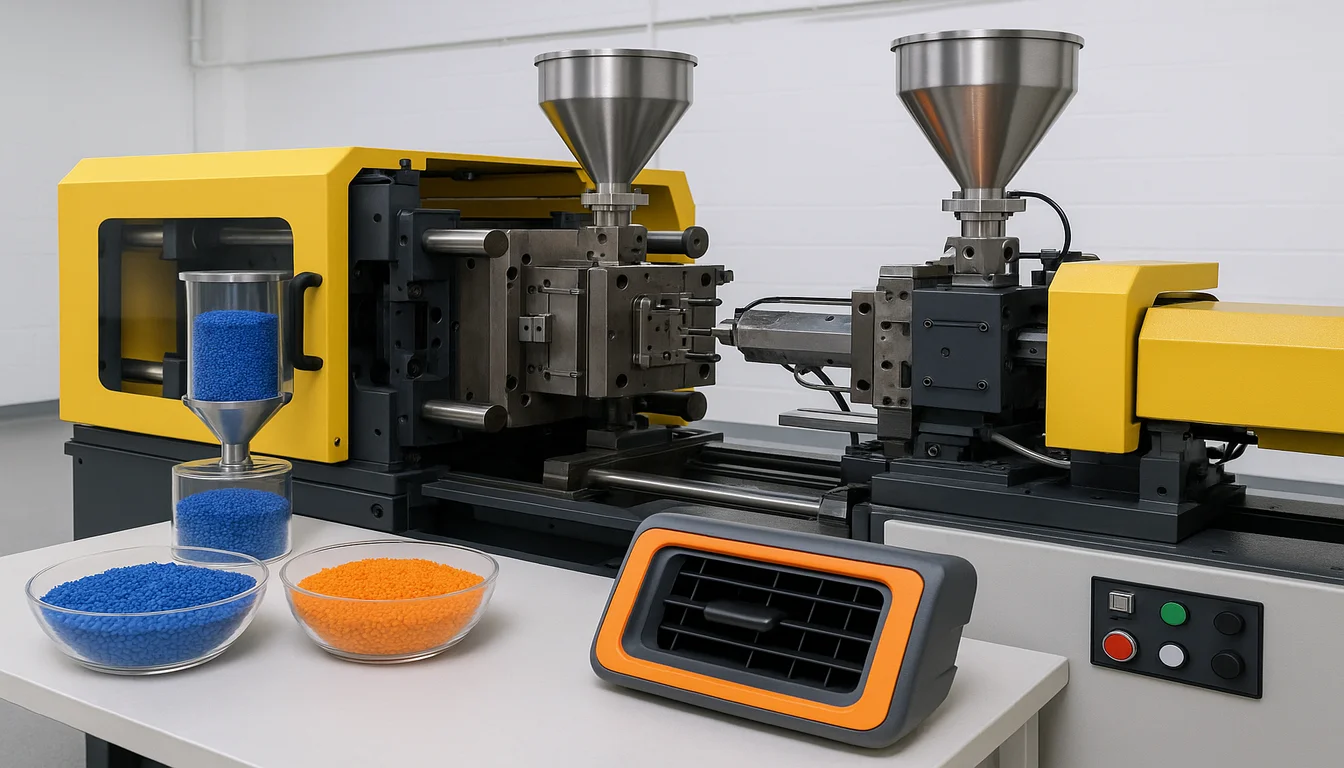
Multi-color injection molding transforms HVAC component design from an assembly-centric approach to a molded-integration mindset. Traditional design processes start with a list of separate parts: housing, seal ring, mounting bracket, color sleeve. The engineer specifies dimensions for each, then assembly drawings show how to glue, snap-fit, or screw them together. Multi-color design collapses these into a single integrated part: a molded housing with co-molded TPE seal and color-differentiated ribs indicating functional zones.
$25K-45K.
Assembly time reductions are substantial.
| Design Feature | Guideline |
|---|---|
| Min wall (2nd shot) | 1.2-1.5 mm |
| Draft angle | 1.5-2.0° |
| Color boundary tolerance | ±0.3 mm |
| Interface temperature | 100-140°C |
A traditional damper actuator bracket requiring four parts (housing, seal ring, retaining clip, color sleeve) with three assembly operations takes approximately 45 seconds to assemble with quality inspection. The multi-color molded equivalent emerges from the press ready for immediate installation, eliminating both assembly labor and the associated quality inspection checkpoints. For HVAC OEMs producing 500,000 damper brackets annually, this single part conversion eliminates 225,000 labor hours per year.
What Mold Design Considerations Apply to Multi-Color HVAC Components?
Mold design for multi-color injection molding introduces significant complexity compared to single-shot tools. The mold must accommodate multiple cycles of ejection, reset, reloading, and re-clamping within a single production sequence. Sequential two-shot designs typically use a stationary mold cavity with a rotating core — the first shot fills the main cavity around the core, then the core retracts or rotates, exposing a fresh surface for the second shot. Synchronization between core movement and injection timing must maintain tolerances within 0.5 millimeters to prevent cold-weld lines or incomplete color boundaries.
Gate location becomes particularly critical. First-shot gates must position the resin to fill completely while leaving access areas for the second shot to fill.
| Material Pair | Peel Strength | HVAC Use |
|---|---|---|
| PA66 + TPE | 3.5 kN/m | Seal housings |
| PC + ABS | 4.0 kN/m | Sensor bezels |
| ABS + TPU | 2.8 kN/m | Grip surfaces |
Second-shot gates must position the second resin to fill without entrapping air in the first material or breaking into the first-shot cavity prematurely. This often requires small secondary gates or edge-fed designs that demand higher injection pressure and careful machine control.
Cooling channel design must balance competing requirements: the first material needs rapid cooling to solidify enough to support the second injection without deforming, yet cooling too aggressively can create frozen residual stress that causes warping or cracking during the second cycle’s reheating. Our mold design process typically includes computational fluid dynamics simulation of the cooling sequence to verify that resin temperature at the first-second interface reaches the target range — typically 100 to 140 degrees Celsius — to promote chemical bonding without exceeding material limits.
How Do Operator Cues Improve HVAC System Installation and Maintenance?
Multi-color HVAC components provide visual language that speeds installation and reduces field errors. In traditional single-color damper blade systems, field technicians must carefully read labels or reference installation manuals to identify which blade rotates for supply versus return versus exhaust air.
| Application | Maintenance Interval |
|---|---|
| Yellow (fresh air) | Seasonal filter change |
| Blue (return air) | Annual duct cleaning |
| Red (caution zone) | Certified tech only |
A color-coded damper system — blue for supply, red for return, white for neutral — eliminates this confusion entirely. Technicians can verify correct installation at a glance, reducing commissioning time and preventing the costly mistakes that lead to warranty claims.
Sensor housings benefit similarly. A multi-color design with white mounting points highlights where to attach the sensor to the ductwork, red indicating caution areas where electrical connections are present, and blue indicating the data port.
| Color Code | HVAC Function | Component |
|---|---|---|
| Blue | Supply air | Damper blade |
| Red | Return air / caution | Actuator tab |
| White | Neutral / safe grip | Access panel |
| Yellow | Fresh air intake | Damper blade |
First-time installation success rates improve 15 to 25 percent when components use consistent color coding, directly reducing field service costs and improving customer satisfaction scores.
Maintenance technicians benefit from the same visual cueing. A technician arriving for a routine cleaning might initially misidentify which component to service. Color-differentiated assemblies make the functional zones immediately apparent — a yellow damper blade might be the fresh air intake (requiring seasonal filter changes), while a blue blade is the return air damper (requiring different maintenance intervals). This visual organization reduces training time and decreases the risk of incorrect service procedures that damage equipment.
What are the Key Performance and Cost Metrics for HVAC Multi-Color Molding?
Multi-color injection molding HVAC components introduces specific performance and economic considerations that must be evaluated during the design phase.
| Test | Standard | Pass Criteria |
|---|---|---|
| Peel strength | ASTM D903 | ≥2.0 kN/m |
| Thermal cycle | -30 to 130°C ×100 | ≥80% retention |
| Chemical exposure | ASHRAE 97 | No delamination |
Peel strength at the first-second resin interface typically targets a minimum of 2.0 kN/m, with 3.0 kN/m representing good performance and 5.0 kN/m or higher representing excellent bonding. Most two-shot combinations achieve 2.0-3.5 kN/m with proper gate location and cooling control. Peel strength degrades under thermal cycling and chemical exposure — our qualification protocol includes peel testing after thermal cycling (minus 30 to 130 degrees Celsius × 100 cycles) and after immersion in typical HVAC fluids, with acceptable parts maintaining ≥80 percent of initial strength.
| Metric | Single-Shot + Paint | Multi-Color 2-Shot |
|---|---|---|
| Mold Cost | $25K-45K | Leitfaden für Mehrfarben-Spritzguss für HVAC-Komponenten |
| Cycle Time | 40 sec | 50-70 sec |
| Unit Cost (1M vol) | $0.80-1.20 | $0.70-0.90 |
| Assembly Labor | 2-3 sec/unit | 0 |
| Total Cost/100K units | $8,500-12,500 | $8,200-10,900 |
| Break-Even Volume | — | 75K-100K units |
| Setup Complexity | Low | High |
Cost comparison at various production volumes confirms the break-even point. At 50,000 units annually, single-shot molding plus painting remains more economical. At 100,000 units, multi-color molding achieves 20-25 percent total cost reduction. At 500,000 units, the savings reach 30-40 percent when labor automation is factored in. For most HVAC OEMs considering multi-color conversion, demonstrating 75,000 to 100,000 annual unit volume is the minimum justification for tooling investment.
Frequently Asked Questions About Multi-Color Injection Molding for HVAC?
Can multi-color injection molding handle white or translucent resins?
Yes, both white and translucent (clear or tinted) resins work well in multi-color applications. White resins actually offer advantages for color contrast — white combined with colored second shots creates sharp visual boundaries. Translucent resins enable backlighting applications in HVAC display panels and sensor indicators. The challenge arises when combining white or light colors with dark pigments: dark pigments can migrate into light base resins if not controlled through proper gate placement and resin residence time management. We recommend dedicating separate machines to white or translucent base shots to prevent cross-contamination with previous dark-pigmented runs.
What is the minimum detail size that can be molded on the second shot?
Second-shot details can achieve wall thicknesses as low as 0.8 millimeters and rib dimensions as fine as 1.0 millimeter width with proper gate design and injection control. However, successful fine details depend on the second-shot material’s viscosity, the mold temperature, and the injection speed profile. Our recommendation for HVAC components is to target minimum wall thickness of 1.2-1.5 millimeters for the second shot to ensure consistent fill and avoid voids or incomplete color transitions at fine features. Thinner sections require validation molding and may not justify the added process complexity compared to direct gate-gating or simple rectangular second-shot regions.
How do thermal cycling and aging affect color stability in multi-color parts?
Color stability in multi-color HVAC components is excellent when proper material pairs and gate designs are used. Most color pigments and dyes remain stable through 100 cycles of minus 30 to 130 degree Celsius thermal cycling with no visible fading or cracking at color boundaries. The greater challenge is dimensional stability: different thermal expansion coefficients between first and second materials can cause slight warping or stress whitening at the interface under extreme temperature cycling. Our validation protocol includes thermal cycling with post-cycle dimensional inspection and stress-relief heating to ensure long-term stability. Outdoor HVAC components using light colors should specify UV-stabilized base resins to prevent color fade over 15+ years of sun exposure.
Can multi-color molding be used with recycled or regrind plastic?
Multi-color molding works with recycled plastics provided the virgin-to-regrind ratio remains within acceptable limits — typically 80 percent virgin to 20 percent regrind maximum. The second shot must use virgin material to ensure reliable color development and interface adhesion. Using regrind in the second shot introduces contamination, discoloration, and potentially weak adhesion at the first-second interface. For high-volume HVAC programs, we establish dedicated regrind recovery from first-shot material only, then add virgin colorant for the second shot. This approach allows sustainability benefits (regrind reduction cost) while maintaining quality and color consistency.
What maintenance is required for multi-color injection molding equipment and molds?
Multi-color molds require more frequent maintenance than single-shot tools due to the added moving components — rotating cores, platen movements, or cavity resets. Hydraulic synchronization systems need monthly inspection for pressure leaks and directional valve function. Core pins and moving surfaces require higher-grade tool steel and more frequent polishing to prevent drag marks or incomplete color boundaries. We recommend quarterly mold inspections for high-volume multi-color tools, including dimensional verification of cavity insert fit-ups, visual inspection of cooling channel condition, and functional testing of all rotation/retract sequences. Properly maintained multi-color molds achieve 1-2 million shot life; neglected tooling may fail before 500,000 shots due to dimensional drift or mechanical failure of rotation mechanisms.
-
injection molding: Injection molding is a manufacturing process in which molten thermoplastic material is forced under pressure into a precision-machined mold cavity, cooled until solid, and ejected as a finished part. ↩
-
color molding: Color molding is a process in which multiple colored thermoplastic resins are combined within a single injection molding cycle, either by sequential injection or by rotating the mold to expose different cavity surfaces for successive color applications. ↩
-
HVAC: HVAC refers to heating, ventilation, and air conditioning — an integrated system of equipment designed to regulate indoor temperature, humidity, and air quality in residential, commercial, or industrial buildings. ↩





