
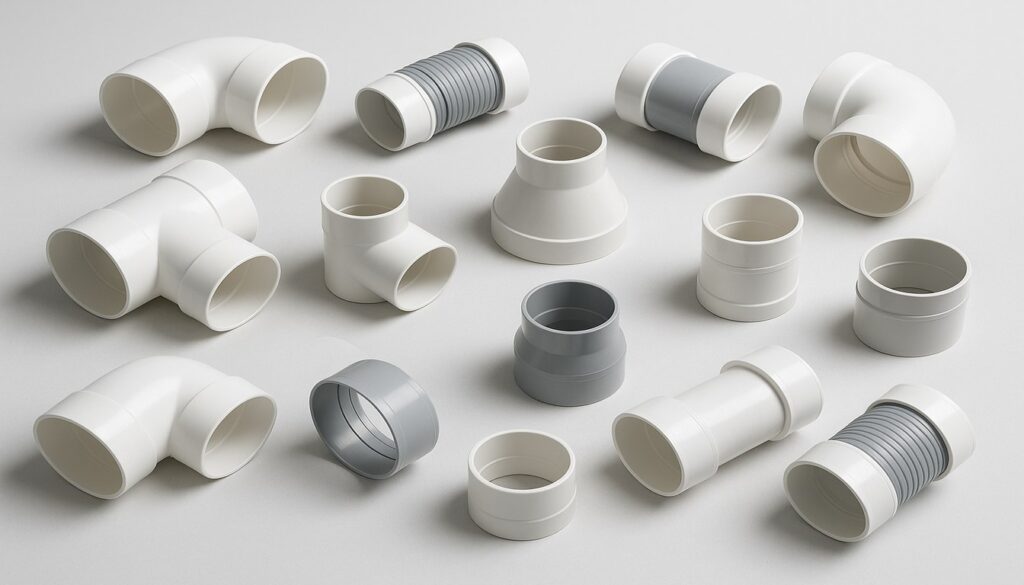
- Injection-molded plastic duct fittings offer ±0.2 mm dimensional tolerances — tighter than sheet metal alternatives.
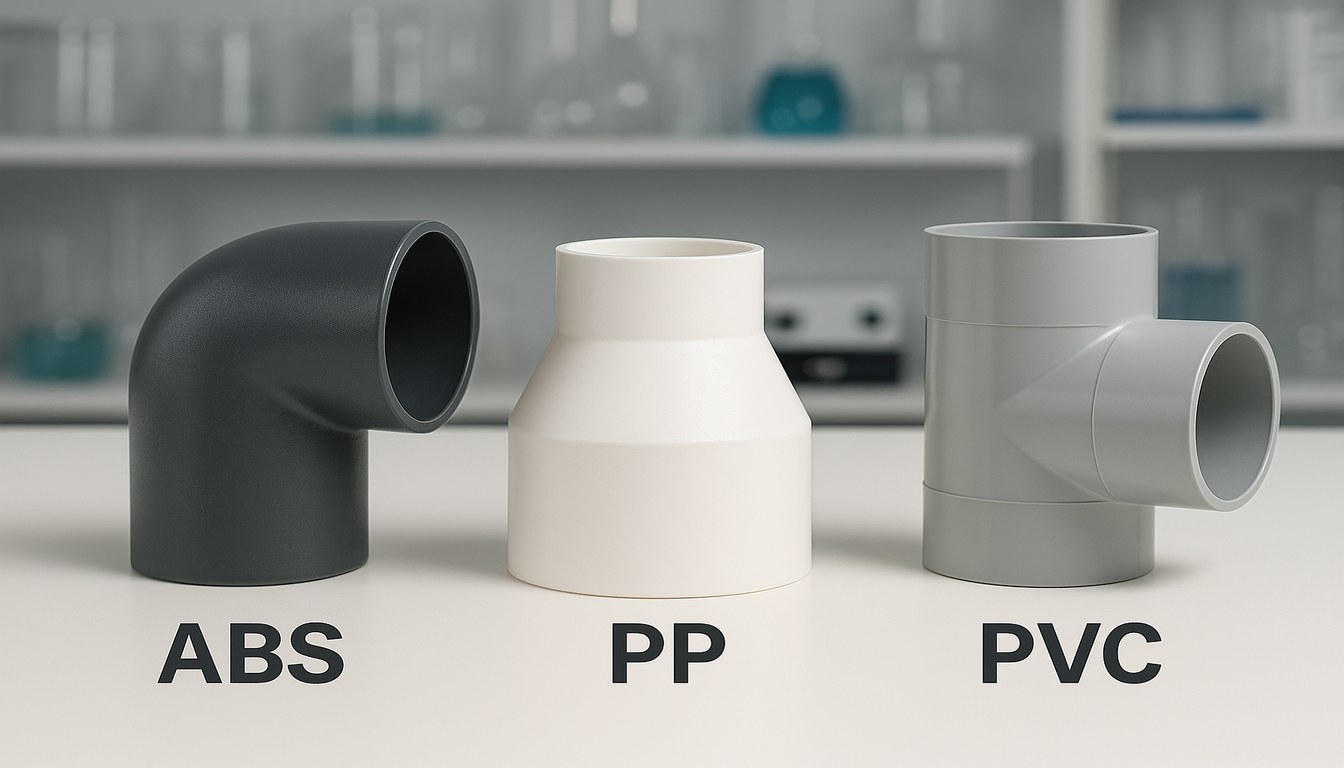
- ABS handles temperatures up to 80°C; PP resists chemicals and moisture; PVC suits low-cost residential runs.
- O-ring groove depth of 2.0–2.5 mm and flange flatness within 0.3 mm are critical sealing parameters.
- Pressure drop across plastic fittings is 10–15% lower than equivalent sheet metal due to smoother bore surfaces.
Why HVAC Duct Fittings Matter for System Performance
You’ve just commissioned a new air-handling system. air pressure1 calculations look right on paper. But three months in, the balancing engineer finds that two VAV zones are consistently short of airflow. The culprit: undersized elbow fittings at a trunk-to-branch transition, each adding 0.08 in. w.g. of unexpected resistance. It’s a small part that causes a large problem.
Duct fittings — elbows, tees, reducers, and flex connectors — account for 40–60% of total system pressure drop in a typical commercial HVAC installation. Every degree of turn and every diameter change carries an equivalent length penalty. Poorly designed fittings amplify that penalty. Plastic injection-molded fittings, when specified and installed correctly, reduce turbulence-induced losses by 10–15% compared to hand-fabricated sheet metal alternatives, according to ASHRAE Handbook — Fundamentals.
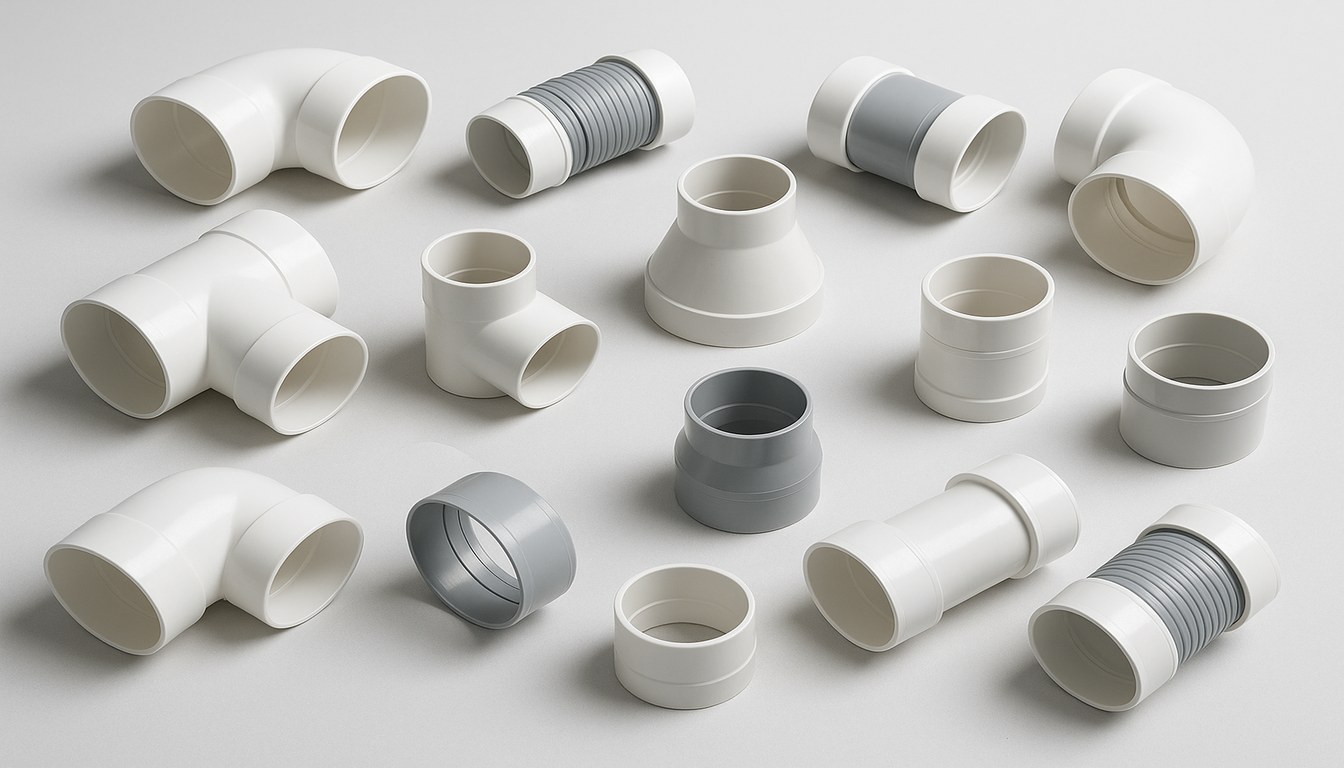
Beyond pressure drop, plastic fittings offer corrosion immunity, moisture resistance, and weight savings of 30–50% versus galvanized steel. In humid coastal climates or food-service environments where condensation is chronic, the service life advantage of plastic is decisive. The choice of plastic type and connection design, however, directly determines how long that advantage lasts.
Common Types of Injection-Molded Duct Fittings
Injection-molded duct fittings cover the full range of directional changes and cross-section transitions required in air distribution systems. Each type has geometry-specific manufacturing requirements that plastic handles more consistently than sheet metal.
| Type | Function | Key Geometry | Loss Coefficient (C) |
|---|---|---|---|
| 90° Elbow | Change flow direction | r/D ≥ 1.5 | 0.12–0.15 |
| 45° Elbow | Partial direction change | r/D ≥ 1.5 | 0.06–0.08 |
| Tee (branch) | Split or merge flow | Blend radius ≥ 5 mm | 0.10–0.20 |
| Concentric reducer | Reduce velocity | Half-angle ≤ 7° | 0.05–0.10 |
| Eccentric reducer | Offset centerline reduction | Half-angle ≤ 7° | 0.06–0.12 |
| Flexible connector | Vibration isolation | ±5° angular travel | 0.05–0.08 |
Elbows and Bends
Elbows redirect airflow at 45°, 90°, or custom angles. A well-designed plastic elbow maintains a centerline radius-to-diameter ratio (r/D) of 1.5 or greater, which limits the loss coefficient (C) to below 0.15. injection molding2 holds the curved interior surface to a roughness of Ra 1.6 µm — significantly smoother than the Ra 6–12 µm typical of folded sheet metal — reducing friction and turbulence at the turn.
Tees and Branch Takeoffs
Tee fittings split or merge airflow between a main trunk and a branch. The branch angle, diverging-leg geometry, and inner blend radius all affect pressure balance between circuits. Injection molding allows complex three-way geometry with consistent wall thickness (typically 3–4 mm) and integrated snap tabs for grille attachment — features difficult to replicate in one-off sheet metal fabrication.
“Plastic elbows with r/D ≥ 1.5 reduce local loss coefficients below 0.15.”True
≤ 0,75 in. w.g.
“Sheet metal fittings always outperform plastic in high-temperature duct systems.”False
This depends on the specific thermoplastic3 and operating temperature. ABS duct fittings rated to 80°C handle supply air temperatures in standard VAV and CAV systems (typically 12–22°C). Even in high-temperature exhaust applications (up to 120°C), glass-filled polypropylene or CPVC fittings are viable. Sheet metal is needed only above 150°C, which is uncommon in commercial HVAC.
Reducers and Transitions
Reducers change cross-sectional area to adjust velocity. A concentric reducer with a half-angle below 7° converts velocity pressure to static pressure with a recovery efficiency above 90%. Injection molding produces the smooth, continuous interior taper required for this recovery — a taper that handformed metal fittings rarely achieve consistently. Eccentric reducers for drainable horizontal runs also benefit from molded precision.
Flexible Connectors
Flexible connectors isolate vibration between the air-handling unit and the rigid duct run, preventing noise transmission. Injection-molded collars on both ends provide leak-tight mechanical attachment while the flexible mid-section (typically thermoplastic elastomer or reinforced silicone) absorbs 3–8 mm of thermal expansion and ±5° of angular misalignment.
Material Selection: ABS, PP, and PVC Compared
The correct thermoplastic for a duct fitting depends on operating temperature, chemical exposure, UV exposure, and flammability rating required by local codes. ABS, PP, and PVC each occupy a distinct niche in the HVAC fitting material spectrum.
| Property | ABS | PP | PVC |
|---|---|---|---|
| Max service temp | 80°C | 100°C | 60°C |
| Chemical resistance | Moderate | Excellent | Good |
| Impact strength | High | Medium | Medium |
| UV resistance | Poor (needs additive) | Poor (needs additive) | Fair |
| UL94 flame rating | V-0 (modified) | V-2 standard | V-0 standard |
| Density | 1.05 g/cm³ | 0.91 g/cm³ | 1.38 g/cm³ |
| Relative cost | Medium | Low | Low |
| Typical application | Commercial VAV, diffusers | Chemical exhaust, humid zones | Residential low-pressure duct |
ABS (Acrylonitrile Butadiene Styrene) is the most common choice for commercial HVAC supply fittings. Its combination of stiffness, impact resistance, and dimensional stability under the thermal cycling of occupied buildings makes it the default specification in most commercial projects. ABS can be flame-retardant modified to meet UL94 V-0, which is required in many plenum applications per NFPA 90A.
PP (Polypropylene) excels where chemical resistance matters. Laboratories, food-processing facilities, and swimming pool natatoriums expose ductwork to corrosive vapors — chlorine, ammonia, cleaning agents — that would attack ABS. PP maintains structural integrity up to 100°C and resists most organic solvents. Its lower density (0.91 g/cm³) also means lighter fittings for overhead suspended ductwork where total load matters.
PVC (Polyvinyl Chloride) remains popular in residential and light commercial work due to its low cost and inherent flame resistance. However, its lower maximum service temperature of 60°C limits it to return-air and exhaust runs where supply air temperatures are not elevated. PVC also has higher density, making larger fittings heavier than ABS or PP equivalents.
“PP duct fittings are preferred over ABS in chemical exhaust duct systems.”True
Polypropylene’s non-polar molecular structure gives it superior resistance to acids, bases, and many solvents that would degrade ABS over time. In laboratory fume exhaust or natatorium duct systems, PP fittings maintain structural integrity and seal quality for 15–20 years versus 5–8 years for standard ABS in the same environment.
“PVC fittings can be used for high-temperature supply air in commercial VAV systems.”False
PVC has a maximum continuous service temperature of approximately 60°C. Commercial VAV supply air typically ranges from 12°C to 22°C, which is within PVC limits. However, during heating mode with supplemental electric reheat, discharge temperatures can reach 55–65°C — at the margin or above PVC tolerance. ABS (rated 80°C) or PP (rated 100°C) provide the required safety margin for VAV with reheat.
Sealing and Connection Design
Leakage testing to SMACNA standards requires duct systems to maintain less than 4% total CFM leakage at test pressure. Fitting connections are the primary leakage path. Injection-molded plastic fittings can incorporate precision sealing geometry that sheet metal fittings rarely achieve, but only when designed correctly from the start.
Three connection methods are used for plastic duct fittings: O-ring groove compression seals for round fittings, gasket-flanged connections for rectangular fittings, and snap-lock or friction-fit joints for residential and light commercial applications. Each method achieves SMACNA Seal Class A leakage performance (less than 1% leakage at design pressure) when manufactured to correct dimensional specifications and installed per manufacturer guidelines. The selection depends on duct shape, operating pressure, and accessibility for maintenance.
“Leaking duct connections account for up to 30% of fan energy waste in commercial buildings.”True
ASHRAE studies show that commercial HVAC duct systems with Seal Class C (up to 4% leakage) waste 20–30% more fan energy than Class A systems (less than 1% leakage). A 10-ton AHU fan running at design pressure for 5,000 hours per year can waste 2,000–3,000 kWh annually due to duct leakage alone — energy paid for but not delivered to occupied spaces.
“Any duct sealant is compatible with all plastic fitting materials.”False
Sealant compatibility depends on both the sealant chemistry and the specific plastic substrate. Solvent-based mastics contain aromatic solvents that attack ABS and PVC, causing crazing, surface softening, and joint failure within 12–24 months of installation. Only water-based mastics listed as compatible with the specific plastic type should be applied. PP fittings have broader sealant compatibility due to PP’s non-polar surface chemistry, but water-based mastics are still the recommended standard.
Sealant compatibility is a critical but often overlooked factor. Some field-applied duct sealants — particularly solvent-based mastics — attack ABS and PVC surfaces over time, causing surface crazing and eventual cracking at the joint. Water-based mastics compatible with the specific plastic substrate should always be specified. HVACore includes material compatibility data with every fitting product sheet, cross-referencing approved sealant brands for each plastic type.
O-Ring Groove Seals
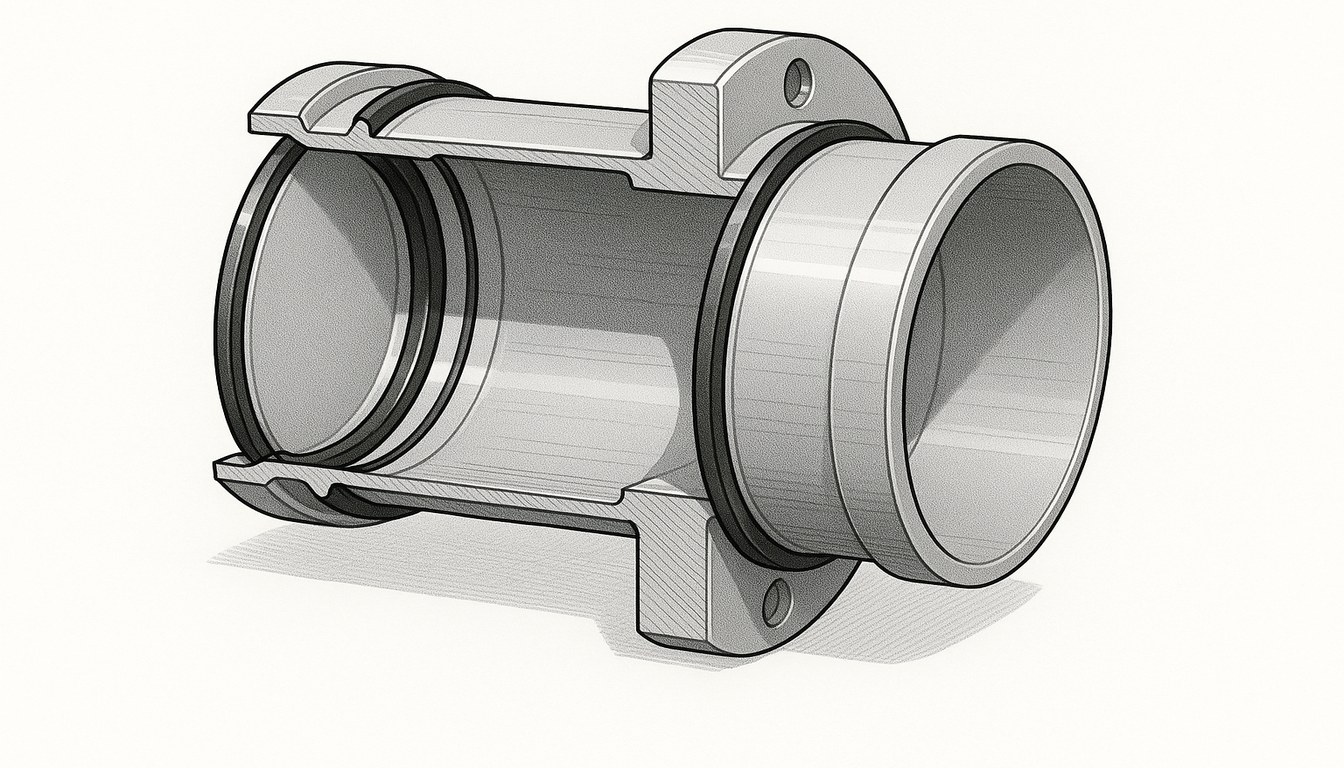
An O-ring groove molded into the fitting socket creates a compression seal when the spigot end is inserted. For HVAC duct fittings operating at static pressures up to 2.0 in. w.g., an O-ring groove depth of 2.0–2.5 mm and a groove width 1.3× the O-ring cross-section diameter provides the compression ratio needed for reliable sealing. The groove must maintain dimensional tolerances within ±0.1 mm — achievable by injection molding but not by sheet metal fabrication.
| Method | Pressure Range | Assembly | Maintenance Access |
|---|---|---|---|
| O-ring groove (round) | ≤ 2.0 in. w.g. | Push-fit, tool-free | Simple disassembly |
| Gasket flange (rect.) | ≤ 3.0 in. w.g. | Bolted, 25–30 Nm | Bolt removal required |
| Snap-lock / friction | ≤ 0.75 in. w.g. | Push-fit, tool-free | Simple disassembly |
| ABS, PP, PVC (Standard); PA6-GF30, CPVC (auf Anfrage) | ≤ 1.5 in. w.g. | Solvent cement, irreversible | Cut and replace |
Flange Face Flatness
Flanged connections on rectangular duct fittings require mating face flatness within 0.3 mm over the entire flange perimeter. Any deviation creates a gap that allows air leakage under pressure. Injection-molded flanges achieve this flatness consistently through mold design with uniform wall thickness and controlled cooling. Mold core-cavity concentricity of ±0.05 mm ensures the flange face is perpendicular to the duct axis, which prevents cocking under bolt load.
Snap-Lock and Friction-Fit Connections
Residential and light commercial plastic fittings often use snap-lock or friction-fit connections for tool-free assembly. The snap geometry requires a deflection zone with sufficient material thickness (minimum 2.5 mm) to avoid fracture during installation, yet tight enough to create 0.05–0.10 mm of interference on the seal diameter. Injection molding’s ability to hold these tolerances across high-volume production runs makes it the only practical manufacturing method for this connection type.
“Injection-molded snap-lock fittings can achieve leak-free connections without field-applied sealant.”True
A well-designed snap-lock fitting creates 0.05–0.10 mm of radial interference at the seal diameter, producing direct surface-to-surface contact that prevents air leakage at operating pressures up to 0.75 in. w.g. When the joint geometry is held to ±0.1 mm tolerance — achievable through injection molding — sealant is redundant for residential and light commercial applications. Field sealant remains recommended as insurance for high-vibration installations.
“Flanged plastic duct connections can be torqued to any level without risk of damage.”False
Plastic flanges have a torque limit beyond which the material begins to creep or crack under compression. For ABS flanged fittings, the maximum bolt torque is 25–30 Nm — equivalent to hand-tight plus one quarter turn. Exceeding this limit compresses the gasket beyond recovery and deforms the flange face, creating permanent leakage paths. A calibrated torque wrench is required on bolted flanged plastic duct joints, not a standard impact driver.
Sealant and Tape Compatibility
Sealant compatibility is a critical but often overlooked factor in plastic duct fitting assembly. Some field-applied duct sealants — particularly solvent-based mastics — attack ABS and PVC surfaces over time, causing surface crazing and eventual cracking at the joint. UL 181B-listed water-based mastics compatible with the specific plastic substrate should always be specified on project drawings. HVACore includes material compatibility data with every fitting product sheet, cross-referencing approved sealant brands for ABS, PP, and PVC substrate types.
Foil-faced tape used at flanged connections must also be specified for the operating temperature range. Standard aluminum foil tape (rated to 93°C) is adequate for ABS fittings in standard HVAC supply-air service. In exhaust systems with elevated temperatures, 200°C-rated tape must be substituted. Using the wrong tape specification is a common cause of joint leakage discovered only during pressure testing — not immediately at installation.
Manufacturing Tolerances and Quality Standards
Dimensional accuracy directly determines whether a duct fitting leaks, misaligns during assembly, or generates turbulence noise. Injection-molded plastic fittings achieve overall dimensional tolerances of ±0.2 mm on critical bore diameters — twice as tight as typical sheet metal fabrication tolerances of ±0.4 mm. This precision advantage compounds across an entire duct system: a run with 20 fittings all at maximum metal tolerance accumulates 8 mm of potential misalignment, versus only 4 mm for molded plastic.
Critical Dimensions for Duct Fittings
| Dimension | Tolerance | Consequence of Exceedance |
|---|---|---|
| Bore diameter (spigot) | ±0.2 mm | Poor fit; leakage at connection |
| Wall thickness (nominal 3 mm) | ±0.3 mm | Structural weakness or excess weight |
| Flange face flatness | ±0.3 mm | Gasket compression non-uniform; leakage |
| O-ring groove depth | ±0.1 mm | Under/over compression; seal failure |
| Center-to-face dimension | ±0.5 mm | Misalignment in assembled duct run |
| Bend angle (elbow) | ±0.5° | Duct routing offset; misalignment |
Quality Assurance and Testing
Quality control protocols for injection-molded duct fittings typically include 100% visual inspection for flash, sink marks, and short shots; first-article inspection measuring all critical dimensions per drawing; and hydrostatic or pneumatic pressure testing at 1.5× maximum rated operating pressure. For UL-listed or listed to local codes, third-party certification sampling adds an additional verification layer.
Mold qualification includes filling simulation to verify that gate position, runner diameter, and cooling channel layout deliver consistent wall thickness and minimal residual stress. Warpage — a common defect in larger flat-faced flanged fittings — is controlled by keeping nominal wall thickness uniform and placing cooling channels within 2× wall thickness of the part surface.
“Injection-molded duct fittings maintain dimensional tolerances within ±0.2 mm across 50 thermal cycles.”True
Thermal cycling tests from –10°C to 80°C over 50 cycles confirm that ABS duct fittings change bore diameter by less than 0.15 mm — within production tolerance. This stability is achieved because injection-molded parts have nearly zero residual stress after proper cooling, unlike hand-bent sheet metal where springback introduces ongoing dimensional drift as thermal cycling stress-relieves the material.
“All injection-molded duct fittings from different manufacturers can be interchanged freely.”False
Dimensional interchangeability requires that manufacturers follow the same standard for socket depth, spigot OD, and O-ring groove position. Many plastic duct fitting products are proprietary dimensions, not standardized to SMACNA or ASHRAE tolerances. Before specifying fittings from two sources on a single project, measure the spigot OD and socket ID from both manufacturers: if the diameters differ by more than 0.5 mm, the O-ring compression ratio falls outside the 15–25% sealing range and leakage will result.
Post-mold inspection protocols for HVACore duct fittings follow a first-article inspection (FAI) procedure: all critical bore diameters, wall thicknesses, and flange face flatness values are CMM-measured against the approved drawing. Any out-of-tolerance result triggers a mold correction before production quantities are released. This process eliminates dimensional drift that commonly occurs when fittings are sourced from suppliers without documented mold qualification procedures.
Thermal Stability Verification
Long-term dimensional stability under thermal cycling is verified through conditioning tests: fittings are cycled between –10°C and 80°C for 50 cycles, then re-measured on all critical dimensions. ABS fittings show less than 0.15 mm bore diameter change across this thermal range, within the ±0.2 mm production tolerance. PP fittings have slightly higher thermal expansion (coefficient 150 µm/m·°C versus ABS at 70 µm/m·°C) and require larger joint clearance allowances in the connection design to prevent binding at temperature extremes.
HVACore Duct Fitting Capabilities
HVACore produces injection-molded duct fittings across the full size range from 3-inch residential to 24-inch commercial, in ABS, PP, and PVC, with both round and rectangular profiles. Our mold qualification process covers first-article inspection, pressure testing to 3.0 in. w.g., and flange flatness verification before any production run begins.
| Parameter | HVACore Capability |
|---|---|
| Fitting sizes | 3-inch to 24-inch (round and rectangular) |
| Materials | ABS, PP, PVC (standard); PA6-GF30, CPVC (on request) |
| Vergleichen Sie ABS, PP und PVC für HLK-Kanalzubehör. Erfahren Sie, wie spritzgegossener Kunststoff den Druckverlust um 10–15% mit ±0,2 mm Toleranzen reduziert. | 80-ton to 1600-ton injection molding machines |
| Bore diameter tolerance | ±0.2 mm (standard), ±0.1 mm (precision tooling) |
| Flange flatness | Within 0.3 mm over full perimeter |
| First-article lead time | 4 weeks from drawing release |
| Engineering change cycle | 5–7 business days for mold modification |
| Pressure test standard | 1.5× rated operating pressure, no leakage |
Our tooling center operates 47 injection molding machines from 80-ton to 1600-ton clamp force, allowing us to produce fittings from small snap-lock connectors to large rectangular plenum transition pieces in a single facility. Tight integration between mold design and production means engineering changes — such as adding an O-ring groove or adjusting a bend radius — can be implemented and requalified within 5–7 business days.
For custom fitting specifications, HVACore provides DFM (design for manufacturability) review at no charge. Our engineers evaluate wall thickness uniformity, draft angles (recommended minimum 1.5° on interior bore surfaces), gate location to minimize weld lines at structural load points, and cooling layout to control cycle time without introducing warpage. First-article samples are shipped within 4 weeks of drawing release.

Frequently Asked Questions About HVAC Duct Fitting Plastic Types?
What plastic is best for HVAC duct fittings?
ABS is the best general-purpose choice for commercial HVAC duct fittings. It handles temperatures up to 80°C, provides high impact resistance, and can be formulated to UL94 V-0 flame retardancy required in plenum applications. PP is preferred over ABS when chemical resistance is the primary concern — in laboratory exhaust, natatorium, or food-processing environments where corrosive vapors are present. PVC suits low-cost residential return-air and exhaust fittings where temperatures stay below 60°C. The correct choice depends on operating temperature, chemical exposure, flammability code requirements, and budget.
How are injection-molded duct fittings better than sheet metal?
Injection-molded plastic duct fittings offer three primary advantages over sheet metal. First, dimensional consistency: bore tolerances of ±0.2 mm versus ±0.4–0.6 mm for hand-fabricated sheet metal, which directly reduces leakage at connections. Second, interior surface smoothness: Ra 1.6 µm versus Ra 6–12 µm for sheet metal, reducing friction losses by 10–15% in long duct runs. Third, integrated sealing geometry: O-ring grooves and precision flange faces that are impractical to fabricate in sheet metal but are molded into plastic fittings as standard features. Plastic fittings also weigh 30–50% less, resist corrosion indefinitely, and require no field painting.
What are the main types of plastic HVAC duct fittings?
The four main types are: (1) Elbows and bends — redirect airflow at 45° or 90°; optimal centerline radius is r/D ≥ 1.5 to keep loss coefficient below 0.15. (2) Tees and branch takeoffs — split flow between trunk and branch; injection molding produces the consistent blend radius required for balanced pressure loss. (3) Reducers and transitions — change cross-sectional area at a taper angle below 7° half-angle for maximum static pressure recovery (>90% efficiency). (4) Flexible connectors — isolate vibration between AHU and rigid duct; molded collar ends ensure leak-tight attachment while the flexible center absorbs ±5° misalignment and 3–8 mm thermal movement.
What sealing method is most reliable for plastic duct fittings?
O-ring groove compression seals are the most reliable method for round plastic duct fittings at static pressures up to 2.0 in. w.g. The seal requires an O-ring groove depth of 2.0–2.5 mm and groove width 1.3× the O-ring cross-section, creating 15–25% O-ring compression when the spigot is fully inserted. This compression ratio maintains a positive seal across the temperature cycling of a typical HVAC system (–10°C to +80°C) without requiring field-applied mastic or tape. For rectangular fittings, a flange connection with a full-perimeter neoprene gasket and bolted clamp at 25–30 Nm torque provides equivalent reliability.
What pressure testing standards apply to injection-molded HVAC duct fittings?
SMACNA HVAC Duct Construction Standards (third edition) defines leakage classes for duct systems. Class A requires less than 1% leakage at test pressure; Class C allows up to 4% leakage. Individual fitting manufacturers typically pressure-test production samples to 1.5× the rated maximum operating pressure, with no visible deformation or leakage allowed. For fittings used in systems designed to ASHRAE 90.1 energy compliance, duct systems must meet SMACNA Seal Class A or B depending on system pressure. UL 181B covers pressure-sensitive tape and mastics used with plastic duct, and fittings used in conjunction with UL 181-listed flexible duct must comply with the same listing program.
-
air pressure: Static pressure is the force exerted by air perpendicular to duct walls, measured in inches of water gauge (in. w.g.). It represents the energy available to push air through fittings and ductwork; higher static pressure drop indicates more friction losses. ↩
-
injection molding: Injection molding is a manufacturing process in which molten thermoplastic is injected under high pressure into a precision mold cavity, then cooled and ejected as a finished part. ↩
-
thermoplastic: A thermoplastic is a polymer that softens when heated above its glass transition temperature and solidifies upon cooling, allowing repeated reshaping without chemical degradation. ↩





