Gasunterstütztes Spritzgießen.
From a molding perspective, a 25mm thick solid plastic handle is a nightmare. It requires a massive cooling time, consumes excessive resin, and inevitably suffers from "sink marks" (surface depressions) as the material shrinks.
The solution we implemented was Gas-Assist Injection Molding (GAIM). By introducing high-pressure nitrogen into the melt stream, we cored out the handle, leaving a strong tubular structure. This is not just about lightweighting plastic parts; it is the only way to mold thick, ergonomic geometries without surface defects.
This article details the process, parameters, and realities of using gas-assist technology in portable AC manufacturing.
Key Takeaways
- Gas-Assist uses nitrogen to hollow out thick sections, creating a tubular structure that is often stiffer than a solid part.
- It eliminates sink marks by applying internal gas pressure that packs the plastic against the mold wall.
- Cycle times are drastically reduced because there is less molten mass to cool.
- Process control is critical: slight deviations in gas delay time can cause "fingering" or "blow-through."
What Is Gas-Assist Injection Molding (GAIM)?
Gas assist injection molding Vorteile.
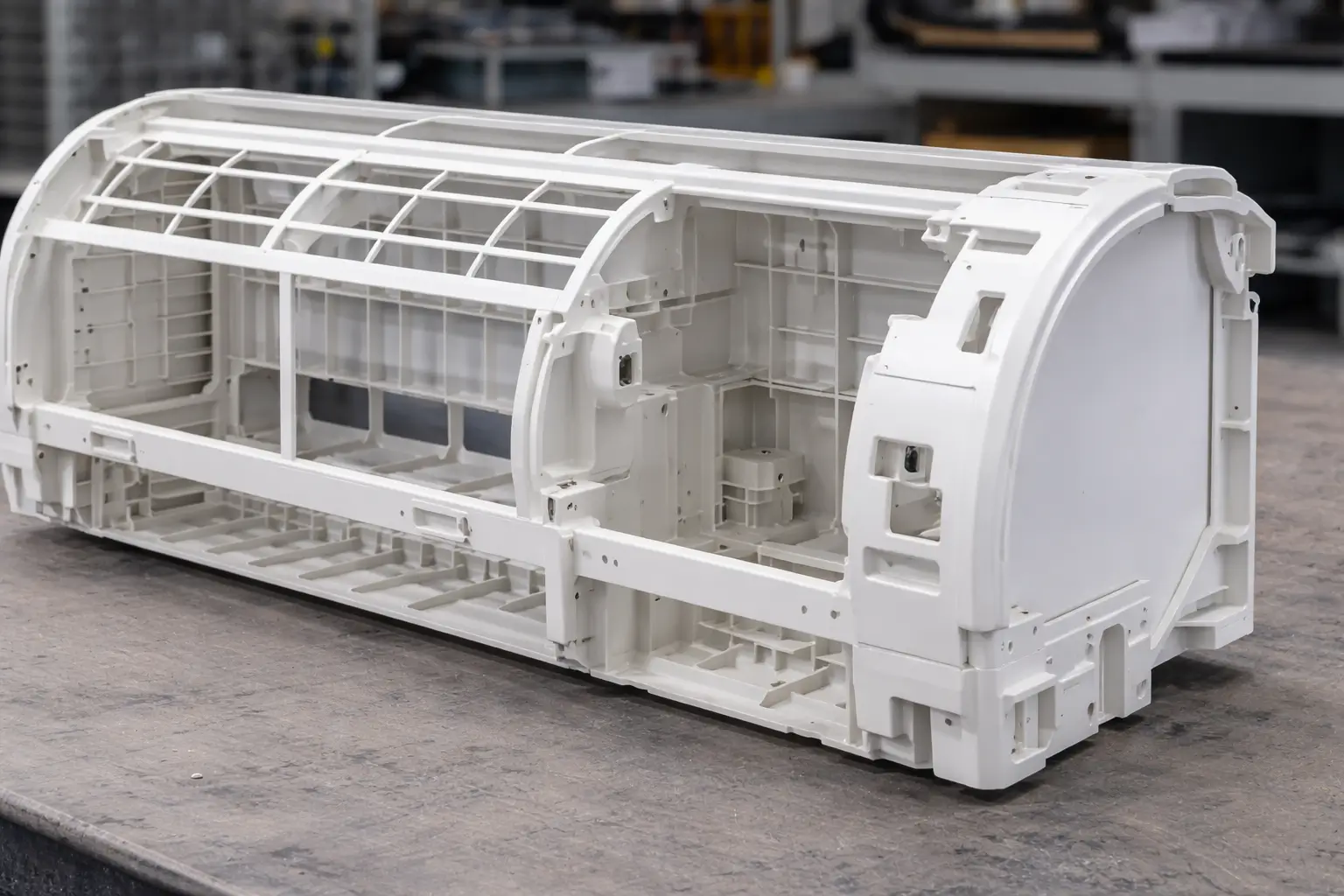
In HVAC, we use this primarily for:
- Thick Handles: Ensuring a comfortable grip without mass-production defects.
- Structural Frames: Creating internal channels that act like beams for rigidity.
- Tubular Parts: Reducing resin usage in airflow components.
Key Parameters for GAIM Process Control
Unlike standard molding, GAIM introduces a third phase: Gas Injection.
| Parameter | Typical Range | HVAC Application Context |
|---|---|---|
| Gas Pressure | 50 – 300 Bar | Higher pressure ensures the plastic skin is pressed tight against the mold for a Class-A surface finish. |
| Gas Delay Time | 0.5 – 3.0 sec | The pause between resin injection and gas injection. Too short = gas blows through the skin; Too long = gas cannot push the cooling plastic. |
| Shot Size (Fill %) | 70% – 95% | For handles, we use a "Short Shot" method. We fill the mold partially, and the gas fills the rest. |
| Gas Hold Time | 5 – 20 sec | Keeps the hollow channel pressurized while the part cools to prevent shrinkage. |
Step-by-Step: Solving the Dehumidifier Handle Problem
I once worked on a dehumidifier housing where the top carrying handle was integrated into the main shell (ABS material).
The Challenge:
The handle cross-section was 30mm x 20mm. Attempting to mold this solid resulted in a 90-second cycle time and deep sink marks that looked like dimples on a golf ball.
The GAIM Solution:
- Resin Injection (Short Shot):
We set the injection unit to fill the mold cavity to only 75%. At this stage, the part looks incomplete. - Gas Injection (The Core-Out):
Through a specialized gas nozzle, we injected Nitrogen at 150 Bar. The gas entered the center of the handle melt stream. - Expansion:
The gas bubble pushed the molten ABS forward to fill the remaining 25% of the cavity. It effectively "cored out" the center of the handle, leaving a uniform 3mm wall thickness. - Packing & Cooling:
The gas pressure was held for 12 seconds. This internal pressure acted like a "packing phase," forcing the plastic against the textured mold surface. - Gas Venting:
Before the mold opened, the gas was vented back out (or to the atmosphere) to depressurize the part. - Ejection:
The result was a handle with perfect exterior aesthetics, no sink marks, and a cycle time reduced to 55 seconds (down from 90s).

Myth vs. Fact: Gas-Assist Molding
This is a misconception. While the part has less mass, the gas channel creates a tubular geometry. In structural engineering, a tube has a higher moment of inertia (resistance to bending) than a solid rod of equal weight. We often see improved stiffness in gas-assisted handles.
Compressed air contains Oxygen. At the high temperatures and pressures of injection molding, oxygen can cause the plastic to oxidize (burn) or even cause a diesel-effect explosion inside the mold. We strictly use inert Nitrogen.
Advantages and Disadvantages of GAIM in HVAC
| Feature | Advantages | Polycarbonat (PC) |
|---|---|---|
| Quality | Complete elimination of sink mark reduction in thick areas. Superior surface finish. | "Shadow marks" or flow lines can appear where the gas channel transitions to thin walls. |
| Efficiency | Significant cycle time reduction (cooling thin walls is faster than thick solids). Resin savings (10–30%). | High initial setup cost. Requires a Gas Control Unit and Nitrogen generator. |
| Design | Allows for variable wall thicknesses in one part (e.g., thin housing + thick handle). | Mold design is complex. Gas channel placement must be simulated carefully. |
Practical Tips for Factory Implementation
1. The "Overflow Well" Trick
Sometimes, you cannot use the "Short Shot" method because the surface finish suffers during the hesitation. In these cases, we fill the mold 100% and attach a secondary cavity called an "Overflow Well."
- How it works: We inject gas, and the gas pushes the excess molten plastic out of the main part and into the overflow well.
- Use Case: High-gloss cosmetic panels where you need a perfect surface but a hollow structural rib. We cut the overflow scrap off after molding.
2. Guide the Gas with Ribs
Gas is lazy—it takes the path of least resistance (the hottest, thickest area). To control where the hollow channel goes:
- Design a "gas channel" rib along the handle.
- Ensure the wall thickness of the channel is thicker than the surrounding walls so the gas stays centered and doesn’t "finger" into the thin walls.
3. Vertical vs. Horizontal Orientation
For hollow plastic parts, gravity matters. If you are molding a long vertical handle, the gas bubble might migrate upwards if the viscosity is too low. We often adjust the gate location to push gas against gravity or use high-viscosity resins to keep the bubble centered.
HVAC Application Scenarios
- Portable AC Side Handles:
- Large, deep pocket handles that need to support 30kg of unit weight. GAIM creates a rigid, pipe-like structure that doesn’t flex when lifted.
- Condenser Fan Shrouds:
- Large circular frames often warp. By running a gas channel around the perimeter ring, we create a rigid "hoop" that keeps the shroud perfectly round for fan clearance.
- Drip Trays with Integrated Spouts:
- The drain spout on a condensate tray is a thick tube. Molding it solid causes warpage. GAIM allows us to mold the tray and the hollow spout in one shot without side-action slides.
Frequently Asked Questions (FAQ)
1. Can any injection molding machine do Gas-Assist?
The machine itself (the press) is standard, but you need an external Gas Control Unit and a nitrogen generator. You also need a signal interface so the press can tell the gas unit exactly when to fire.
2. What materials work best for GAIM?
Polypropylene (PP), ABS, and Polycarbonate (PC) Mehrfarben-Spritzgießen.
3. Does the hole go all the way through?
No. In most HVAC handles, the gas channel is sealed inside. The entry point is usually a needle hole at the nozzle or within the runner system. The part appears solid from the outside.
4. Why does the surface finish look better?
In standard molding, as plastic cools, it shrinks away from the mold wall. In GAIM, the internal gas pressure (200 bar) actively pushes the plastic skin against the mold steel until it freezes, replicating the mold texture perfectly.
5. What is "Fingering"?
Fingering is a defect where the gas bubble wanders away from the intended thick channel and spreads into the thin walls of the part. This weakens the wall and looks bad. We fix this by lowering gas pressure or increasing the wall thickness difference between the channel and the rest of the part.
Technical Summary
Gas-Assist Injection Molding (GAIM) is a critical technology for portable AC manufacturing, enabling the production of ergonomic, thick-sectioned components without the penalties of weight or warpage. By displacing the molten core of a part with high-pressure nitrogen, manufacturers create hollow plastic parts that offer superior structural rigidity (due to tubular geometry) and Class-A surface aesthetics (due to internal packing pressure). While the process requires specialized equipment and precise control over gas delay and pressure profiles, the result is a significant reduction in cycle time and resin costs, solving the inherent trade-off between part strength and manufacturing efficiency.