
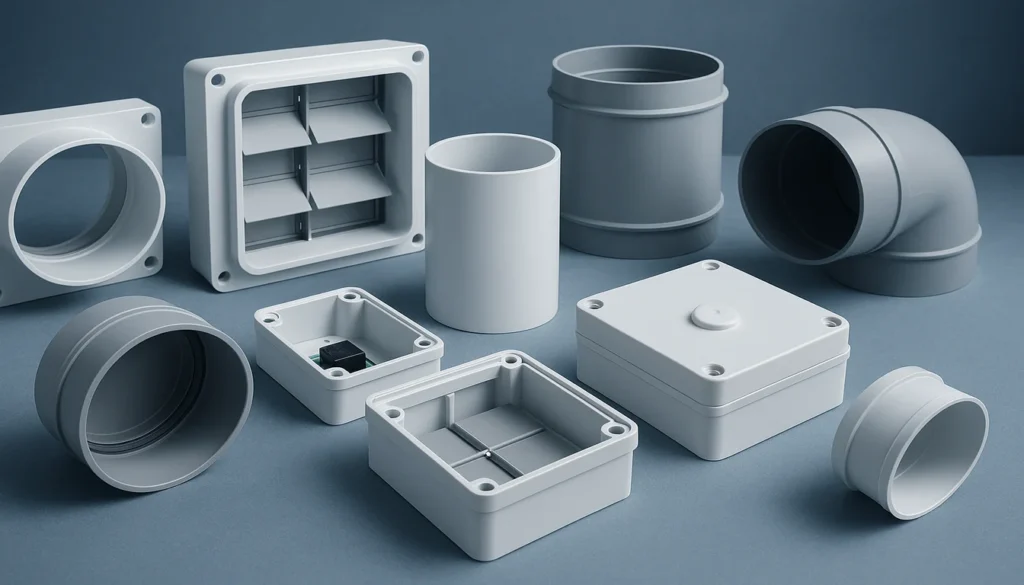
- حساسية الرطوبة ضئيلة مقارنة بالمواد الاسترطابية مثل النايلون. يتطلب الأبس من 2 إلى 4 ساعات من التجفيف عند 80 درجة مئوية قبل المعالجة — مقارنة بـ 4 إلى 6 ساعات في درجات حرارة أعلى للنايلون. بعض درجات الأبس تتحمل المعالجة بمحتوى رطوبة يصل إلى 0.1 بالمائة دون عيوب سطحية مرئية، رغم أن النتائج المثلى تتطلب التجفيف إلى أقل من 0.05 بالمائة. هذه الحساسية المخففة للتجفيف تعني بدء إنتاج أسرع ورفضات أقل متعلقة بالرش خلال تغييرات الورديات.
- ABS maintains mechanical integrity from minus 20 to 80 degrees Celsius, covering the full operating range of indoor HVAC equipment including thermostats, vent grilles, damper housings, and sensor enclosures.
- The material processes at melt temperatures between 220 and 260 degrees Celsius with minimal moisture sensitivity, making it one of the most forgiving engineering thermoplastics for high-volume HVAC production.
- ABS accepts painting, chrome plating, ultrasonic welding, and laser marking without surface preparation, enabling customized branding and functional integration for HVAC OEMs.
- UL 94 V-0 flame-retardant ABS grades meet plenum-rated requirements for HVAC components installed in air-handling spaces above suspended ceilings.
What Is ABS and Why Do HVAC Manufacturers Prefer It?
ABS — acrylonitrile butadiene styrene — is an amorphous thermoplastic terpolymer that combines three monomers to create a material with balanced mechanical, thermal, and aesthetic properties. The acrylonitrile component provides chemical resistance and surface hardness.
| QC Check | Method | Frequency |
|---|---|---|
| Surface defects | Vision inspection | 100% |
| Dimensions | CMM | 1st/last + hourly |
| Impact strength | Izod test | Per lot |
| Color delta-E | Spectrophotometer | Per lot |
The butadiene rubber phase delivers impact strength and toughness. The styrene matrix contributes rigidity, processability, and the glossy surface finish that makes ABS the default choice for visible HVAC components.
| QC Check | Method | Frequency |
|---|---|---|
| Surface defects | Vision inspection | 100% |
| Dimensions | CMM | 1st/last + hourly |
| Impact strength | Izod test | Per lot |
| Color delta-E | Spectrophotometer | Per lot |
For injection molding1 of thermostat housings, vent registers, and control panel bezels, no other material matches this combination of performance and cost efficiency.
HVAC manufacturers standardized on ABS for indoor components because the material solves their primary design challenge: creating parts that look professional, resist daily handling abuse, and maintain dimensional accuracy across thousands of heating and cooling cycles — all at a material cost of $2.00 to $3.50 per kilogram. A thermostat housing molded in ABS maintains its snap-fit retention force after 10,000 open-close cycles, resists yellowing under fluorescent lighting for 15 years, and produces consistent color matching across production lots of 500,000 units.
At HVACoreTech, ABS accounts for approximately 28 percent of our total resin consumption across all العوامل البيئية2 programs — second only to glass-filled nylon for structural applications. Our engineering team has processed over 1,800 unique ABS part designs, from 2-gram thermostat button caps to 800-gram return air grille assemblies. This experience base means we understand exactly how ABS behaves under every processing condition and can predict part performance with confidence before cutting mold steel.
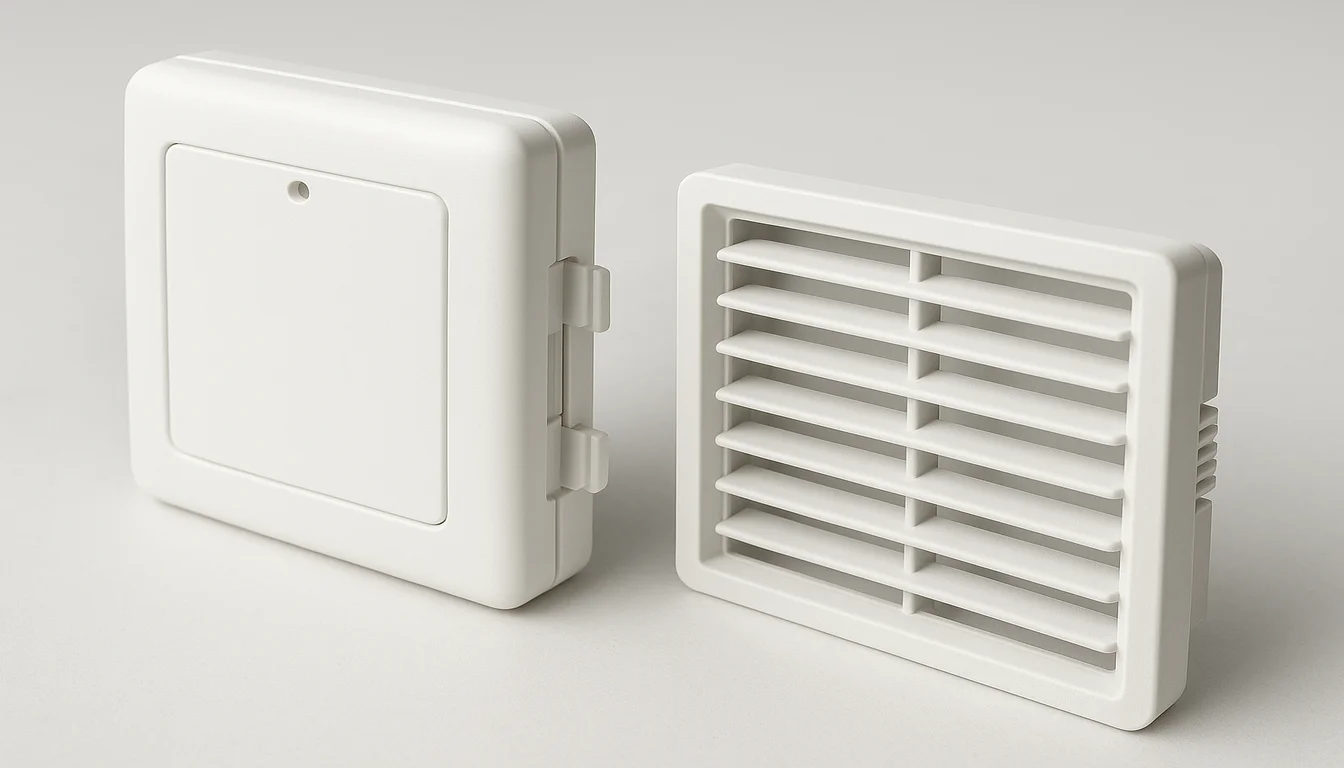
What Are the Key Properties of ABS for HVAC Applications?
ABS mechanical properties position it precisely in the performance gap between commodity polypropylene and engineering-grade polycarbonate. Tensile strength ranges from 40 to 55 MPa depending on grade — sufficient for snap-fit assemblies, screw bosses, and cantilever latches used in HVAC enclosures. Impact strength measured by notched Izod testing reaches 200 to 400 J/m, providing excellent resistance to the accidental drops and installation impacts that HVAC components experience during field service.
| Property | ABS | Polycarbonate | PP | PA66-GF30 |
|---|---|---|---|---|
| Tensile Strength (MPa) | 45-55 | 60-70 | 30-35 | 185 |
| Impact Strength (J/m) | 200-400 | 600-900 | 40-80 | 85 |
| HDT at 0.46 MPa (°C) | 96-105 | 135-140 | 95-100 | 255 |
| Surface Finish | Excellent | Excellent | Fair | Fair |
| Cost ($/kg) | 2.00-3.50 | 3.50-5.50 | 1.20-1.80 | 4.50-6.50 |
| Best HVAC Use | Visible parts | Clear/impact | Hidden ducts | Structural |
Thermal performance defines where ABS excels and where alternatives become necessary. The heat deflection temperature of standard ABS at 0.46 MPa loading is 96 to 105 degrees Celsius — adequate for indoor HVAC components that rarely exceed 60 degrees Celsius ambient. However, ABS softens noticeably above 85 degrees Celsius under sustained load, making it unsuitable for heat pump compressor compartments or furnace proximity applications where glass-filled nylon or polycarbonate performs better.
“ABS provides the best balance of surface finish quality and impact resistance among thermoplastics commonly used for visible HVAC components.”True
ABS produces Class A surface finishes directly from the mold without post-processing, achieving surface roughness values below Ra 0.1 micrometers with polished mold cavities. Simultaneously, the butadiene rubber phase provides impact resistance 3-5 times higher than polypropylene and comparable to polycarbonate at 40% lower material cost. No other thermoplastic in the $2-4/kg price range matches this combination — polypropylene lacks surface quality, polycarbonate costs significantly more, and glass-filled nylon produces visible fiber read-through on cosmetic surfaces.
“ABS is suitable for all HVAC applications including outdoor equipment and high-temperature environments.”False
ABS has significant limitations that restrict it to indoor, moderate-temperature HVAC applications. UV exposure causes ABS to yellow, chalk, and lose 30-50% of impact strength within 2,000 hours of outdoor weathering. Continuous operating temperatures above 80-85 degrees Celsius cause dimensional instability and creep under load. Chemical exposure to ketones, esters, and chlorinated solvents can cause stress cracking. For outdoor HVAC equipment, ASA or polycarbonate provides superior UV resistance; for high-temperature applications, glass-filled nylon or PPS is required.
How Does ABS Perform in HVAC Indoor Environments?
Indoor HVAC environments present a specific set of challenges that ABS handles exceptionally well. Temperature cycling between 15 and 35 degrees Celsius during daily heating and cooling operations falls well within ABS thermal limits. Humidity variations from 20 to 80 percent relative humidity have minimal effect on ABS dimensional stability because the amorphous polymer structure absorbs less than 0.3 percent moisture — compared to 2.5 percent for nylon, which can swell measurably in humid environments.
Chemical resistance in indoor HVAC service is excellent for the exposures encountered. ABS resists household cleaning agents, mild detergents, and the dilute quaternary ammonium solutions used for HVAC coil cleaning. The material also withstands contact with common HVAC refrigerants including R-410A and R-32 at temperatures below 60 degrees Celsius.
| QC Check | Method | Frequency |
|---|---|---|
| Surface defects | Vision inspection | 100% |
| Dimensions | CMM | 1st/last + hourly |
| Impact strength | Izod test | Per lot |
| Color delta-E | Spectrophotometer | Per lot |
However, direct contact with acetone, MEK, or chlorinated solvents — sometimes used for PVC pipe welding during HVAC installation — can cause stress cracking and must be avoided through installation procedures or protective covers.
Color stability under indoor lighting conditions is a key ABS advantage. Standard ABS grades maintain consistent color appearance under fluorescent, LED, and natural indirect lighting for 15 to 20 years without visible yellowing or fading. This long-term color stability is critical for HVAC components visible in occupied spaces — thermostat housings, wall-mounted controllers, and ceiling-mounted sensor enclosures must maintain their original appearance throughout the building’s service life to meet architectural specifications.
What Processing Advantages Does ABS Offer for HVAC Manufacturing?
ABS ranks among the most processable engineering thermoplastics, making it ideal for the high-volume, tight-tolerance production runs typical of HVAC manufacturing. Melt temperatures between 220 and 260 degrees Celsius keep energy costs moderate while providing a wide processing window that tolerates minor parameter variations without producing defective parts. The material flows easily into thin-wall sections down to 1.0 millimeter, filling complex geometries with multiple snap-fits, bosses, and ribs that characterize HVAC enclosure designs.
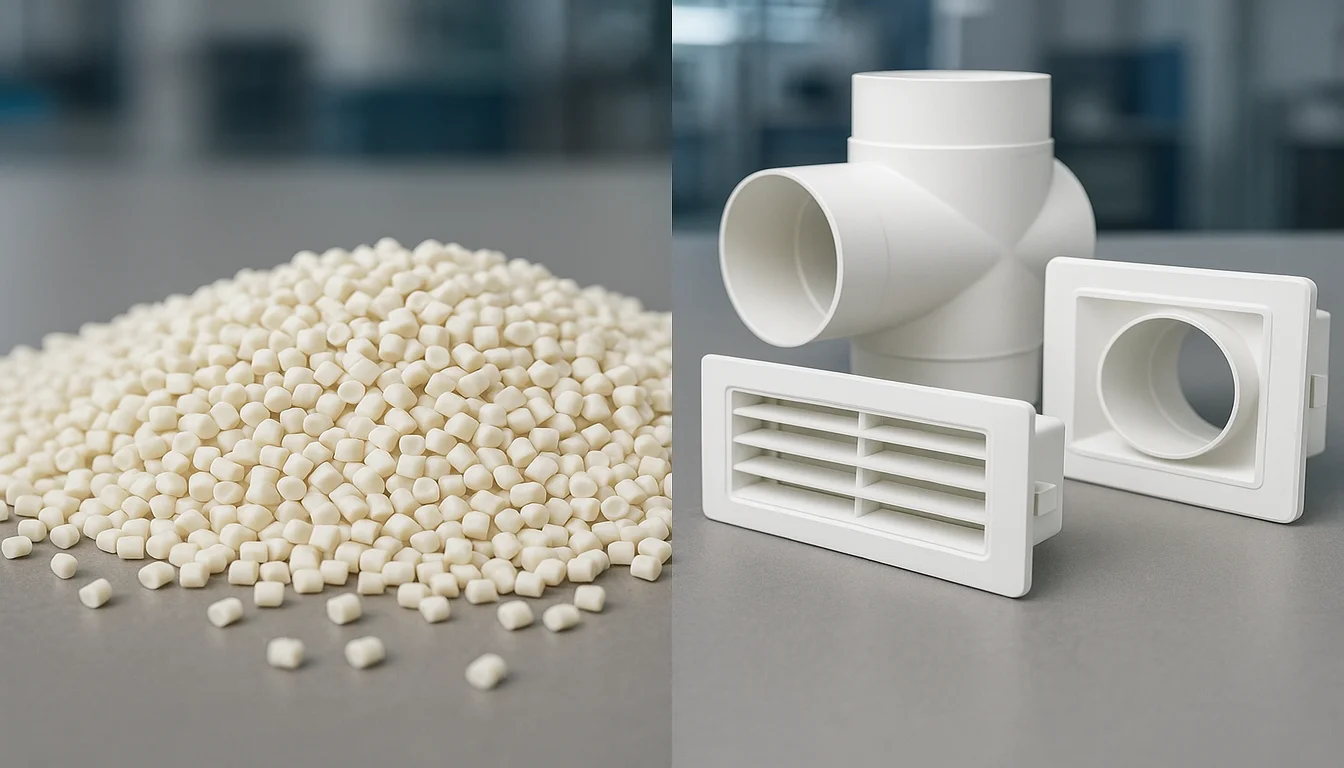
Cycle times for ABS HVAC components run 15 to 25 percent shorter than equivalent polycarbonate parts because the lower processing temperature reduces cooling time. A typical thermostat housing with 2.0-millimeter wall thickness cycles in 18 to 25 seconds in ABS versus 25 to 35 seconds in polycarbonate. Across a production run of 500,000 units, this cycle time advantage translates to 40 to 60 fewer machine-hours — a direct cost savings of $3,000 to $5,000 per production run.
Moisture sensitivity is minimal compared to hygroscopic materials like nylon. ABS requires 2 to 4 hours of drying at 80 degrees Celsius before processing — compared to 4 to 6 hours at higher temperatures for nylon. Some ABS grades tolerate processing with moisture content up to 0.1 percent without visible surface defects, though optimal results require drying to below 0.05 percent. This reduced drying sensitivity means faster production startups and fewer splay-related rejects during shift changes.
“دليل شامل للقولبة بالحقن من الأكريلونيتريل بوتادين ستايرين لمكونات التدفئة والتهوية والتكييف”True
ABS processes at 220-260 degrees Celsius versus 280-320 degrees Celsius for polycarbonate, resulting in lower thermal energy input per cycle and faster cooling to ejection temperature. The lower melt viscosity of ABS also allows faster injection speeds at lower pressures, reducing the fill phase duration. Independent production data from HVAC thermostat housing programs confirms 18-25 second cycles for ABS versus 25-35 seconds for PC at identical wall thickness and geometry.
“ABS does not require any material drying before injection molding processing.”False
While ABS is less moisture-sensitive than nylon or polycarbonate, it still requires pre-drying to achieve optimal part quality. ABS absorbs 0.2-0.4% moisture under ambient storage conditions. Processing with moisture above 0.1% causes silver streaks (splay marks) on the part surface, reducing both cosmetic quality and mechanical properties. Industry best practice requires drying ABS at 80 degrees Celsius for 2-4 hours to achieve moisture content below 0.05% before processing. Skipping this step risks producing up to 5-8% defective parts due to surface splay.
What Secondary Operations Can Be Performed on ABS HVAC Parts?
ABS accepts a wider range of secondary finishing operations than almost any other HVAC thermoplastic, making it the material of choice when post-molding customization is required. Painting adheres directly to ABS surfaces without primer or flame treatment — the styrene component provides natural paint adhesion through solvent welding between the paint carrier and the polymer surface. Chrome plating transforms ABS components into metallic-appearance parts for premium HVAC product lines, with the butadiene rubber phase providing the micro-etched surface topology required for electroless copper and nickel deposition.
Ultrasonic welding joins ABS HVAC assemblies with bond strengths reaching 85 to 95 percent of parent material tensile strength. This joining method eliminates adhesives, screws, and snap-fit retention features for sealed enclosures — critical for HVAC sensor housings requiring IP54 or IP65 ingress protection ratings.
| QC Check | Method | Frequency |
|---|---|---|
| Surface defects | Vision inspection | 100% |
| Dimensions | CMM | 1st/last + hourly |
| Impact strength | Izod test | Per lot |
| Color delta-E | Spectrophotometer | Per lot |
Laser marking provides permanent, chemical-resistant identification text and barcodes directly on ABS surfaces without ink, labels, or pad printing consumables.
Pad printing and screen printing apply multi-color graphics, logos, and instructional text to ABS HVAC components with excellent adhesion and durability. The smooth ABS surface accepts fine-detail printing at resolutions up to 150 lines per inch, enabling small-text safety warnings and regulatory compliance markings required on HVAC equipment. Hot stamping applies metallic foil logos and decorative borders that resist 10 years of handling without peeling or fading.
How Does HVACoreTech Deliver ABS HVAC Components at Scale?
HVACoreTech operates dedicated ABS production cells optimized for HVAC component quality and consistency.
| Secondary Operation | ABS Compatibility | Bond Strength |
|---|---|---|
| Painting | No primer needed | Excellent |
| Chrome plating | Electroless Cu/Ni | Excellent |
| Ultrasonic welding | 85-95% parent | Very Good |
| Laser marking | Permanent | N/A |
Our 47 injection molding machines range from 50 to 1,600 tons of clamping force, with 18 machines running ABS programs daily. Each ABS cell maintains dedicated material handling — separate drying hoppers, purged feed lines, and color-specific grinder stations — to prevent cross-contamination that could compromise color consistency or introduce foreign material. This ensures consistent airflow3 component quality across millions of production cycles.
Our ABS color matching capability covers the full RAL and Pantone spectrum, with delta-E color deviation held below 1.0 across production runs.
| ABS Processing Parameter | Recommended Range |
|---|---|
| Melt Temperature | 220-260°C |
| Mold Temperature | 50-80°C |
| Drying Time | 2-4h at 80°C |
| Max Moisture | 0.05% |
For HVAC OEMs requiring exact corporate color matching — white thermostats matching specific architectural white standards, gray vent grilles matching ceiling tile specifications — our color lab produces custom masterbatch formulations validated against physical color standards before production release. Color consistency between first and last shot of a 500,000-unit run remains within delta-E 0.5.
Quality control for ABS HVAC components includes automated vision inspection for surface defects (splay, flow marks, sink marks), dimensional verification using coordinate measuring machines, and mechanical testing of snap-fit retention forces. Every production lot undergoes Izod impact testing to verify that the butadiene phase has not degraded during processing — a critical check because excessive residence time or melt temperature can crosslink the rubber phase, reducing impact strength by 30 to 50 percent without visible surface indication.
Frequently Asked Questions About ABS Injection Molding for HVAC?
What ABS grades are best for HVAC thermostat housings?
General-purpose high-impact ABS grades such as SABIC Cycolac MG47, LG Chem HI121H, or Chi Mei PA-757 provide the optimal balance of impact resistance, surface finish, and flow for HVAC thermostat housings. These grades offer notched Izod impact strength of 250-350 J/m, heat deflection temperatures of 96-100 degrees Celsius, and melt flow rates of 10-15 g/10min that fill thin-wall thermostat geometries with 1.5-2.0mm walls reliably. For housings requiring UL 94 V-0 flame retardancy — such as thermostats installed in plenum-rated spaces — specify flame-retardant grades like Cycolac FR15 or equivalent that maintain V-0 rating at 1.5mm thickness while retaining 80% of standard-grade impact performance.
Can ABS HVAC components withstand outdoor installation?
Standard ABS is not recommended for outdoor HVAC installation. UV radiation causes photodegradation of the butadiene rubber phase, resulting in surface yellowing within 6-12 months and impact strength loss of 30-50% within 2,000 hours of direct sunlight exposure. For outdoor applications, specify ASA (acrylonitrile styrene acrylate) as a direct replacement — ASA offers identical processability and similar mechanical properties to ABS but replaces the UV-sensitive butadiene with an acrylate rubber that resists UV degradation for 10 or more years. Alternatively, UV-stabilized ABS grades containing 1-2% HALS (hindered amine light stabilizer) extend outdoor service life to 3-5 years for partially shaded installations such as equipment behind louvers or under overhangs.
How does ABS compare to polycarbonate for HVAC sensor enclosures?
For most HVAC sensor enclosures, ABS provides equivalent or superior performance at 40-50% lower material cost. ABS delivers adequate impact resistance (200-400 J/m) for sensor enclosures that experience only occasional handling impacts, while polycarbonate’s higher impact strength (600-900 J/m) is unnecessary for this application. ABS processes faster (18-25 sec vs 25-35 sec cycles) and requires less aggressive drying. However, polycarbonate becomes necessary when the enclosure requires optical clarity for LED indicator windows, when operating temperatures exceed 85 degrees Celsius, or when the design specification requires UL 94 V-0 at wall thicknesses below 1.0mm. Our recommendation is ABS for opaque enclosures below 80 degrees Celsius, PC for transparent or high-temperature applications.
What is the recyclability of ABS HVAC components?
ABS is fully recyclable within closed-loop manufacturing systems. Production regrind — runners, sprues, and rejected parts — can be reprocessed at ratios up to 25% regrind to 75% virgin without measurable property loss. At 30-40% regrind content, impact strength decreases 5-10% and surface gloss may diminish slightly, though both remain within specification for most HVAC applications. Post-consumer ABS recycling is more challenging due to contamination, degradation, and color mixing, but sorted ABS waste can be reprocessed into non-cosmetic HVAC components such as internal brackets, duct supports, and hidden structural elements. We track regrind ratios for every ABS production lot and maintain separate regrind streams by color family to maximize recycled content while preserving quality.
What wall thickness is recommended for ABS HVAC components?
Recommended wall thickness for ABS HVAC components ranges from 1.5 to 3.0 millimeters depending on the application. Thermostat housings and sensor enclosures typically use 1.5-2.0mm walls, providing adequate structural rigidity while minimizing cycle time and material cost. Vent grilles and return air registers use 2.0-2.5mm walls to resist the deflection forces from airflow pressure differentials. Large access panels and equipment covers may require 2.5-3.0mm walls or strategically placed ribs to prevent visible flexing under handling loads. Wall thickness uniformity is critical — variations greater than 25% between adjacent sections cause visible sink marks on the cosmetic surface. Our DFM review checks wall uniformity and recommends coring or rib placement to maintain consistent cross-sections throughout the part geometry.
-
injection molding: Injection molding is a manufacturing process in which molten thermoplastic material is forced under high pressure into a precision-machined mold cavity, cooled until solid, and ejected as a finished part. ↩
-
HVAC: HVAC refers to heating, ventilation, and air conditioning — an integrated system of equipment designed to regulate indoor temperature, humidity, and air quality in residential, commercial, or industrial buildings. ↩
-
airflow: Airflow refers to the controlled movement of air through HVAC ductwork, measured in cubic feet per minute or liters per second, that delivers conditioned air to occupied spaces while maintaining pressure balance across the distribution system. ↩





