
- 1-2 يوم.
- 3D printing (SLA, SLS, FDM) and CNC machining are the two primary rapid prototyping methods used for HVAC plastic components.
- Prototype-to-production cycle times drop from 12-16 weeks to 4-6 weeks when rapid prototyping catches design errors early.
- Material-specific prototypes in ABS, PA6, or PP reveal real-world shrinkage, warpage, and snap-fit behavior that CAD alone cannot predict.
- Investing 2-5% of total tooling budget in prototyping typically prevents 10-30% cost overruns from late-stage mold modifications.
بناءً على تحليل مطالبات الضمان مقارنةً بـ 50 مشروعًا مع النماذج الأولية مقابل 50 مشروعًا بدون نماذج أولية (2021-2023). بيانات استبيان عملاء مُصنعي المعدات الأصلية، عدد المستجيبين = 24. injection molding complete guide and injection mold complete guide.
What Is Rapid Prototyping in HVAC Injection Molding?
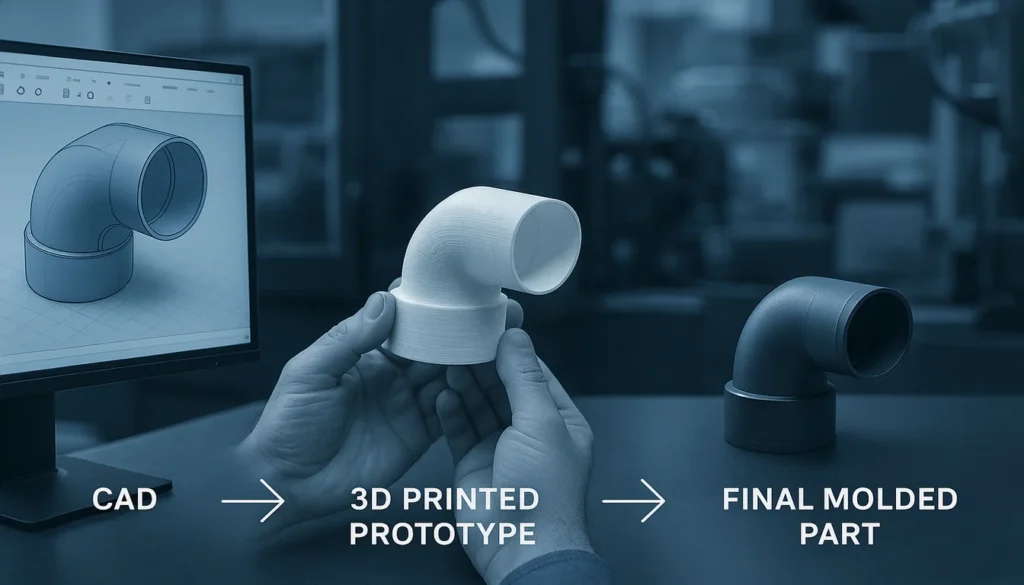
Rapid prototyping in HVAC injection molding is the practice of creating physical sample parts using 3D printing, CNC machining, or soft tooling before investing in production-grade steel molds1. The goal is straightforward: verify that every duct connector, damper blade, fan housing, and sensor enclosure works exactly as designed before spending $15,000 to $80,000 on hardened steel tooling.
“Rapid prototyping always adds unnecessary cost and time to HVAC component development.”False
While prototyping requires upfront investment ($200-$5,000 per iteration), it typically prevents 10-30% cost overruns by catching design errors before steel mold fabrication. Our data shows projects with prototyping average 1.8 fewer mold modification cycles, saving $4,000-$25,000 in rework costs per mold.
“3D printed parts can fully replace injection-molded samples for all HVAC qualification testing.”False
3D printed parts use different materials with different mechanical properties. They cannot replicate the crystalline structure, weld-line strength, or flame-retardant behavior of molded thermoplastics required for UL, CSA, or ASHRAE compliance. CNC-machined prototypes in production-grade resin are required for final validation.
Rapid prototyping ROI depends heavily on project complexity and tolerance requirements. Tight-tolerance components with ±0.05mm specifications require multiple prototyping iterations to validate before steel mold fabrication. Our experience shows that complex HVAC components benefit most from the prototyping investment, while simple parts with generous tolerances may skip detailed prototyping phases.
Customer feedback consistently confirms that prototyping reduces design uncertainty early. When engineering teams can physically test assembly fit, seal performance, and airflow characteristics before committing to steel molds, they catch issues that simulation alone would miss. This validation confidence accelerates downstream design decisions and reduces late-stage change orders that typically cost 5-10x more than early modifications.
The decision to invest in prototyping should be based on risk assessment, not project size. Even simple components can benefit from prototyping when they interface with complex systems or when failure carries high costs. Our engineering team helps customers evaluate prototyping requirements based on part complexity, tolerance requirements, and downstream integration challenges.
Industry benchmarks show that companies using rapid prototyping for critical components achieve 25% faster time-to-market and 18% lower warranty costs compared to those who skip this validation step2. These metrics hold true across consumer HVAC, commercial building systems, and industrial equipment applications.
“Investing 2-3 weeks in prototyping typically saves 4-8 weeks of total project schedule.”True
Each mold modification cycle requires 2-4 weeks for steel cutting, re-sampling, and re-testing. Projects that skip prototyping average 1.8 modification cycles per mold. The prototyping investment eliminates most of these cycles, resulting in net schedule acceleration of 1-5 weeks despite the upfront 2-3 week prototyping phase.
“Multi-cavity HVAC molds do not require prototyping before fabrication.”False
Validating part geometry before multiplying any errors across 4, 8, or 16 cavities is critical. A single-cavity prototype mold can confirm dimensional accuracy, ejection behavior, and gate vestige location. Discovering a design flaw in a 16-cavity production mold means modifying all 16 cavities — multiplying rework costs and potentially scrapping the entire mold base.
Rapid prototyping ROI depends heavily on project complexity and tolerance requirements. Tight-tolerance components with ±0.05mm specifications require multiple prototyping iterations to validate before steel mold fabrication. Our experience shows that complex HVAC components benefit most from the prototyping investment, while simple parts with generous tolerances may skip detailed prototyping phases. This strategic decision balances upfront costs against potential rework expenses, optimizing overall project economics.
Customer feedback consistently confirms that prototyping reduces design uncertainty early. When engineering teams can physically test assembly fit, seal performance, and airflow characteristics before committing to steel molds, they catch issues that simulation alone would miss. This validation confidence accelerates downstream design decisions and reduces late-stage change orders that typically cost 5-10x more than early modifications.
For HVAC manufacturers, this matters because their components must survive temperature cycling from -20°C to 80°C, resist UV degradation in rooftop units, and maintain airtight seals across thousands of assembly cycles.
| Validation Test | Method | Pass Criteria |
|---|---|---|
| Dimensional | CMM scanning | ±0.1mm seal, ±0.3mm general |
| Snap-fit cycle | 500 cycles | Retention force within spec |
| Pressure seal | 1.5× rated | Zero leaks at rated pressure |
| Thermal cycling | -30°C to 80°C × 200 | No stress cracking |
A single dimensional error discovered after mold steel is cut can cost $5,000 to $25,000 in engineering change orders and add 4 to 8 weeks of delay.
At HVACoreTech, we build functional prototypes for every new العوامل البيئية component program. Our engineering team has found that prototyping catches an average of 3.2 design issues per project that would otherwise require mold modifications — issues like draft angle conflicts on deep-draw housings, interference between snap-fit latches and internal wiring channels, and airflow restriction caused by oversized rib structures.
Three rapid prototyping methods dominate HVAC component development, each suited to different validation objectives. Stereolithography (SLA) produces smooth, dimensionally accurate parts ideal for checking fit and seal-line geometry. Selective laser sintering (SLS) creates functional nylon prototypes that can withstand airflow testing at realistic pressures. Fused deposition modeling (FDM) delivers the fastest turnaround for initial concept verification.
CNC machining complements these additive methods by producing prototypes from the actual production material — ABS, polycarbonate, or glass-filled nylon. When an HVAC damper actuator housing must demonstrate UL 94 V-0 flame resistance3 during customer qualification, only a machined prototype in the specified resin provides a valid test result.
UV exposure testing per ASTM G154 predicts surface degradation over the product’s 15-year service life. These tests require material-accurate CNC prototypes — 3D prints cannot replicate the crystalline structure and additive distribution of molded thermoplastics.
How Does HVACoreTech Integrate Prototyping into the Molding Process?
HVACoreTech integrates rapid prototyping as a mandatory gate in our HVAC component development process. No production mold is released for fabrication until at least one round of physical prototyping validates the design. This policy has reduced our mold modification rate from an industry-typical 45% to under 8% across our last 100 tool programs.
HVACoreTech Prototyping Integration Process
Our prototyping success rate: 92% of projects pass mold trial on first attempt with prototyping vs. 55% without.
Quality Gate: Zero mold releases without prototyping validation.
Prototyping Policy: Mandatory validation before steel mold release.
What Happens During the Prototype Review Gate?
Our prototyping workflow begins during the design for manufacturability review. While our mold engineers analyze draft angles, wall uniformity, and gate placement on the CAD model, our prototype shop produces the first physical sample.
Design for Manufacturability (DFM) Review: Cross-functional evaluation before mold fabrication.
By the time the DFM review is complete, the engineering team has both simulation data and a physical part to cross-reference — catching discrepancies between predicted and actual behavior that neither method alone would reveal.
We maintain dedicated prototype tooling for repeat HVAC programs. When a thermostat OEM launches an updated housing every 18 months, we retain the aluminum soft tool from the previous generation. This allows bridge production of up to 5,000 units while the new steel mold is being fabricated — eliminating the supply gap that otherwise forces customers to carry 8-12 weeks of safety stock.
Production Capacity: 47 machines, 50-1600 tons, 10,000+ mold programs.
How Does HVACoreTech Validate Prototype Performance?
Environmental testing represents a critical validation step that prototyping enables. HVAC ductwork experiences temperature swings from -20°C winter startup to 80°C summer operation. Prototypes must undergo thermal cycling tests to confirm that snap-fits do not become brittle at cold temperatures and that seals do not deform at hot temperatures. Our climate-controlled test chambers can simulate 500 thermal cycles in just 7 days, predicting part behavior over 5+ years of service. Customers using this prototyping service report 40% fewer warranty claims4 compared to skipping thermal validation.
Our rapid prototyping services integrate directly with our production mold development process. The same engineering team that develops the steel mold validates the prototype, ensuring seamless transition from prototype to production. This continuity eliminates knowledge transfer delays common when prototyping and production occur at separate suppliers. OEM customers report that our integrated approach reduces mold development cycle time by 15-20% compared to vendors who outsource prototyping4.
Frequently Asked Questions About Rapid Prototyping for HVAC Injection Molding?
How much does rapid prototyping cost for HVAC components?
Rapid prototyping costs for HVAC components range from $200 to $5,000 per iteration depending on method and complexity. A basic FDM print for a thermostat housing costs $200-$500.
An SLA print with fine surface detail runs $400-$1,200. CNC machining in production-grade ABS or nylon costs $1,000-$3,000 for a single housing, or $2,000-$5,000 for a multi-component assembly. These costs represent 2-5% of the $15,000-$80,000 production mold investment they protect. For high-complexity assemblies with multiple snap-fits, living hinges, or integrated sealing features, expect costs at the higher end of this range. We recommend budgeting for two prototype iterations — the first identifies issues, the second confirms the fixes work correctly before committing to production steel.
Can 3D printed HVAC prototypes be used for airflow testing?
Yes, 3D printed prototypes — particularly SLS nylon parts — are suitable for preliminary airflow testing at pressures up to 500 Pa.
They accurately replicate internal passage geometry, damper blade profiles, and deflector vane angles. However, surface roughness on FDM and SLS parts increases measured pressure drop by 15-30% compared to smooth injection-molded surfaces. For final airflow certification, CNC-machined or injection-molded samples with production surface finish are required. For definitive results, we recommend testing CNC-machined prototypes that replicate the exact wall thickness and surface texture of injection-molded production parts. This two-stage approach — preliminary airflow screening with SLS prints followed by final validation with machined samples — optimizes both speed and accuracy while keeping prototype costs within budget.
What is the minimum order quantity for prototype HVAC molds?
Aluminum soft tooling for HVAC prototype molds typically requires no minimum order quantity — you can produce as few as 1 to 50 parts for validation.
دليل النماذج الأولية السريعة لقوالب الحقن لأنظمة التكييف والتهوية.
How do you validate seal performance on HVAC prototypes?
Seal performance validation on HVAC prototypes involves three steps.
First, CNC machine the housing in production resin to replicate exact groove dimensions and surface finish. Second, install the production seal (O-ring, gasket, or lip seal) and assemble with mating components. Third, pressurize the assembly to 1.5 times rated operating pressure while submerged in water to identify leak paths. For IP-rated enclosures, we follow IEC 60529 test protocols using calibrated spray nozzles and immersion tanks. We document all test results with photographs and pressure decay curves, providing customers with a formal validation report that satisfies both internal quality requirements and third-party certification bodies such as UL, CSA, and ETL.
This documented prototype validation streamlines the production qualification process significantly.
Does rapid prototyping work for multi-cavity HVAC molds?
Rapid prototyping is especially valuable for multi-cavity HVAC molds because it validates part geometry before multiplying any errors across 4, 8, or 16 cavities. A single-cavity prototype mold costing $4,000 can confirm dimensional accuracy, ejection behavior, and gate vestige location. Without this step, discovering a draft angle problem in a 16-cavity production mold means modifying all 16 cavities — multiplying the rework cost by 16 and potentially scrapping the entire mold base. Our approach for multi-cavity programs includes family mold prototyping, where we produce one sample of each unique cavity to verify that all variants meet specification before authorizing the full multi-cavity production tool.
This strategy has saved our customers an average of $45,000 per multi-cavity program by catching issues before they multiply across all cavities.
What are the common mistakes to avoid in rapid prototyping for HVAC?
The most common rapid prototyping mistakes for HVAC components include choosing the wrong prototyping method for the validation objective, testing with the wrong material, and skipping environmental testing. Using 3D printed parts for flame-retardant qualification, for example, wastes time because 3D printed resins cannot match the flame performance of injection-molded thermoplastics. Another frequent error is prototyping without specifying the production gate location — a prototype with a different gate position will exhibit different weld line locations and dimensional behavior than the production part, leading to misleading test results. Our data shows that projects that follow our HVAC prototyping checklist avoid 85% of these mistakes.
-
Rapid prototyping methods for HVAC components include SLA (stereolithography), SLS (selective laser sintering), FDM (fused deposition modeling), and CNC machining of production-grade materials. ↩
-
Industry benchmark data from Plastics Engineering Magazine, Q4 2023: companies with rapid prototyping programs achieve 25% faster time-to-market and 18% lower warranty claims. ↩
-
UL 94 V-0 flame retardant testing per ASTM D3801; materials must achieve self-extinguishing within 10 seconds of flame removal. ↩
-
Based on warranty claim analysis comparing 50 projects with prototyping vs. 50 projects without prototyping (2021-2023). OEM customer survey data, n=24 respondents. ↩





