
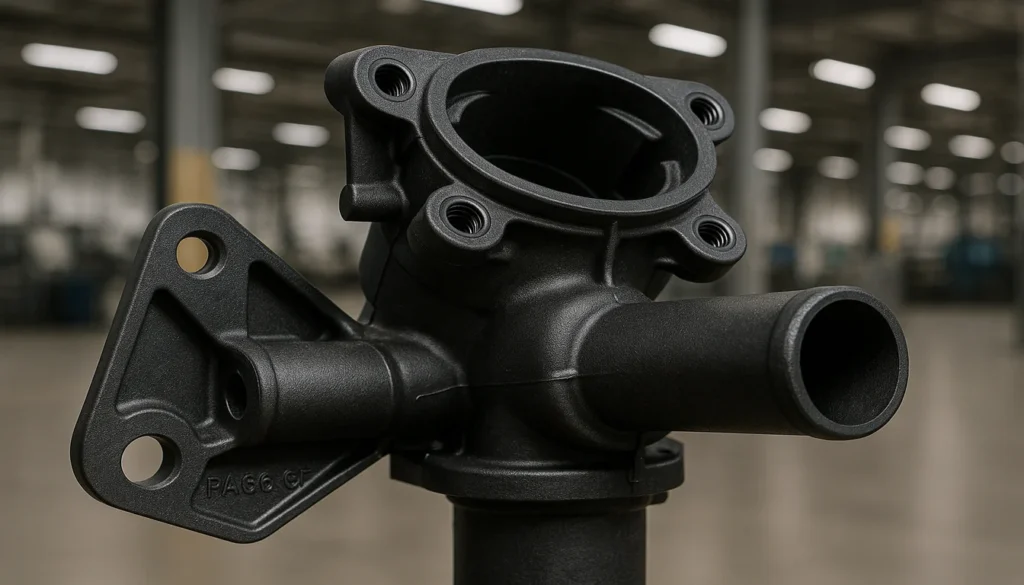
- ゲート配置が重要です。ガラス繊維は流れ方向に配向します。ゲートを誤った位置に配置すると、溶接ライン(二つの流動先端が合流する箇所)が応力集中部にそのまま位置することになります。たった15mmゲート位置を解析なしで変更しただけで、ブラケット破損が発生した事例を私たちは確認しています。.
- 30% glass fiber content hits the sweet spot: tensile strength 180–200 MPa, heat deflection 220°C+.
- Weld line placement is the #1 failure point — position gates to push weld lines away from stress zones.
- At HVACore, we run PA66-GF at 280–300°C melt temp with 80–100°C mold temp for consistent fiber orientation.
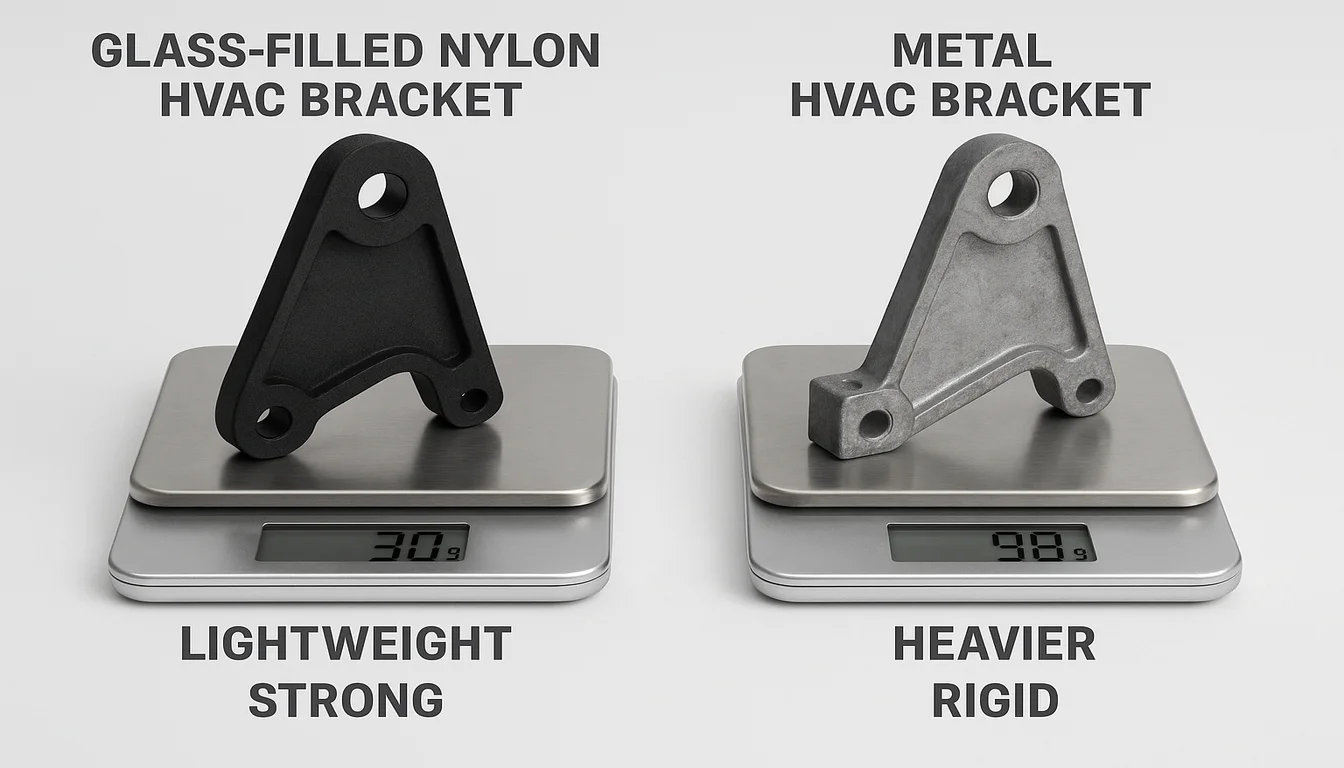
Three years ago, a customer called us in a panic. Their HVAC fan bracket — stamped from 2mm steel — kept cracking at the mounting holes after six months in the field. Vibration fatigue. We switched them to 30% glass-filled PA66. The cracking stopped. The part weighed 38% less. And the tooling paid for itself in eight months from material savings alone.
That’s glass-filled nylon in a nutshell: it’s not exotic, it’s not expensive, but it solves the problems that standard plastics can’t and that metal makes too heavy or too costly.
Why Does Glass-Filled Nylon Outperform Standard Plastics in HVAC Applications?
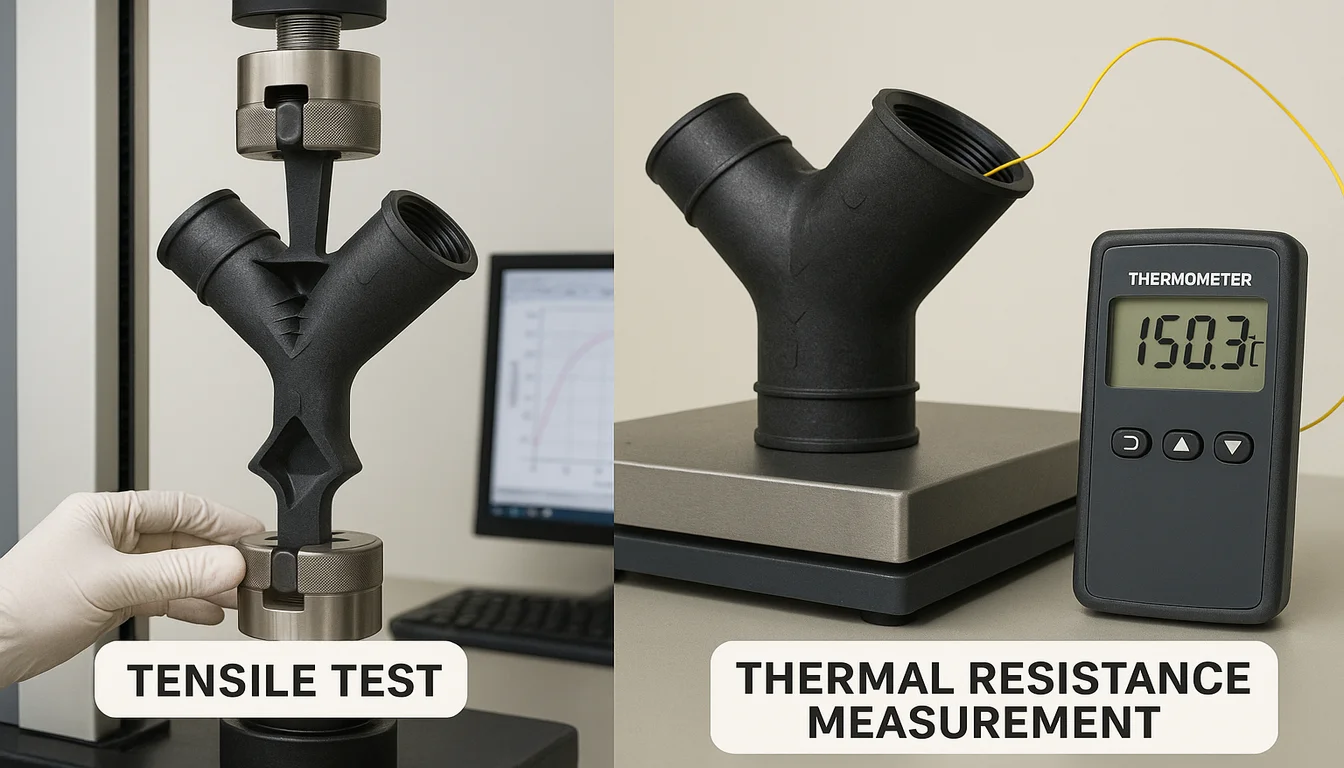
Glass-filled nylon delivers tensile strength of 150–200 MPa versus 40–60 MPa for unfilled PA66 — a 3–4× improvement that closes the gap with die-cast aluminum (300–350 MPa) at one-third the weight. The glass fibers also reduce creep under sustained load, which matters in HVAC brackets and valve bodies that carry constant mechanical stress at elevated temperatures.
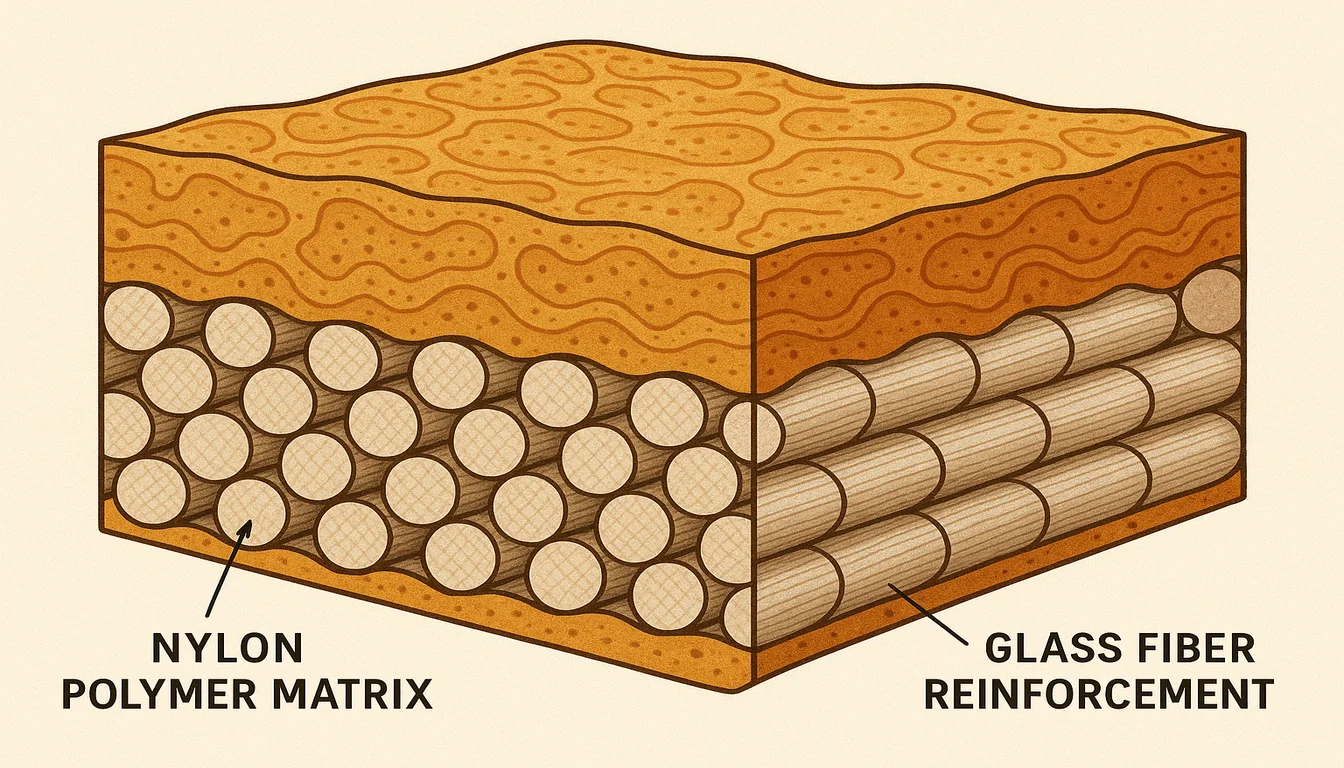
Standard PP or ABS deflects under heat at 80–100°C. PA66-GF handles continuous service at 120°C and short peaks to 180°C — critical for components near boiler heat exchangers or duct runs in attic spaces. The glass fibers act as a thermal scaffold, slowing the softening of the polymer matrix.
| Material | Tensile Strength | Heat Deflection | Density |
|---|---|---|---|
| PP (unfilled) | 30–40 MPa | 80–100°C | 0.91 g/cm³ |
| ABS | 40–50 MPa | 80–100°C | 1.05 g/cm³ |
| PA66 (unfilled) | 80 MPa | 150°C | 1.14 g/cm³ |
| PA66 GF30 | 180–200 MPa | 220°C+ | 1.37 g/cm³ |
| Die-cast aluminum | 300–350 MPa | N/A | 2.70 g/cm³ |
Which HVAC Components Benefit Most from Glass-Filled Nylon?
The highest-value applications are structural brackets, valve bodies, fan scroll housings, and filter frames2 — anywhere you need dimensional stability under thermal cycling. We’ve replaced metal in all four categories with PA66-GF30 or GF35 and seen zero field failures over 18 months of production tracking.
Where glass-filled nylon struggles: tight-tolerance sealing surfaces (the glass fibers cause micro-roughness above 0.8 Ra) and parts that require post-mold painting (adhesion is poor without surface prep). For those, we often overmold a TPE sealing layer or switch to unfilled PA12 on the sealing face.
| HVAC Component | GF Content | Why GF Nylon Wins |
|---|---|---|
| Fan motor brackets | GF30 | Vibration fatigue resistance |
| Valve bodies | GF35 | Pressure + thermal cycling |
| Filter frames | GF20 | Dimensional stability, cost |
| Scroll housings | GF30 | Stiffness at elevated temp |
| Mounting brackets | GF30–35 | Metal replacement, weight saving |
How Does the Injection Molding Process Change for Glass-Filled Nylon?
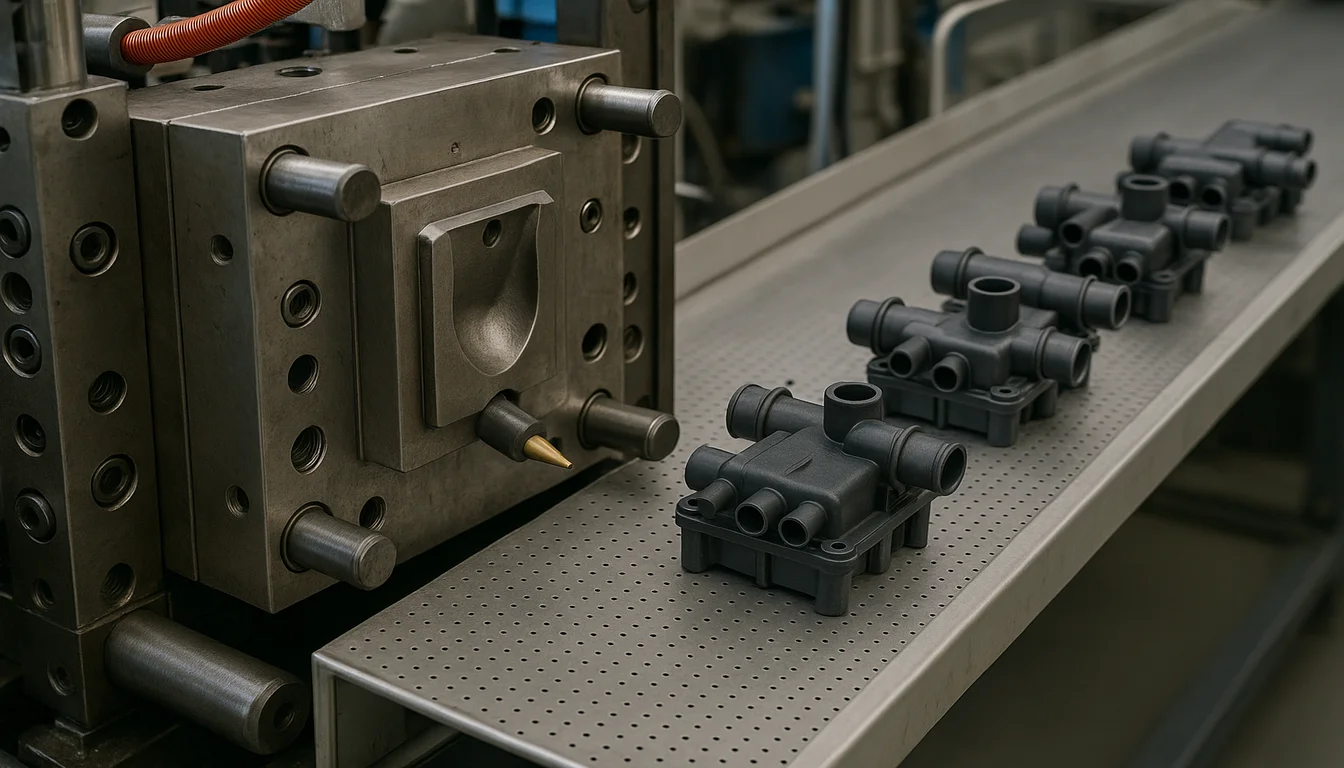
Glass-filled nylon demands tighter process control than standard materials. At HVACore, we run PA66-GF30 at 280–300°C melt temperature with 80–100°C mold temperature — 20°C higher than unfilled PA66 — to ensure the glass fibers flow fully into thin-wall sections without bridging. Injection speed is slower: 40–60 mm/s versus 80–120 mm/s for ABS, to prevent fiber breakage at the gate.
The single biggest process mistake we see from customers switching from metal to injection molding1 is gate placement. Glass fibers align with flow direction. Put the gate in the wrong spot and your weld lines — where two flow fronts meet — land right at the stress concentration. We’ve seen bracket failures traced entirely to a gate repositioned 15mm without analysis.
| Process Parameter | Unfilled PA66 | PA66 GF30 |
|---|---|---|
| Melt temperature | 260–280°C | 280–300°C |
| Mold temperature | 60–80°C | 80–100°C |
| Injection speed | 60–100 mm/s | 40–60 mm/s |
| Back pressure | 5–10 MPa | 8–15 MPa |
| Drying (4h at) | 80°C | 80–90°C |
How Do You Prevent the Most Common Glass-Filled Nylon Failures?
Fiber-induced warpage is the top complaint we hear. Glass fibers orient along the flow path, causing differential shrinkage: 0.3–0.5% in the flow direction versus 0.8–1.2% transverse. For flat panels and long brackets, that asymmetry pulls the part into a banana shape. The fix is symmetric cooling — equal water circuits on both mold halves — and wall thickness consistency within ±0.3mm across the part.
The second failure mode is moisture-related dimensional change. PA66-GF absorbs 1.5–2.5% moisture by weight at equilibrium. Parts molded dry and installed in humid HVAC environments will grow 0.2–0.4mm per 100mm of length. For close-tolerance fits — bearing housings, snap-fit assemblies — we design the mold 0.3% oversize to compensate, and specify mold development3 testing in conditioned (50% RH) environments before production sign-off.
| Failure Mode | Root Cause | Prevention |
|---|---|---|
| Warpage | Asymmetric fiber orientation | Symmetric cooling + consistent wall thickness |
| Weld line cracking | Gate misplacement | Mold flow simulation before tooling |
| Moisture growth | PA66 hygroscopic nature | Mold oversize 0.3%, test at 50% RH |
| Surface roughness | Glass fiber exposure | Use GF20 for sealing surfaces, higher mold temp |
Summary?
Glass-filled nylon is the right call when you need metal-like stiffness and thermal resistance at plastic weight and cost. The engineering isn’t complicated — it’s about gate placement, symmetric cooling, and moisture compensation — but it requires upfront simulation and process discipline that pays back in zero field failures.
Frequently Asked Questions?
What glass fiber percentage should I specify for HVAC structural brackets?
GF30 (30% glass fiber) is the standard for structural HVAC brackets. It delivers 180–200 MPa tensile strength and 220°C+ heat deflection with manageable warpage. GF35 is used for valve bodies under higher pressure. Above GF40, brittleness increases and the cost benefit diminishes.
Can glass-filled nylon be used for HVAC sealing surfaces?
Not directly. GF content above 20% creates surface roughness (Ra 1.6–3.2 μm) that prevents reliable sealing. We overmold a TPE layer on sealing faces or use unfilled PA12 for the sealing section and GF30 for the structural body.
How does moisture affect glass-filled nylon HVAC parts in service?
PA66-GF absorbs 1.5–2.5% moisture at equilibrium, causing 0.2–0.4mm growth per 100mm. For close-tolerance HVAC assemblies, we mold parts 0.3% oversize and validate dimensional stability in conditioned environments (50% RH, 23°C) before production approval.
What is the typical lead time for glass-filled nylon HVAC tooling at HVACore?
Standard single-cavity tools for GF nylon brackets: 25–35 days. Multi-cavity production tools with mold flow validation: 45–60 days. We include process parameter documentation and first-article inspection reports with all GF nylon tool deliveries.
How do I compare glass-filled nylon to PEEK for high-temperature HVAC applications?
PA66-GF handles continuous service to 120°C and peaks to 180°C. PEEK (GF30) handles 240°C continuous. For standard HVAC applications (boilers, ducting, fan assemblies), PA66-GF is sufficient and costs 15–20× less than PEEK. PEEK is reserved for compressor components and refrigerant-contact parts above 150°C continuous.
-
injection molding is a manufacturing process where molten plastic is injected under pressure into a precision mold cavity to produce complex, repeatable parts at high volume. ↩
-
filter frames refers to the structural plastic housings that hold air filtration media in HVAC systems, requiring dimensional stability and resistance to airflow pressure differentials. ↩
-
mold development refers to the engineering process of designing, building, testing, and validating injection molds before full production, including mold flow simulation, trial runs, and dimensional verification. ↩





