
プロファイリング済み(スロー-ファスト).
In-Mold Labeling (IML) solves these specific failure modes. By integrating the graphic layer directly into the IML injection molding process, we stop treating labeling as a secondary post-process and start treating it as part of the structural molding cycle.
As a manufacturing engineer, I view IML not just as a cosmetic upgrade, but as a functional necessity for durable equipment labeling in harsh environments. It eliminates the peeling, scratching, and fading inherent to pad printing or adhesive labels.
Key Takeaways
- IML fuses the graphic film with the molten resin, creating a single, inseparable piece.
- It eliminates secondary labor costs (stickering/printing) but requires automated robotics at the press.
- Material compatibility is non-negotiable; the label substrate must match the resin (e.g., PP label for a PP part) to ensure chemical bonding.
- Gate location is critical to prevent "ink washout" or label shifting during high-pressure injection.
Definition: HVAC In-Mold Labeling (IML)
In-Mold Labeling (IML) is a plastic decoration technology where a pre-printed, pre-cut polymer film (label) is placed inside the open injection mold cavity. The mold closes, and molten plastic is injected behind the label. The heat of the melt fuses the label to the part, resulting in a final product where the graphic is embedded in the wall, not stuck on it.
In HVAC, we use this for:
- Permanent Branding: Logos on outdoor condenser grilles.
- User Interfaces: HVAC control panel molding with integrated button icons.
- Safety Data: Wiring diagrams inside service panels that cannot peel off due to heat.
Key Parameters for IML Process Control
Success in IML depends on the precise interaction between the label, the robot, and the injection unit.
| Parameter | Typical Value / Type | Why it Matters in HVAC |
|---|---|---|
| Label Substrate | Polypropylene (PP) or ABS | Must match the injected resin. A PP label won’t bond to an ABS housing; it will delaminate. |
| Static Charge | 10 kV – 20 kV | The robot applies static electricity to "stick" the label to the steel mold face before injection. |
| Foil Thickness | 50 – 100 microns | Too thin = wrinkles/burn-through. Too thick = edge lines visible or poor heat transfer. |
| Injection Speed | Profiled (Slow-Fast) | 鋭い90°の角にIMLラベルを巻き付けようとしないでください。破れたりしわになったりします。ラベルを巻き付ける必要がある場合は、最小半径2mm〜3mmを使用してください。. |
| Melt Temp | 200°C – 240°C | Excessive heat destroys the ink or distorts the label film. |
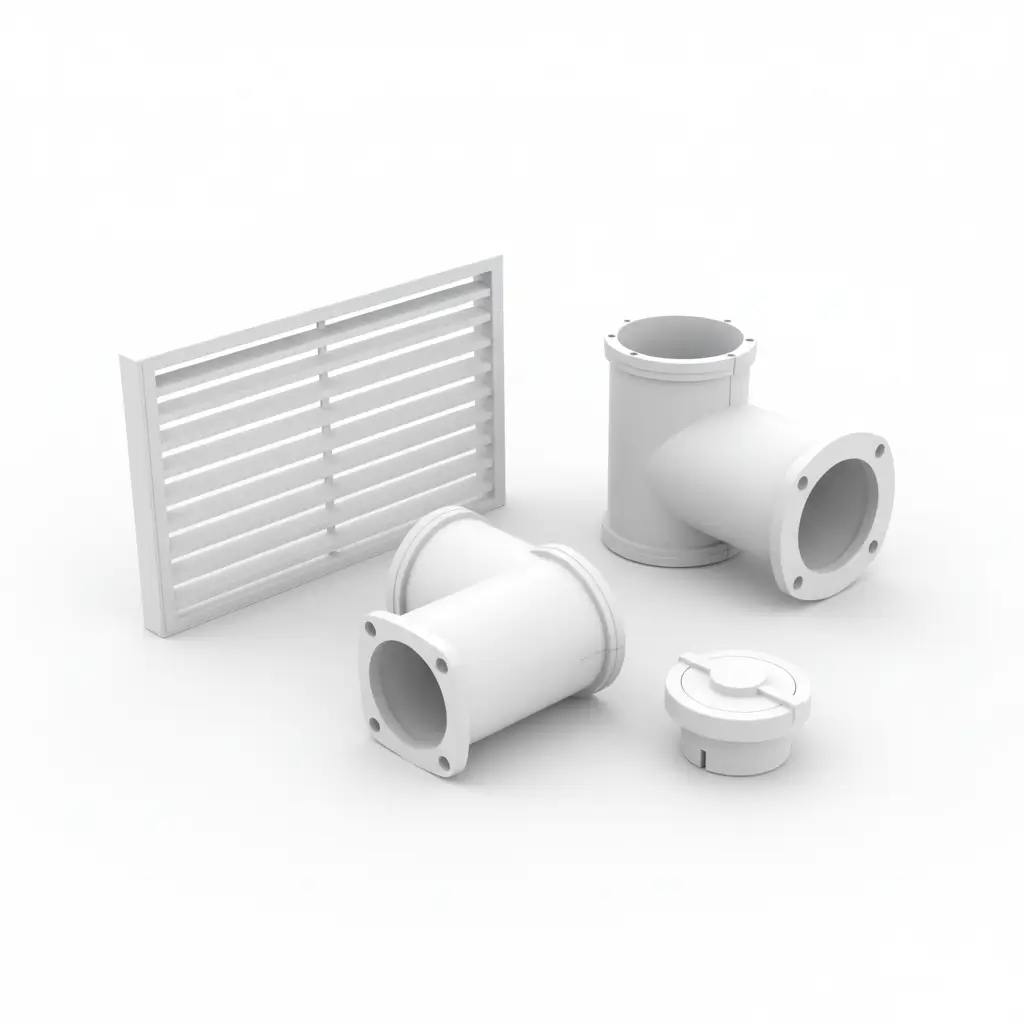
Step-by-Step: The IML Production Cycle
Here is how we execute in-mold labeling HVAC production on the factory floor, using a real example of a smart thermostat faceplate.
1. Label Placement (The Robot)
We cannot do this by hand. The cycle time is too fast, and consistency is key. A side-entry robot picks the label from a magazine. It moves into the open mold and applies a high-voltage static charge to the label. This static electricity pins the label against the cavity wall (the "A-side" or cosmetic side).
2. The Injection Phase (The Critical Moment)
The mold closes. This is where most defects happen.
- The Challenge: If we inject at standard high speeds, the sheer force of the plastic entering the cavity will rip the label off the wall or scour the ink off the film (known as "gate wash").
- The Solution: We use a wide "fan gate" or "film gate" rather than a pin gate. This distributes the flow. We program the screw speed to start very slow—just enough to cover the label edges—and then ramp up to fill the part.
3. Fusing and Cooling
The molten resin (e.g., Polycarbonate/ABS blend) melts the back layer of the label. They become one molecular structure. As the part cools, the label shrinks with the plastic.
- Factory Note: If the label material shrinks at a different rate than the resin, the part will warp like a potato chip. We must match Coefficient of Thermal Expansion (CTE).
4. Ejection
The mold opens. The part is ejected. There is no need for a drying tunnel, adhesive curing, or operator stickering. The part is finished immediately.
Real Factory Case: The "Washed Out" Logo
We were producing a front grille for a portable air conditioner using a metallic-finish IML label.
- The Defect: Near the injection gate, the metallic silver ink appeared smeary and transparent. The turbulence of the plastic flow had literally washed the ink away.
- The Investigation: The gate was located directly opposite the center of the label, hitting it perpendicularly.
- The Fix: We redesigned the tool to use a "submarine gate" that injected into a non-visible rib on the back, allowing the plastic to flow parallel to the label rather than impacting it directly. We also lowered the injection speed by 20% for the first 0.5 seconds of the shot.
Myth vs. Fact: IML in HVAC
This is incorrect. In fact, IML is often *more* eco-friendly than stickers. Since the label and the part are made of the same material (e.g., a PP label on a PP housing), the entire component can be reground and recycled without peeling off the label.
You must use films specifically engineered for molding. Standard vinyl stickers will melt, curl, or burn under the 200°C+ temperatures and high pressures of the injection molding process.
Advantages and Disadvantages of IML
| Feature | Advantages | Disadvantages |
|---|---|---|
| Durability | Graphics are encapsulated; cannot be scratched, peeled, or faded by UV. | High cost of entry. Molds often need modification for label placement. |
| Security | Impossible to remove the serial number or brand without destroying the part (Anti-counterfeit). | If the label is defective (print error), the entire plastic part is scrap. |
| Aesthetics | Can achieve "soft touch," metallic, or wood grain finishes impossible with painting. | Longer lead times. You must wait for label printing before you can mold parts. |
| Production | Combines molding and decorating into one step (lower labor). | Slightly longer cycle time (1–2 seconds) for robot interaction. |
Practical Tips for Implementation
- Design for "Magazines": The labels need to be stackable so the robot can pick them. Complex 3D shapes are hard to stack. Keep the label area relatively flat or with a gentle curve (2D or 2.5D).
- Avoid Sharp Corners: Do not try to wrap an IML label around a sharp 90° corner. It will tear or wrinkle. Use a minimum radius of 2mm–3mm if the label must wrap.
- 耐久性のあるHVAC機器:インモールドラベリングの利点を発見 If your part has a textured surface, IML can hide sink marks and flow lines that would be visible on a glossy paint finish.
- Static Pinning is Mandatory: Do not rely on vacuum ports to hold the label in the mold. Vacuum ports leave visible marks on the label surface. Electrostatic pinning is the only professional standard for cosmetic HVAC parts.
HVAC Application Scenarios
- Thermostat Interfaces: Using IML films that are conductive allows for Capacitive Touch buttons to be molded directly into the housing. The user touches the plastic, and the sensor behind it registers the input.
- Warning Labels on Heater Cores: Unlike stickers that dry out and fall off in high-heat environments, an IML warning label on a PPS or Nylon part remains legible at high temperatures.
- Outdoor Unit Branding: Metallic-look logos on the front of condensers that do not rust (because they are plastic) and do not peel (because they are fused).
Frequently Asked Questions (FAQ)
1. Can I use IML for low-volume production?
Generally, no. The cost of the label printing setup and the robot automation creates a high Minimum Order Quantity (MOQ). It becomes cost-effective usually above 10,000 to 20,000 units per year.
2. Is IML suitable for outdoor HVAC units?
Yes, but you must specify UV-stable inks and films. Standard indoor inks will fade under direct sunlight. We use specific UV-cured ink systems for outdoor condenser parts.
3. Can I change the design easily?
Yes. This is a huge advantage. To change the model name from "Pro Series 100" to "Pro Series 200," you just swap the stack of labels in the robot magazine. You do not need to change the steel mold or the resin.
4. Does the label affect the part dimensions?
Slightly. The label has thickness (e.g., 0.05mm). In tight tolerance assemblies, you must account for this. Furthermore, the label acts as an insulator on one side of the mold, which can cause asymmetrical cooling and slight warpage if not compensated for in cooling time.
5. What happens if the robot misses a label?
Modern IML systems have vision inspection or sensors. If the robot fails to place a label, the press sends an alarm and stops. If a part is molded without the label, it is usually dimensionally smaller (by the thickness of the label) and may not fit the assembly.

Technical Summary
In-Mold Labeling (IML) transforms HVAC components from simple plastic shells into fully integrated, branded, and functional interfaces. By fusing a compatible polymer film with the substrate during IML injection molding, manufacturers achieve a level of durability that post-mold stickers cannot match—essential for the temperature fluctuations and humidity of HVAC applications. While it requires higher initial investment in automation and tooling precision (specifically gate design and static pinning), the result is a permanent, counterfeit-proof, and premium finish that enhances the perceived value of HVAC control panel molding and outdoor enclosures.





