

- ABS outperforms PETG in heat resistance for HVAC applications: HDT of 80–100°C vs. 65–75°C for PETG under 1.82 MPa load.
- PETG offers superior chemical resistance to refrigerant oils and cleaning agents, and produces near-zero warpage in thin-wall duct components.
- ABS is the dominant choice for control panels, thermostat housings, and fan shrouds where dimensional stability and paintability are critical.
- PETG is preferred for transparent covers, inspection windows, and low-temperature duct connectors where chemical exposure is a primary concern.
- Both materials require different mold temperatures and processing conditions; ABS needs a heated mold (60–80°C), while PETG performs well at 20–40°C.
Why Does PETG vs ABS Material Selection Matter for HVAC Components?
Choosing between PETG and ABS for an HVAC component determines whether that part will survive its operating environment for 10–15 years — or fail in the first season. Both PETG and ABS are amorphous thermoplastics with similar processing windows, but their performance profiles diverge sharply when exposed to the conditions typical of HVAC systems: elevated temperatures near heat exchangers, refrigerant oils and cleaning chemicals, UV radiation on rooftop units, and repeated thermal cycling between −20°C and +80°C.
The mistake most engineers make is treating this as a simple cost comparison. ABS is roughly 10–15% less expensive per kilogram than PETG in standard injection molding1 grades, which makes it the default choice. But the correct selection depends on the specific thermal load, chemical exposure, and geometry of each individual HVAC component. A thermostat housing that sees +70°C near a heat exchanger has completely different requirements from a duct elbow connector that sits in a condensate-prone plenum at room temperature.
“ABS is the better default material for HVAC control housings and fan shrouds operating above 60°C.”True
ABS has a heat distortion temperature of 80–100°C at 1.82 MPa (ASTM D648), compared to 65–75°C for standard PETG grades. In a typical split-system air handler, control housing surfaces near the heat exchanger can reach 65–70°C during peak operation. At these temperatures, PETG housings begin to creep under sustained mechanical load from screw bosses and snap-fit joints — accumulating 0.1–0.3 mm of permanent deformation per 500 hours of operation that eventually causes sealing failures and loose mounting interfaces.
“PETG and ABS perform identically in chemical resistance2 to HVAC refrigerant oils and cleaning agents.”False
PETG has significantly better resistance to non-aromatic chemicals, including the polyol ester and alkylbenzene refrigerant oils used in modern HVAC systems, as well as alkaline cleaning agents used in coil maintenance. After 500 hours of immersion in polyol ester oil at 60°C, ABS specimens lose 8–14% of tensile strength and show surface crazing; PETG specimens under the same conditions show less than 3% strength reduction with no surface degradation. In condensate drain components and refrigerant-side housings, PETG’s chemical resistance advantage directly translates to longer service life.
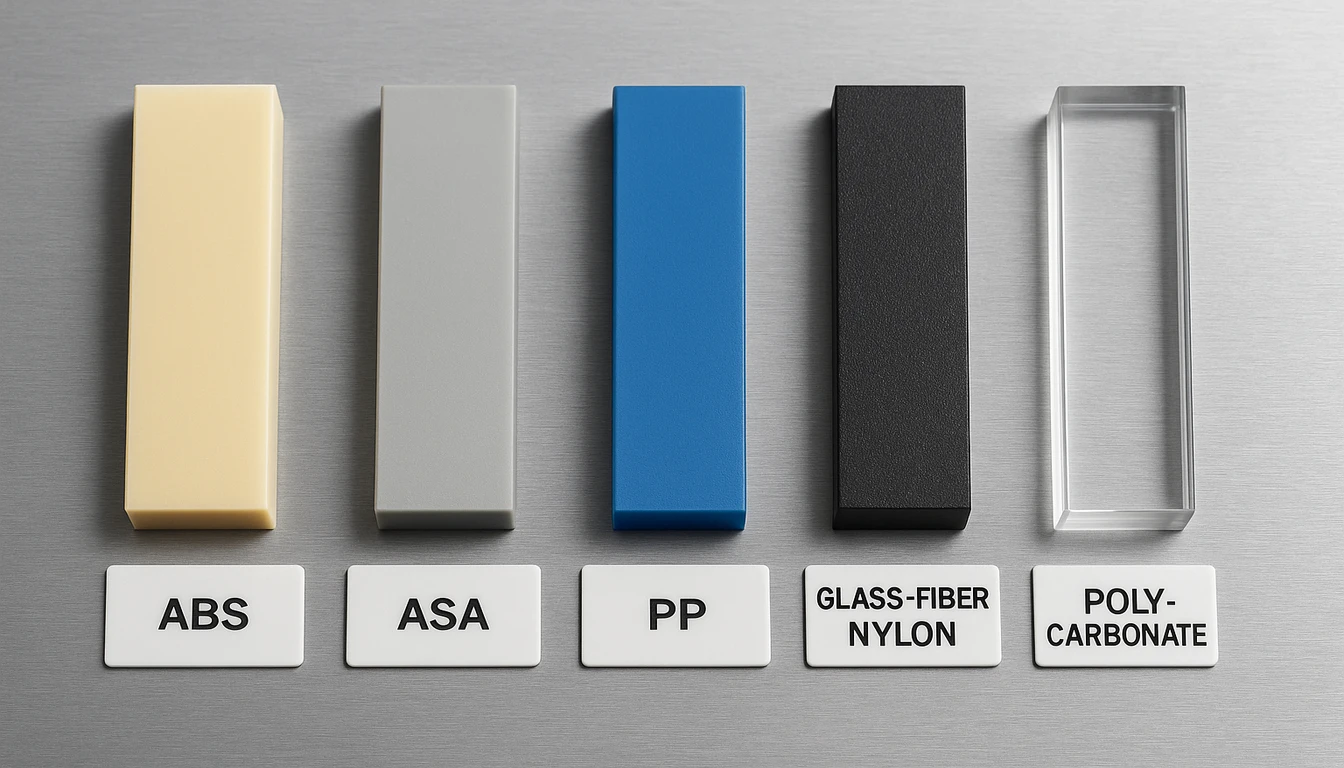
How Do PETG and ABS Compare on the Properties That Drive HVAC Part Failures?
HVAC components fail through four primary mechanisms: thermal creep under sustained load, chemical attack from refrigerants and cleaning agents, UV degradation on outdoor units, and dimensional drift from warpage3 during and after molding. Understanding how PETG and ABS perform across each failure mode is the foundation of correct material selection. The table below summarizes the key property differences as they apply to real HVAC operating conditions.
| Property | PETG | ABS | HVAC Relevance |
|---|---|---|---|
| Heat Distortion Temp (1.82 MPa) | 65–75°C | 80–100°C | Critical for components near heat exchangers |
| Continuous Use Temp | 60–70°C | 70–90°C | Determines safe operating zone |
| Izod Impact (notched) | 35–60 J/m | 150–300 J/m | ABS far superior for housings under mechanical load |
| Tensile Strength | 45–55 MPa | 38–48 MPa | PETG slightly stronger in tension |
| Shrinkage Rate | 0.2–0.5% | 0.4–0.7% | PETG less warpage in thin walls |
| UV Resistance | Fair (needs stabilizer) | Poor (needs ASA or paint) | Both degrade outdoors without treatment |
| Chemical Resistance (oils) | Excellent | Fair–Good | PETG preferred for refrigerant-side parts |
| Transparency | Clear to opaque | Opaque only | PETG for inspection windows |
| Paintability / Adhesion | Difficult | Excellent | Como Diferem os Requisitos de Secagem para PETG e ABS na Produção de HVAC? |
| Flammability (standard grade) | HB | HB or V-2 | FR grades required for electrical enclosures |
| Mold Temperature | 20–40°C | 60–80°C | PETG lower tooling cost per cycle |
| Material Cost (relative) | Base + 10–15% | Base | ABS lower material cost at volume |
What Is the Heat Resistance Advantage of ABS Over PETG?
The 15–25°C gap in heat distortion temperature between ABS and standard PETG is the single most important factor in HVAC housing applications. In a residential split-system unit, control panel housings near the discharge plenum can reach 65–68°C during high-ambient cooling operation. Standard PETG grades at 65–70°C HDT are right at their performance limit — sustained loading from screw bosses and snap-fit interfaces will cause time-dependent deformation (creep) that standard dimensional inspection at room temperature will not detect until the part has been in service for 3–6 months.
ABS, with an HDT of 80–100°C, provides a thermal safety margin of 20–35°C above the peak temperature exposure of most residential HVAC control components. This margin means that even under worst-case conditions — direct solar gain on a rooftop unit cabinet plus internal heat exchanger proximity — ABS housing panels retain full dimensional stability. High-impact ABS grades (notched Izod 150–300 J/m) also far outperform PETG (35–60 J/m) in the impact loading encountered during shipping, installation, and service access. For fan shrouds and blower housings where airflow turbulence creates sustained vibration loading, ABS’s impact toughness provides reliable long-term performance that standard PETG cannot match.
Where Does PETG’s Chemical Resistance Give It a Real Advantage?
PETG’s superior chemical resistance to refrigerant oils, alkaline cleaning agents, and mild acids makes it the better choice for specific HVAC component categories where ABS regularly fails by surface crazing and stress cracking. Condensate management components — drain pan liners, trap housings, condensate drain connectors — are continuously exposed to water, biological growth inhibitors (quaternary ammonium compounds), and coil cleaning chemicals. ABS stress-cracks in contact with many of these chemicals, particularly ketone-based cleaners and aromatic-solvent-containing coil cleaning foams. PETG resists all of these, often with no measurable degradation at room temperature.
Refrigerant-side components in commercial HVAC systems that use polyol ester (POE) or alkylbenzene (AB) lubricating oils present a similar case. These oils are aggressive toward ABS, especially under elevated temperature conditions inside compressor housings and refrigerant line components. PETG’s ester-linkage chemistry makes it inherently compatible with POE oils — the same chemical family — with less than 3% tensile strength reduction after 500 hours of immersion at 60°C. For transparent refrigerant sight glasses and inspection windows on refrigerant lines, PETG provides both the optical clarity needed and the chemical resistance required — a combination that ABS cannot offer at all, since standard ABS is opaque.
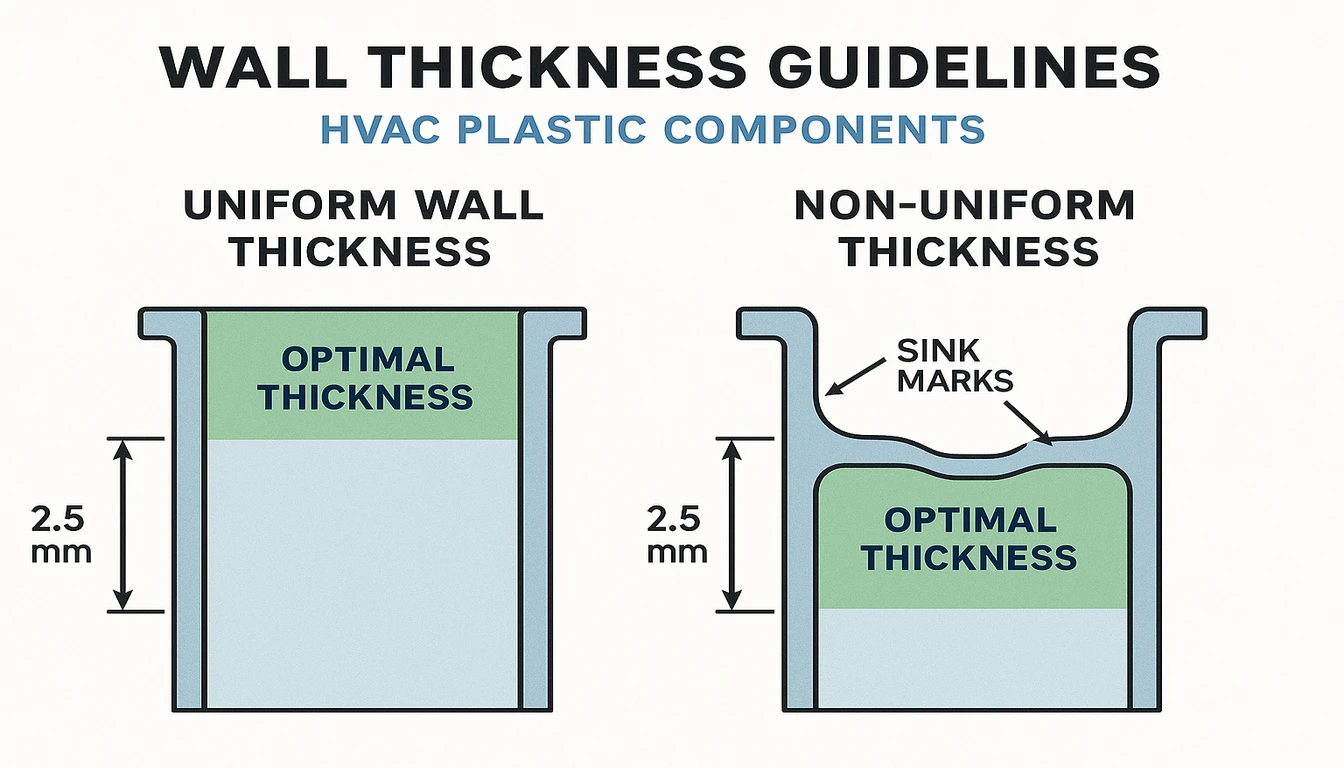
Which HVAC Components Should Use ABS and Which Should Use PETG?
The most effective way to apply the PETG vs ABS decision is to categorize HVAC components by their primary performance requirement — thermal load, chemical exposure, optical clarity, or paintability — and match the material to the dominant requirement. In practice, most HVAC assemblies contain both ABS and PETG parts in different positions, selected for the specific conditions at each location within the system.
Control Panels, Thermostat Housings, and Fan Shrouds: ABS
Control panel housings, thermostat bezels, blower motor housings, and fan shrouds are the core ABS application territory in HVAC. These parts require: operating temperatures of 70–90°C (within ABS HDT range), paintability for color matching to cabinet finishes, dimensional stability for tight snap-fit and screw-boss interfaces, and impact resistance for handling during installation. ABS meets all four requirements.
Paintability is a particularly strong ABS advantage — ABS accepts solvent-based and water-based paints with standard adhesion primers, while PETG requires surface flame treatment or specific adhesion promoters before painting because of its low surface energy. At HVACore, 100% of control housing and panel production uses ABS or ABS/PC blends, with flame-retardant (FR) grades applied wherever UL 944 V-0 is specified.
Duct Connectors, Condensate Components, and Inspection Windows: PETG
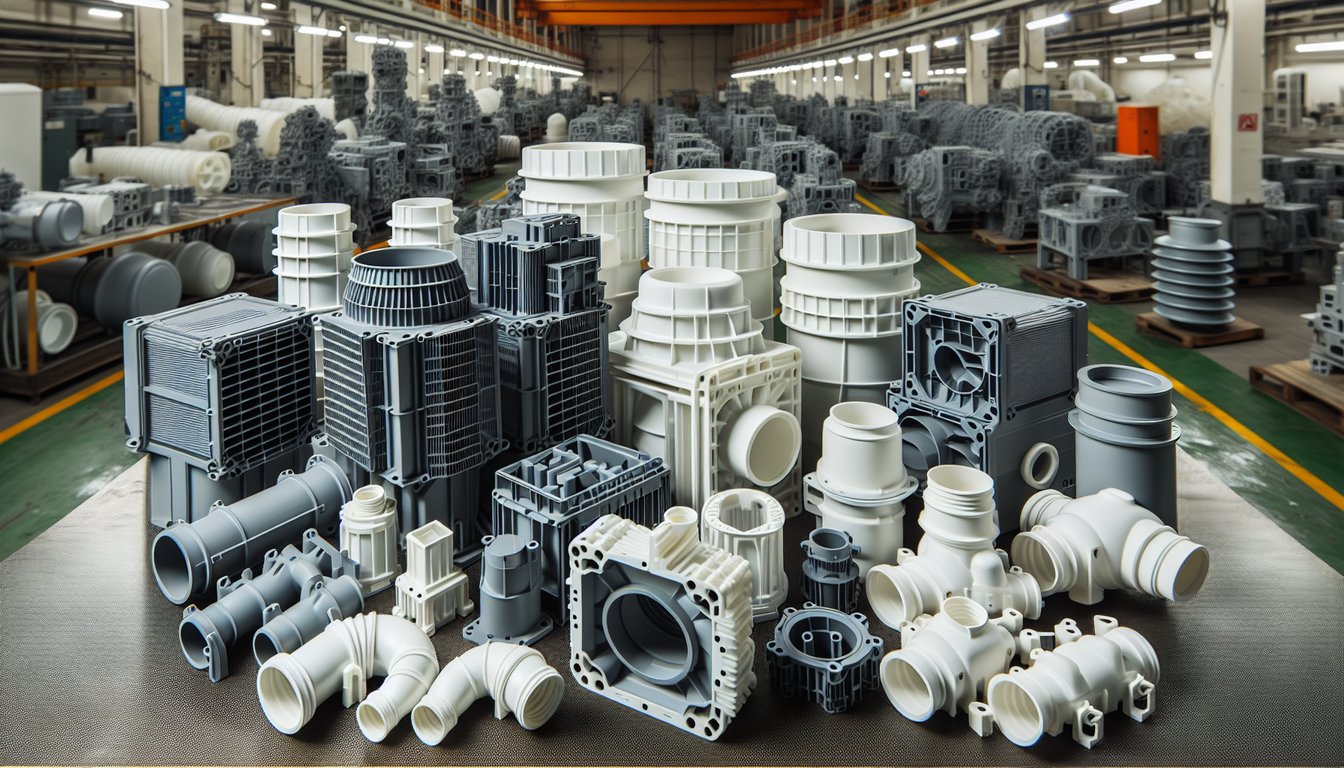
Low-temperature duct connectors, drain pan components, condensate trap housings, and inspection windows are the primary PETG application areas in HVAC. Duct connectors in the return-air side of a residential system typically see temperatures of 20–40°C and continuous exposure to humid air with condensation cycling. PETG’s low shrinkage rate (0.2–0.5% vs. 0.4–0.7% for ABS) produces significantly less warpage in large, thin-wall flat-panel geometries of duct connectors — a critical advantage because even 0.5 mm of warpage on a 400 mm duct flange face will create an air leak path.
Condensate trap housings in commercial HVAC drains benefit from PETG’s resistance to the biocides and coil cleaning agents used in regular maintenance cycles. Transparent PETG covers — equipment inspection windows on air handlers, refrigerant sight glass housings, and LED status indicator lenses — exploit PETG’s optical clarity (light transmission up to 88%) while maintaining adequate impact resistance for field service access.
“PETG produces significantly less warpage than ABS in thin-wall, large-format HVAC duct components.”True
PETG’s linear shrinkage of 0.2–0.5% is consistently lower and more isotropic than ABS at 0.4–0.7%, and PETG’s lower mold temperature requirement (20–40°C vs. 60–80°C for ABS) reduces the thermal gradient that drives differential shrinkage in wide, thin parts. At HVACore, production data on 400×300 mm duct flange panels shows average post-ejection warpage of 0.25 mm for PETG versus 0.48 mm for ABS from equivalent mold and processing conditions — a 48% warpage reduction that directly impacts air seal quality without requiring secondary fixture annealing.
“PETG is suitable for HVAC components located near heat exchangers or compressors because its heat resistance is comparable to ABS.”False
PETG’s heat distortion temperature of 65–75°C (1.82 MPa load) places it at or below the peak operating temperatures of components near HVAC heat exchangers (65–80°C) and compressor compartments (80–100°C). Using PETG in these locations creates a thermal creep risk under sustained mechanical loading from screw joints and snap-fit features. ABS at 80–100°C HDT provides a 15–35°C safety margin that PETG cannot match. Heat-stabilized PETG grades exist (HDT up to 85°C), but their cost approaches that of ABS/PC blends, eliminating PETG’s main value advantage in high-temperature HVAC applications.
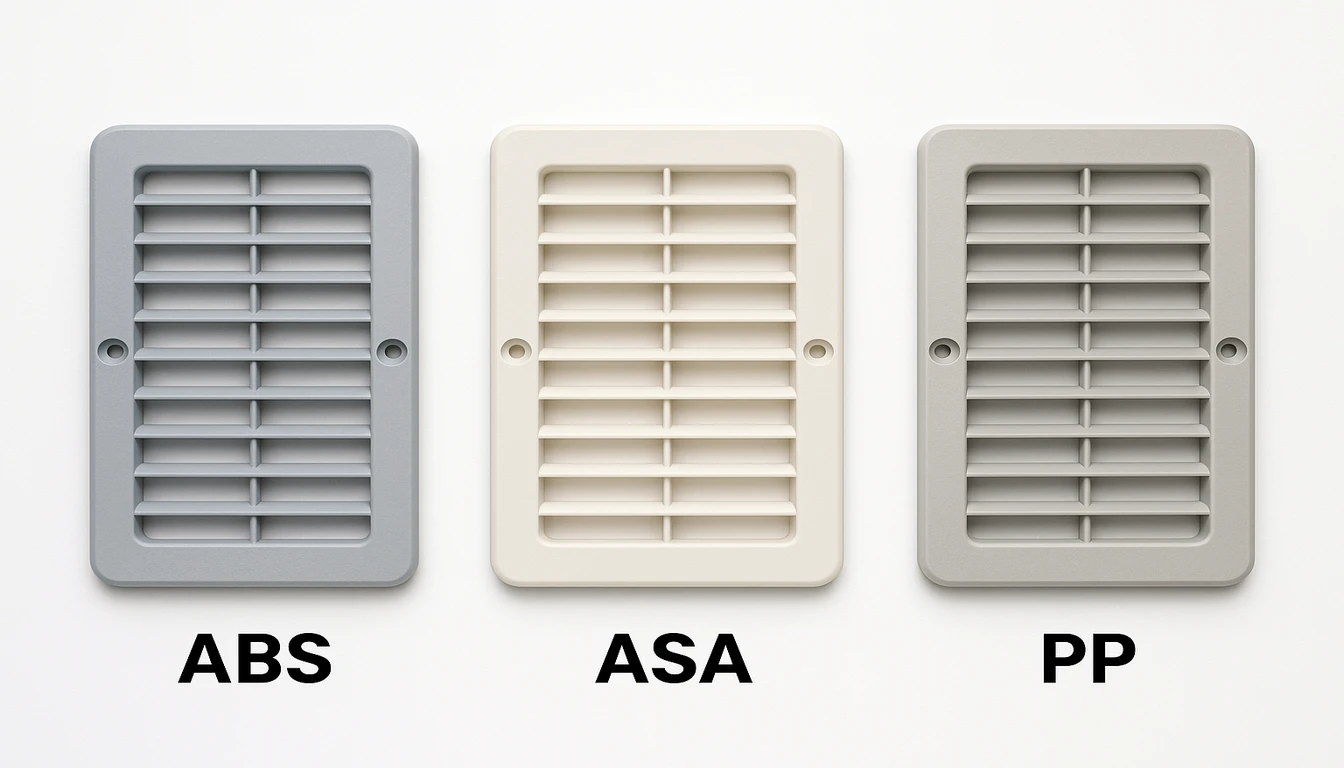
How Do Processing Differences Between PETG and ABS Affect HVAC Production?
Processing differences between PETG and ABS affect tooling investment, cycle time, energy consumption, and the surface quality of finished HVAC parts. These differences are not trivial — a PETG-optimized mold running on ABS will produce parts with surface defects, and vice versa. Understanding the processing requirements of each material is essential for specifying the correct injection molding parameters and tooling standards for HVAC component production.
| Processing Parameter | PETG | ABS |
|---|---|---|
| Melt Temperature | 220–260°C | 220–270°C |
| Mold Temperature | 20–40°C | 60–80°C |
| Injection Pressure | 50–100 MPa | 70–130 MPa |
| Drying Required | 4h at 65°C | 2–4h at 80°C |
| Typical Cycle Time | Shorter (cooler mold) | Longer (heated mold) |
| Shrinkage Rate | 0.2–0.5% | 0.4–0.7% |
| Gate Type (preferred) | Hot runner, edge gate | Hot runner, pin gate |
| Draft Angle Required | 1.0–1.5° minimum | 1.5–2.0° minimum |
| Weld Line Appearance | Visible, moderate strength | Visible, lower strength at weld |
Why Does ABS Require a Heated Mold and How Does This Affect HVAC Production Cost?
ABS requires a heated mold at 60–80°C to prevent premature surface solidification, which would create flow marks and knit lines on cosmetic HVAC panel surfaces. Maintaining mold temperature at 60–80°C requires active mold heating circuits — typically oil or water heaters — and adds 15–25 seconds to cycle time for thermal equilibration after mold changes compared to PETG tooling at ambient temperature. For high-volume HVAC housing production (50,000+ parts/year), this heating requirement increases energy consumption by approximately $0.03–0.08 per part and requires more sophisticated temperature control equipment. The payoff is superior surface gloss uniformity and paint adhesion — critical for residential HVAC panels where cosmetic appearance affects OEM brand perception.
How Do Drying Requirements for PETG and ABS Differ in HVAC Production?
O PETG é mais seguro na maioria das aplicações expostas a produtos de limpeza porque resiste melhor a ácidos diluídos, detergentes alcalinos e ambientes de serviço com alta humidade. O ABS ainda pode funcionar para muitos invólucros internos, mas a exposição repetida a químicos por esguicho ou limpeza aumenta o risco de fissuras por tensão e perda de brilho ao longo do tempo.
In HVAC production environments where humidity varies seasonally, PETG material handling requires more stringent moisture control protocols. At HVACore, we use dehumidifying dryers with integrated dew-point monitoring for all PETG production runs, maintaining resin moisture below 0.04% to prevent any surface quality issues on transparent components.
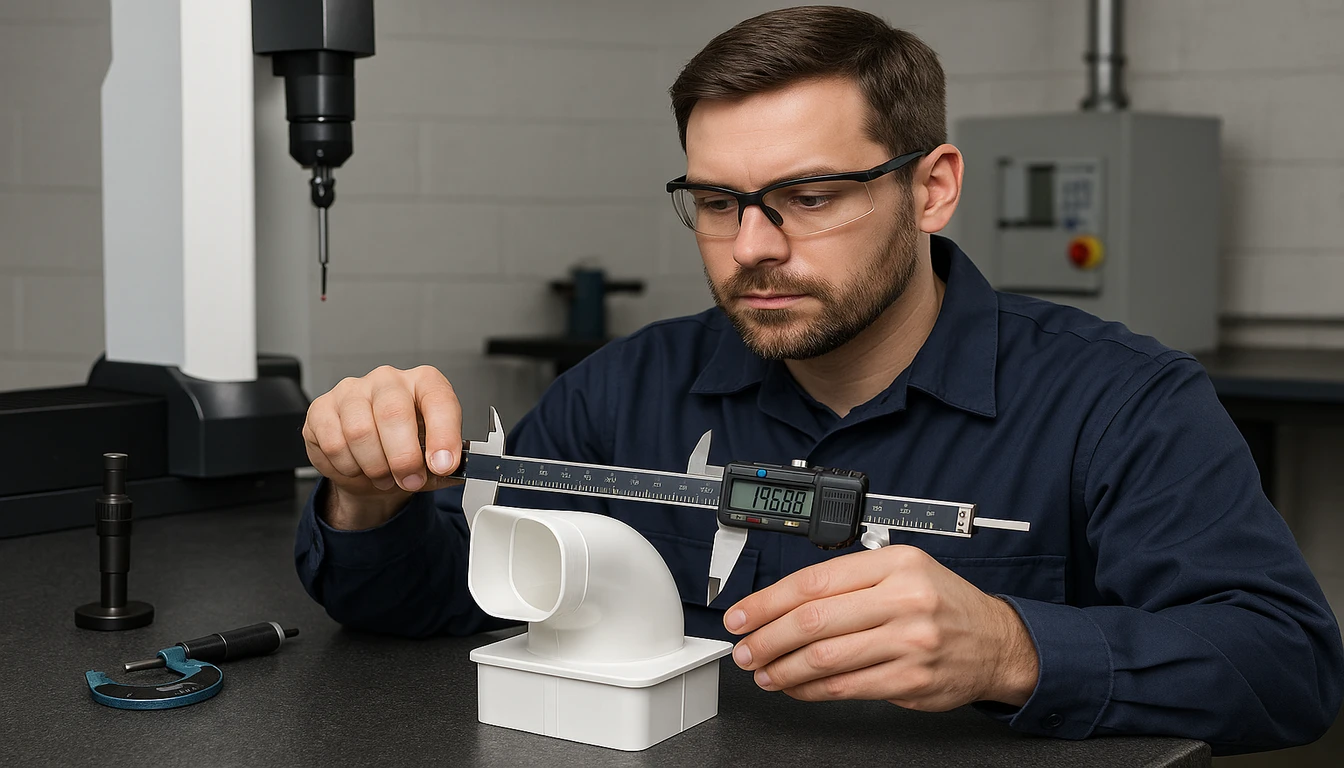
Quality inspection data also changes how teams should interpret PETG versus ABS in production. A material that looks acceptable in a lab coupon can still create downstream quality loss if the molded part has mixed wall thickness, hidden weld lines, or cosmetic zones that customers inspect closely during installation. For indoor HVAC housings, ABS often wins not because one single datasheet number is dramatically better, but because it gives a wider processing window for consistent appearance, edge definition, and assembly fit when the tool starts scaling to larger production lots.
| Property | PETG | ABS |
|---|---|---|
| Warpage (300mm panel) | 0.25 mm | 0.48 mm |
| Chemical resistance | Good | Moderate |
| Impact strength | High | High |
| UV resistance | Low (needs coating) | Moderate |
That wider margin matters on parts such as thermostat housings, indoor control bezels, return-air grilles, and blower covers where small surface defects quickly become visible. PETG can absolutely perform well in controlled molding conditions, especially when clarity or chemical exposure drives the choice, but it usually asks for tighter process discipline around drying, gate balance, and cooling uniformity. If the program team is trying to protect first-pass yield and cosmetic repeatability on an opaque indoor part, ABS is frequently the safer baseline specification.
We also look at how each resin behaves after secondary operations. Painted ABS housings, ultrasonic welding joints, label adhesion, and screw-boss retention tend to be more familiar to HVAC OEM manufacturing teams because the material has a long history in appliance-style enclosures. PETG becomes more attractive when a design benefits from clear windows, translucent covers, or harsher chemical exposure, but those gains should be weighed against the production controls required to keep dimensions and appearance stable over the full run.
What About UV Resistance, Flammability, and Outdoor HVAC Applications?
Outdoor exposure is where many HVAC material selections fail in the field. Engineers sometimes focus on indoor mechanical data and forget that condenser housings, rooftop drain features, and exterior guards see a very different mix of UV radiation, rainwater pooling, thermal cycling, and service abrasion. In these cases, standard ABS should not be treated as a default outdoor resin just because it performs well on indoor housings. PETG is also not an automatic answer for exterior service because its clarity advantage does not solve long-term weathering by itself.
That is why outdoor reviews should separate short-life equipment from long-life equipment. A temporary enclosure, a protected accessory cover, and a disposable service feature can tolerate a different resin choice than a premium branded rooftop cabinet expected to keep appearance and dimensional stability over many seasons. When appearance retention matters, the conversation usually shifts away from standard ABS versus PETG and toward UV-stabilized ASA, coated systems, or redesigned geometry that reduces direct weather loading on the part.
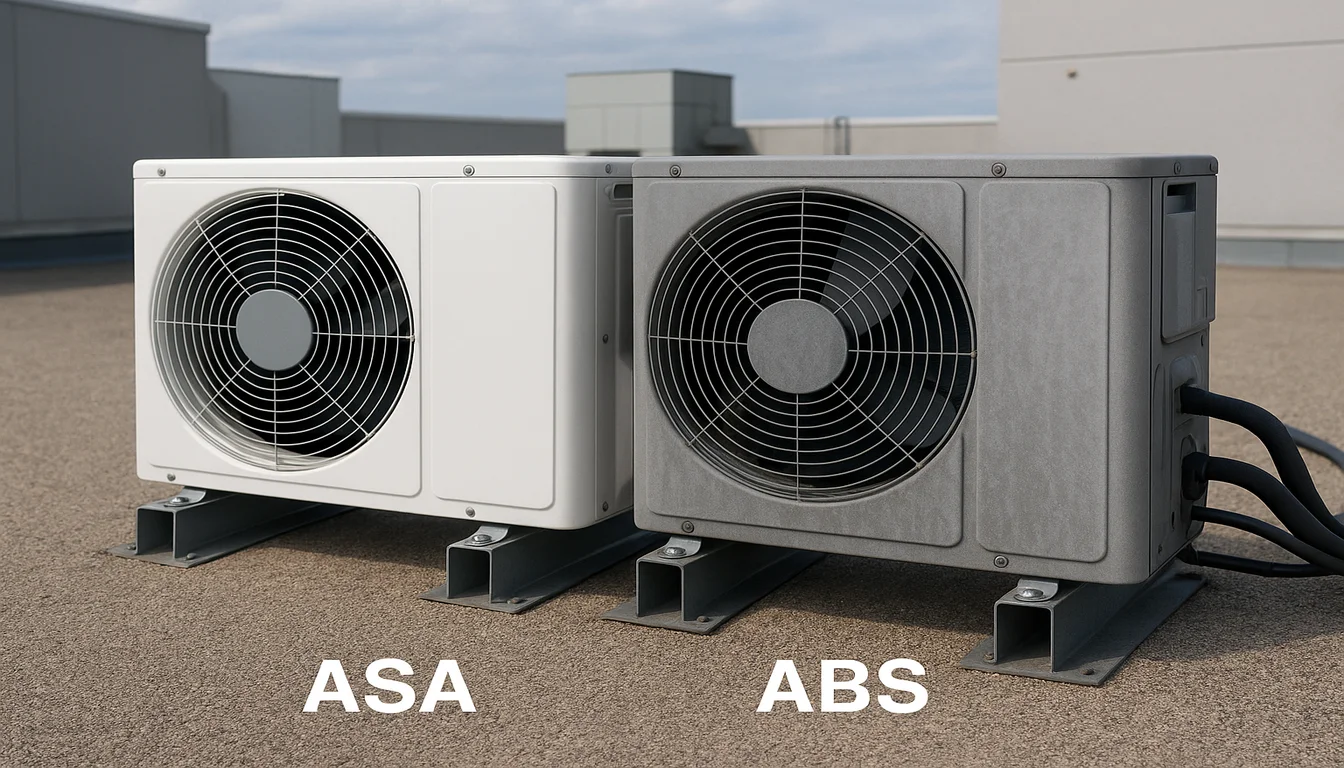
We also recommend validating outdoor parts with accelerated weathering and post-exposure fit checks instead of relying only on virgin resin datasheets. In production, the failure mode is often not dramatic breakage. It is gradual gloss loss, color fade, surface chalking, screw-boss embrittlement, or panel distortion that creates fit-and-finish complaints long before the part fully cracks. Those are exactly the quality issues that HVAC OEM teams want to prevent during DFM review rather than after launch.
Why Neither Standard ABS Nor PETG Works for Long-Term Outdoor HVAC Exposure
For this reason, the decision tree at the end of this article should be treated as an early screening tool, not a substitute for application testing. If the part faces outdoor weathering, heavy cleaners, or transparent inspection requirements at the same time, the best answer may be a material outside the simple PETG-versus-ABS choice. The right process is to narrow the options quickly, then confirm with molding trials, chemical exposure checks, and assembly validation before freezing the production resin.
Outdoor HVAC units — rooftop packaged units, condenser cabinets, outdoor heat pump housings — impose UV degradation and weathering requirements that neither standard ABS nor standard PETG meets adequately without modification. Both materials will yellow, chalk, and lose surface gloss within 6–18 months of outdoor exposure without UV stabilizers or surface protection.
Why ASA Is the Preferred Outdoor Alternative to Both ABS and PETG
For outdoor HVAC applications, ASA (Acrylonitrile Styrene Acrylate) is the standard material specification for most major OEMs, not ABS or PETG. ASA replaces the butadiene rubber phase in ABS with an acrylate rubber that is UV-stable, providing 5–10× better outdoor weathering resistance than ABS and 3–5× better than standard PETG, while maintaining similar processing behavior to ABS. At HVACore, any component specified for outdoor exposure — condenser fan blade covers, outdoor unit cabinet panels, rooftop unit drain pans — defaults to UV-stabilized ASA. When a customer specifies ABS or PETG for an outdoor component, our DFM team flags the material selection as a risk and recommends ASA substitution or an outdoor-grade paint system as alternatives.
Flammability Standards for HVAC Electrical and Control Components
Both ABS and PETG are available in flame-retardant (FR) grades that achieve UL 94 V-0 classification at specified wall thicknesses. For HVAC electrical enclosures, control boxes, and any component adjacent to electrical wiring, FR grades are mandatory under NEC and UL 508A requirements. Standard ABS (HB rating) and standard PETG (HB rating) are not acceptable for these applications — FR-ABS (V-0 at 1.5 mm) or FR-PETG (V-0 at 1.5–2.0 mm) must be specified.
FR grades typically cost 25–40% more than standard grades and may have slightly lower impact strength, requiring wall thickness verification during DFM to confirm that V-0 rating is achieved at the actual wall thickness of the production part. At HVACore, every electrical enclosure drawing review includes a flammability specification check as a mandatory hold before mold design begins.
“ASA is the correct material for outdoor HVAC cabinets and panels — not standard ABS or PETG.”True
Standard ABS suffers UV degradation (chalking, yellowing, 30–50% gloss reduction) within 12 months of outdoor exposure at 500 kLangley UV dose. Standard PETG is similarly UV-unstable. ASA’s acrylate rubber phase is intrinsically UV-stable, maintaining 80%+ of original gloss after 3,000 hours of accelerated weathering (ASTM G154). Major HVAC OEMs (Carrier, Trane, Daikin) specify ASA or ASA/PC blends for all outdoor cabinet components in their supplier standards. Using ABS or standard PETG on outdoor HVAC panels creates a warranty liability that typically manifests as surface degradation complaints within the first 2–3 years of field service.
“Standard ABS meets UL 94 V-0 flammability requirements for HVAC electrical enclosures without FR additives.”False
Standard ABS achieves only HB (horizontal burning) classification under UL 94 — the lowest category, indicating the material slows but does not extinguish a flame. UL 94 V-0 requires complete self-extinction within 10 seconds with no dripping. NEC and UL 508A require V-0 at rated wall thickness for all electrical enclosures in HVAC control applications. FR-ABS with brominated or phosphorus-based flame retardant systems achieves V-0 at 1.5 mm wall thickness; standard ABS cannot achieve V-0 at any practical HVAC housing wall thickness.
How Should You Make the PETG vs ABS Decision for Your HVAC Component?
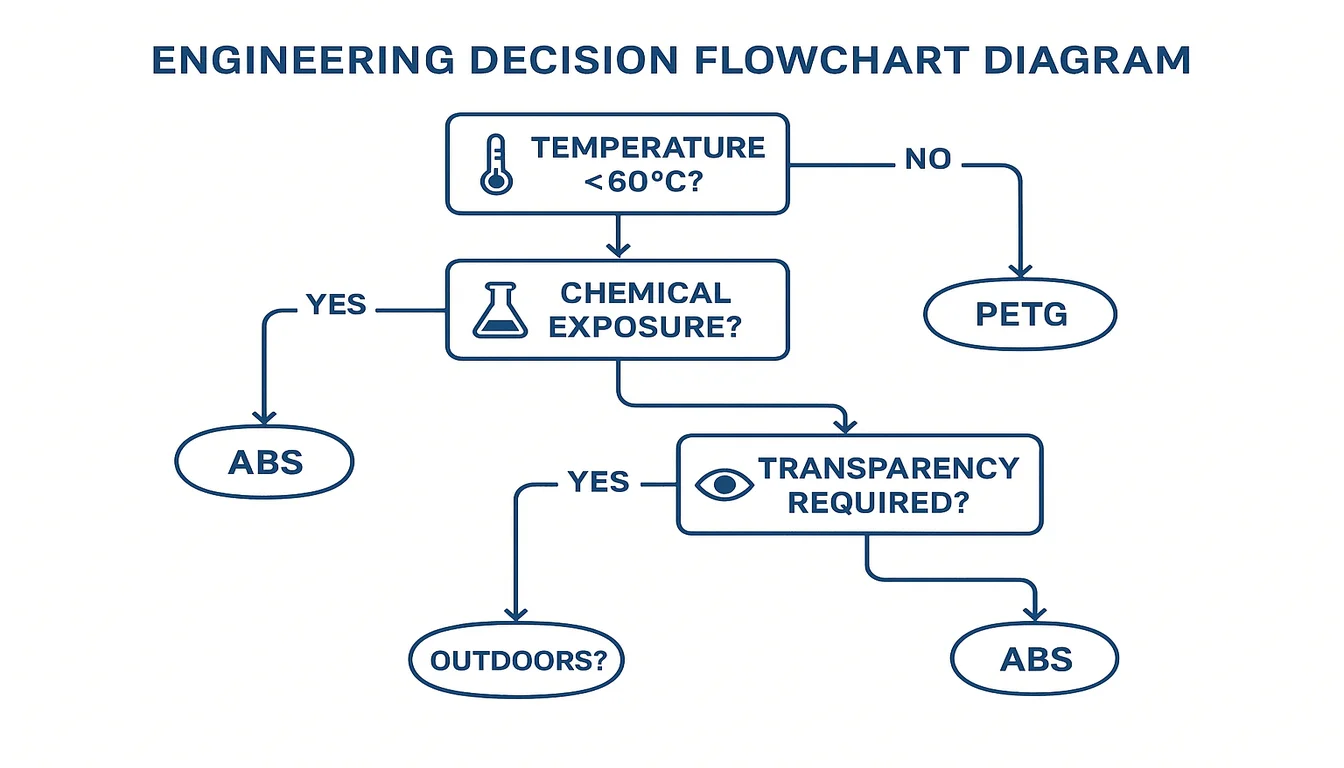
A structured decision process eliminates the most common PETG vs ABS selection errors. At HVACore, our material selection review follows a four-question sequence that covers 95% of real HVAC component scenarios.
At HVACore, every PETG vs ABS decision is logged in the DFM sign-off form against the part number, enabling our engineers to trace the original resin rationale if the specification changes during tooling or production ramp.
Step 1: What Is the Maximum Operating Temperature of This Component?
If the component will be exposed to temperatures above 70°C under any operating condition — including peak summer ambient plus internal heat exchanger proximity — ABS (or ABS/PC blend for >90°C) is mandatory. PETG is disqualified. If the maximum temperature is consistently below 60°C with a safety margin for worst-case conditions, PETG becomes viable and its other advantages (chemical resistance, warpage reduction, clarity) can be evaluated.
Step 2: Will This Component Be Exposed to Refrigerant Oils, Biocides, or Cleaning Agents?
If chemical exposure is confirmed — condensate management components, refrigerant-side parts, components in regular contact with coil cleaning agents — PETG is the better choice at temperatures below 60°C. ABS will stress-crack in contact with ketone-based and aromatic-solvent-based chemicals within 6–18 months. If chemical exposure is not a factor, ABS’s advantages in impact resistance, paintability, and heat resistance make it the default choice.
Step 3: Does the Component Need to Be Transparent or Painted?
Transparency requirements — inspection windows, indicator lenses, sight glasses — eliminate ABS and specify PETG (or polycarbonate for higher-temperature transparent applications). Paint adhesion requirements — OEM-matched cabinet panel colors, branded control housing colors — strongly favor ABS, which accepts paint without surface pre-treatment. PETG requires flame treatment or adhesion promoter before painting, adding process steps and cost. If neither transparency nor painting is required, the thermal and chemical environment drives the decision.
Step 4: Is the Part Located on an Outdoor Unit?
If yes, specify ASA instead of either ABS or PETG. If the component is indoors with no UV exposure, proceed with the temperature and chemical resistance decision from steps 1 and 2. Specifying ABS or standard PETG for outdoor HVAC components is a field-life risk that creates warranty callbacks typically within 2–4 years. ASA is a direct processing substitute for ABS with essentially no tooling or processing changes required.
HVACore’s engineering team reviews every material specification before tooling begins. Send us your component drawing and operating conditions — we’ll confirm PETG vs ABS vs ASA in 24 hours, at no charge.
Frequently Asked Questions About PETG vs ABS for HVAC?
PETG is usually the better choice when an HVAC part needs transparency or stronger resistance to cleaners and refrigerant-side chemicals, while ABS is usually better for opaque housings that need stiffness, impact strength, lower resin cost, and a more forgiving cosmetic finish.
O PETG e o ABS podem ser misturados para obter as melhores propriedades de ambos para aplicações de HVAC?
No in standard production practice. PETG and ABS are not drop-in blend partners for HVAC molding because they process at different temperature windows and create inconsistent mechanical performance unless a specialty compounder develops a controlled alloy. OEM teams typically qualify one material family and then optimize geometry, coating, or additives instead of trying to blend them at the molder level.
Qual material é mais seguro para peças de HVAC expostas a produtos de limpeza de serpentinas e produtos químicos de tratamento de condensado?
PETG is safer in most cleaner-exposed applications because it holds up better against diluted acids, alkaline cleaners, and moisture-heavy service environments. ABS can still work for many indoor housings, but repeated chemical splash or wipe-down exposure raises the risk of stress cracking and gloss loss over time.
O ABS custa sempre menos do que o PETG para projetos de moldagem por injeção de HVAC?
Compare PETG e ABS para peças plásticas de HVAC: resistência ao calor, resistência química, empenamento e custo. Escolha a resina certa para caixas, condutas e painéis.
O PETG é suficientemente resistente para tampas HVAC e painéis de serviço com encaixe por pressão?
PETG can work for light-duty covers, transparent guards, and inspection features, but ABS is usually the safer choice for repeated snap-fit service panels. ABS tolerates repeated installation and removal cycles better because it combines higher stiffness with better notch impact resistance in thick-and-thin wall transitions.
O que os engenheiros devem fazer quando uma parte precisa de exposição exterior, mas o cliente pede ABS?
They should treat that as a risk review point. Standard ABS is not the right long-life outdoor material for rooftop and condenser applications, so the practical options are UV-stabilized ASA, coated ABS, or another weatherable polymer depending on target life, color stability, and cost.
Como escolher entre PETG e ABS durante a revisão inicial de DFM de HVAC?
Start with four filters: temperature, chemical exposure, transparency, and outdoor weathering. If the part needs clarity or stronger chemical resistance, PETG moves to the front. If it needs better stiffness, impact tolerance, painted cosmetics, and lower cost for indoor use, ABS is normally the better starting specification.
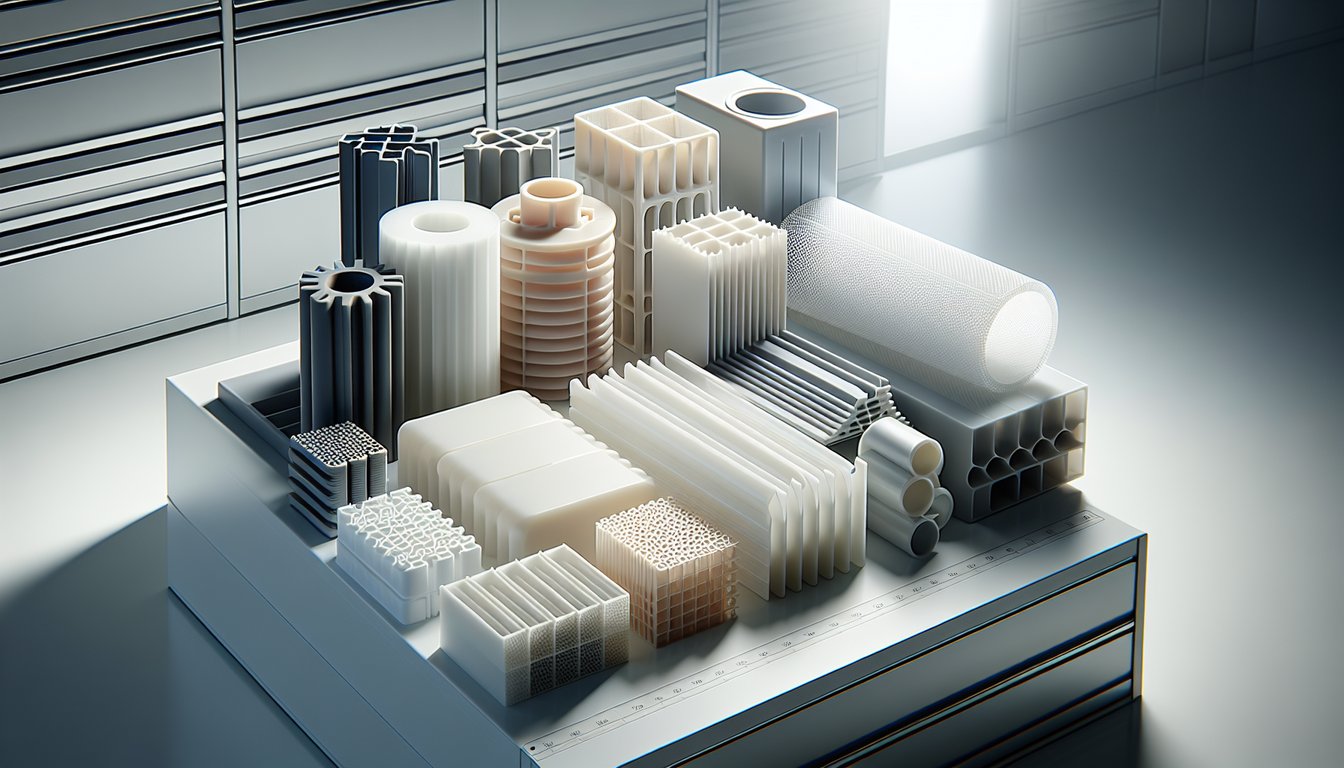
A final checklist image helps teams review the same four decision filters consistently across sourcing, DFM, and quality meetings. It also shortens alignment time when the design team, purchaser, and molder need to agree on whether clarity, chemical exposure, impact resistance, or weathering should dominate the material choice.
Used this way, the article becomes more than a comparison piece. It becomes a practical review framework that reduces avoidable rework before tooling and qualification start.
This extra field-reference image is useful because late-stage material debates usually come down to visible weathering risk, not just abstract property charts. Once teams compare real outdoor exposure evidence with indoor cosmetic requirements, it becomes easier to explain why one HVAC program stays with ABS while another should move to ASA or a protected PETG design.
-
injection molding: Injection molding is a manufacturing process in which molten plastic resin is injected under high pressure into a precision steel mold cavity, then cooled and ejected as a finished part, measured by shot weight in grams and cycle time in seconds. ↩
-
chemical resistance: Chemical resistance is a material property that refers to a plastic’s ability to maintain its mechanical and dimensional properties when exposed to chemicals such as refrigerant oils or cleaning agents, quantified by percentage change in tensile strength after immersion per ASTM D543. ↩
-
warpage: Warpage is a post-ejection dimensional distortion in injection-molded parts caused by uneven cooling rates or residual molding stress, measured in millimeters of deviation from the nominal flat datum, and is a critical quality criterion for HVAC panel and housing components. ↩
-
UL 94: UL 94 is the standard flammability classification used for plastic materials in electrical and control-related HVAC parts.
Ratings such as HB, V-2, V-1, and V-0 help engineers determine whether a housing can meet enclosure safety expectations. ↩





