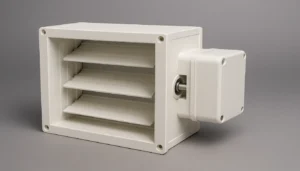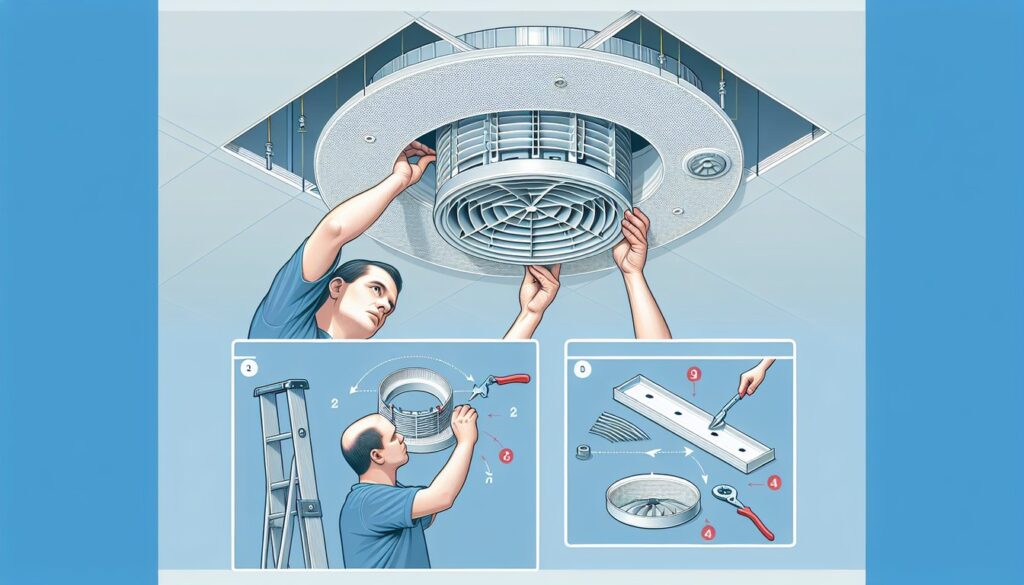
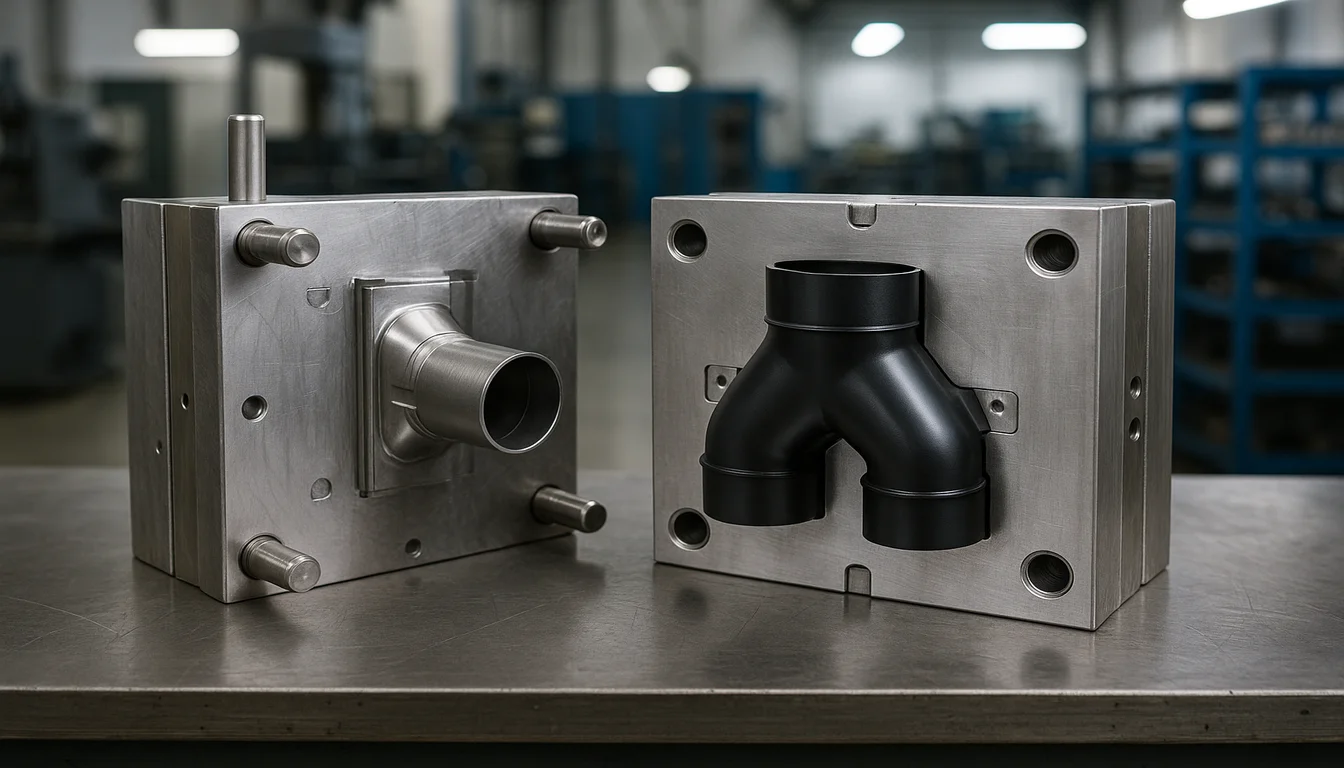
- Low volume injection molding produces 100 to 10,000 HVAC plastic parts per run using aluminum molds that cost 40 to 60 percent less than hardened steel production tooling.
- Aluminum molds deliver 10,000 to 100,000 shots in 2 to 4 weeks — compared to 8 to 16 weeks for conventional steel tooling — enabling faster product validation and market entry.
- Cost per HVAC part ranges from $1.50 to $50 at 100 units, dropping to $0.30 to $5 at 5,000 units as tooling amortization spreads across larger quantities.
- Low volume molding uses the same thermoplastic resins — ABS, ASA, PP, PA66-GF30 — as full production runs, producing HVAC parts with identical dimensional accuracy and material performance.
- Bridge tooling strategy: use aluminum molds for the first 5,000 to 20,000 production HVAC parts while hardened steel production tooling is being manufactured, eliminating launch delays.
- HVACore’s 45 injection molding lines support low volume HVAC projects from 100 pieces with no minimum order requirement and ±0.1 mm tolerance across all mold types.
What Is Low Volume Injection Molding?
| Feature | Specification |
|---|---|
| Typical production volume | 100–10,000 parts per run |
| Tooling type | Aluminum or soft steel molds |
| Tooling cost range | $2,000–$15,000 |
| Lead time (mold to first parts) | 2–4 weeks |
| Minimum order quantity | No minimum (HVACore: from 100 pieces) |
| Dimensional tolerance | ±0.1 mm (same as production) |
| Material compatibility | ABS, ASA, PP, PA66, PC, PETG, and 400+ others |
Low volume injection molding1 is a manufacturing approach that produces 100 to 10,000 plastic parts per run using simplified tooling — typically aluminum molds — at 40 to 60 percent of the cost of conventional production molds. For HVAC manufacturers, it is the fastest path from approved design to first functional parts without the 8 to 16 week lead time and $50,000+ investment of full production steel tooling.
The economics work because aluminum molds cost $2,000 to $15,000 — versus $10,000 to $100,000 for hardened H13 steel molds — and can be machined and ready for first shots in 2 to 4 weeks. That speed and cost reduction comes with a trade-off: aluminum molds last 10,000 to 100,000 shots, not the 500,000 to 2,000,000+ of production steel. For a HVAC component program needing 500 validation samples or 3,000 pre-launch units, that trade-off is completely acceptable.
Unlike 3D printing or CNC machining, low volume injection molding produces parts from actual thermoplastics2 processed as production-grade resin pellets — the same ABS, ASA, PP-GF20, or PA66-GF30 used in full production. This is the critical advantage: a snap-fit housing tested in injection-molded ASA will perform identically to production parts. A snap-fit 3D printed in resin will not. For HVAC components where dimensional stability under 60 to 85°C operating temperatures determines whether the assembly leaks or rattles, material fidelity is non-negotiable.
| Parameter | Low Volume (100–10,000) | High Volume (50,000–1,000,000+) |
|---|---|---|
| Mold material | Aluminum or P20 steel | H13 or S136 hardened steel |
| Tooling cost | $2,000–$15,000 | $20,000–$100,000+ |
| Mold lifespan | 10,000–100,000 shots | 500,000–2,000,000+ shots |
| Lead time (mold ready) | 2–4 weeks | 8–16 weeks |
| Cost per part (500 pcs) | $3–$30 | Not economical |
| Cost per part (5,000 pcs) | $0.50–$5 | $0.50–$5 (similar at break-even) |
| Design change cost | $300–$1,500 | $2,000–$10,000+ |
| Surface finish range | SPI B-2 to C-3 | SPI A-1 to B-1 achievable |
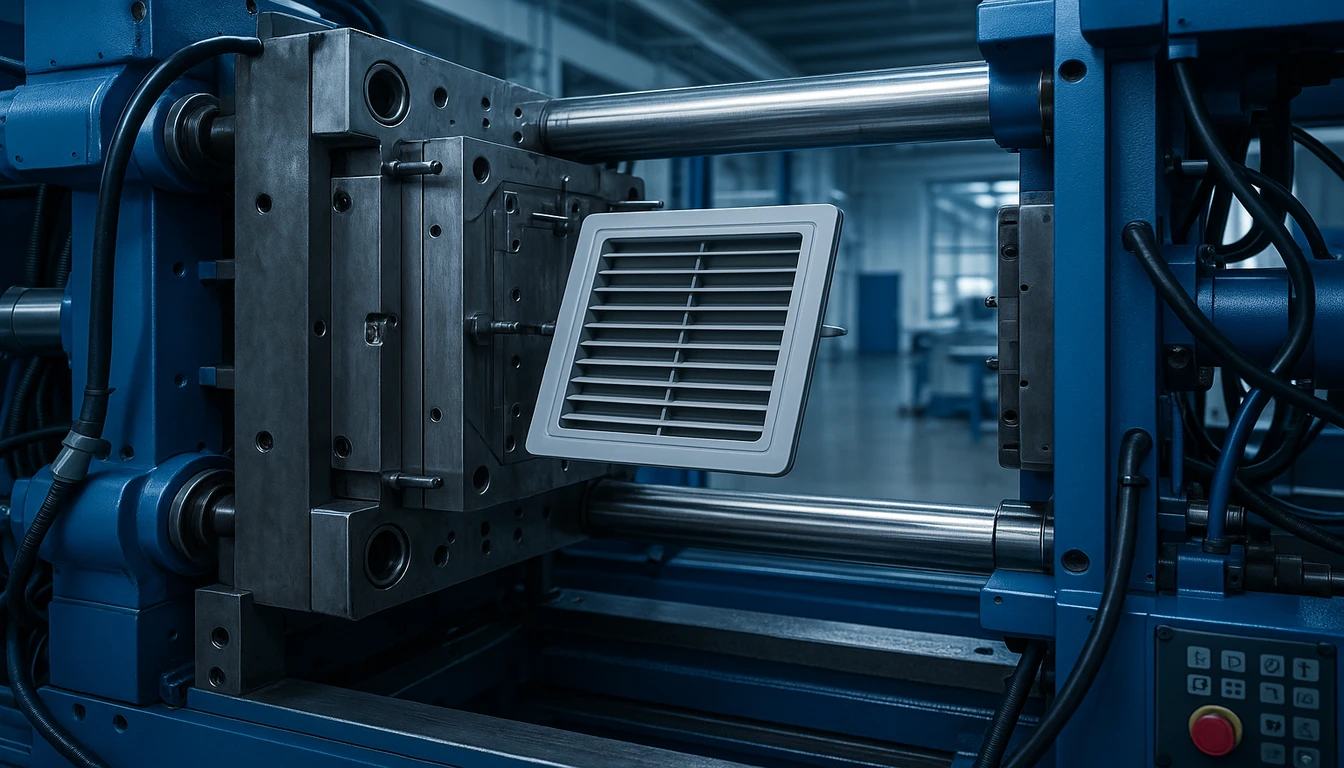
When Does Low Volume Injection Molding Make Sense for HVAC?
Low volume injection molding is the right choice when your HVAC program needs real injection-molded parts — not prototypes — but the production volume does not justify a $50,000+ hardened steel mold. There are five situations where we see this most often in the HVAC industry.
The first is pilot production for a new HVAC component. You have a design for a new duct connector, filter frame, or protective cover. You need 500 to 2,000 functional units to start field trials with HVAC contractors, gather installer feedback, and validate the assembly process. A $6,000 aluminum mold with a 3-week lead time gets you there. A $40,000 steel mold with a 12-week lead time does not — and if field trials reveal a design change, modifying aluminum costs $500 to $1,500 versus $3,000 to $8,000 for hardened steel.
| Use Case | Typical Volume | Tooling Choice | Program Duration |
|---|---|---|---|
| Pilot production | 500–2,000 parts | Aluminum mold ($4K–$8K) | 4–8 weeks |
| Bridge tooling | 5,000–20,000 parts | Aluminum or P20 ($6K–$15K) | 2–4 weeks mold, 3–8 weeks run |
| Custom HVAC components | 1,000–20,000/year | Aluminum mold ($3K–$10K) | Ongoing |
| Design iteration | 50–500 parts/iteration | Aluminum insert ($800–$2K each) | 2–3 weeks per iteration |
| Compliance testing | 50–200 parts | Aluminum mold ($2.5K–$6K) | 3–4 weeks |
The second is bridge tooling. Your production steel mold is being manufactured — 10 to 14 weeks out. But your customer’s launch date is in 8 weeks. We build an aluminum bridge tool in 3 weeks and run the first 5,000 to 15,000 production parts while the steel tool is being finished. This is one of the most common use cases in HVAC OEM supply chains and eliminates launch delays entirely.
The third is custom or low-production-volume HVAC components — parts for specialist commercial applications, regional product variations, or retrofit programs. When the total lifetime production volume is under 20,000 units, aluminum tooling delivers a better return on investment than steel. We have HVAC clients running the same aluminum mold for 3 to 4 years across multiple small-batch orders.
Design Iteration and Compliance: Two More Cases for Low Volume Molding
| Approach | Part Accuracy | Cost (100 parts) | Compliance Valid? |
|---|---|---|---|
| Low volume injection molding | Production-equivalent | $1,500–$10,000 | Yes (all certifications) |
| 3D printing (FDM) | Poor (±0.5mm) | $200–$800 | No (material differs) |
| 3D printing (SLA/SLS) | Good (±0.2mm) | $400–$1,500 | No (material differs) |
| CNC machining | Excellent | $2,000–$20,000 | Limited (no flow properties) |
| Urethane casting | Good | $800–$3,000 | No (different process) |
The fourth is design iteration during development. HVAC product design involves multiple rounds of testing — airflow performance, thermal cycling, UV resistance, assembly fit. Low volume molding allows parallel iteration: we can build two or three cavity inserts with minor geometry variations at $800 to $2,000 each, test them simultaneously, and incorporate findings before freezing the design for production tooling. In our factory, this approach typically compresses HVAC product development cycles by 4 to 8 weeks.
The fifth is regulatory compliance testing. HVAC components often require UL 94, RoHS, or REACH certification from production-intent molded parts — not parts from rapid prototyping3 methods. Certification labs require parts made from the actual resin in the actual production process. Low volume injection molding satisfies this requirement at a fraction of full production tooling cost.
“Aluminum molds can produce HVAC parts with the same tolerances as steel molds for most applications.”True
For standard HVAC plastic components — duct connectors, filter frames, louvers, protective covers — aluminum molds routinely achieve ±0.1 mm dimensional tolerances. Aluminum’s higher machinability allows finer surface details and tighter cavity dimensions than P20 or mild steel at similar cost. The limitation is surface hardness: aluminum does not hold sharp edges or textured surfaces as well as hardened steel over 100,000+ cycles. For most HVAC programs under 50,000 total parts, this limitation is irrelevant.
“Low volume injection molding always costs more per part than high volume production.”False
This is only true when comparing equivalent programs at high volumes. At 500 parts, low volume molding at $8 per part is cheaper than high volume molding at $30+ per part (when tooling is amortized over 500 units instead of 500,000). The break-even point — where high volume tooling becomes more economical — typically falls between 10,000 and 50,000 parts depending on part geometry and material. Below that threshold, low volume tooling delivers better economics every time.
The HVAC industry has a unique low volume dynamic: many HVAC product programs have total lifetime volumes under 100,000 units. A specialized connector for a commercial rooftop unit, a custom filter housing for a cleanroom application, or a snap-fit bracket for a niche product line may never exceed 10,000 to 30,000 total units — permanently in low volume territory. For these programs, committing to ,000 hardened steel tooling is never justified. Aluminum molds running 1,000 to 5,000 parts per year represent the optimal economics for the entire program lifecycle, and HVACore has HVAC clients who have run the same aluminum tool for five consecutive years across multiple product generations.
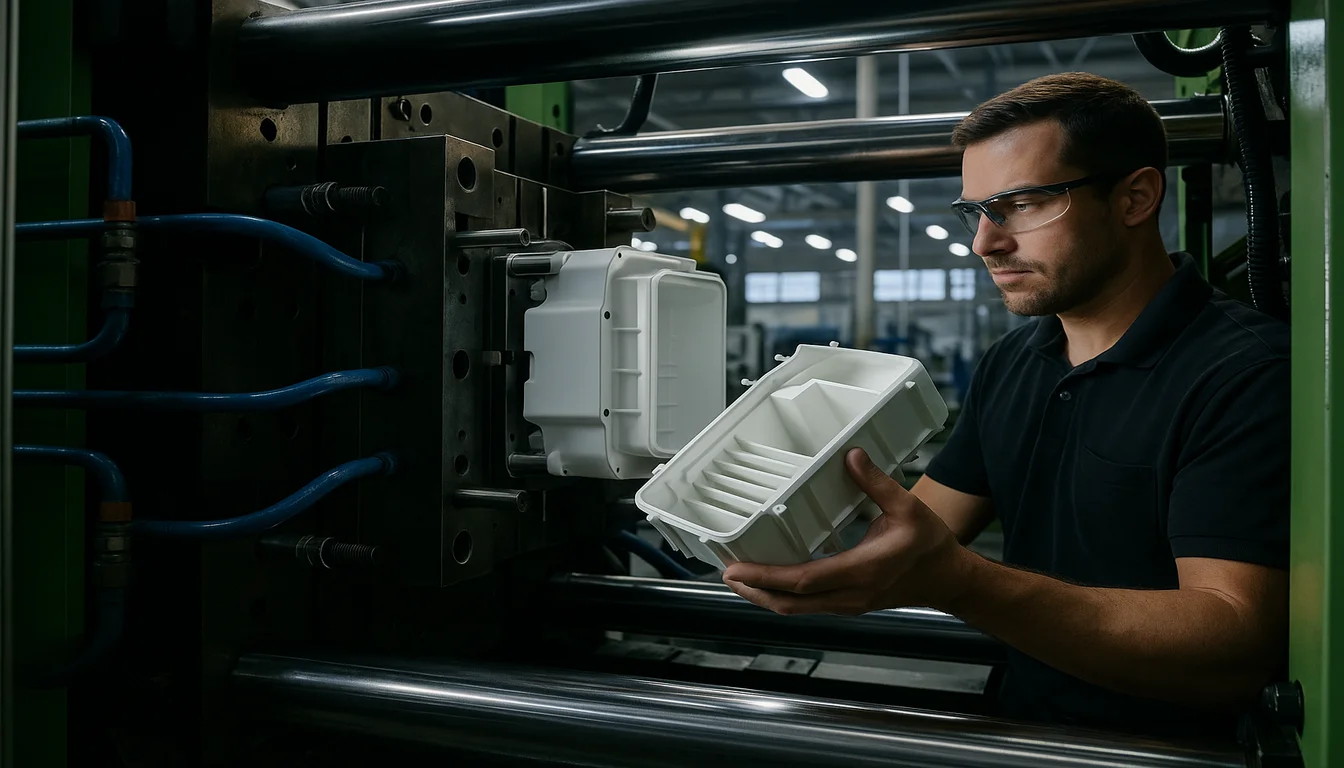
What Tooling Options Are Available for Low Volume HVAC Parts?
The tooling choice drives the entire economics of a low volume HVAC program. There are four main options, each suited to different production volumes, materials, and surface finish requirements.
7075 aluminum molds are the workhorse of low volume production. At $2,000 to $10,000 per tool, they deliver 1 to 3 week lead times and 10,000 to 100,000 shot life. Aluminum’s thermal conductivity — 205 W/m·K versus 25 W/m·K for P20 steel — provides faster cycle cooling, which partially offsets higher per-part cost at small volumes. For HVAC components like filter frames, duct connectors, and snap-fit covers processed from ABS, ASA, or PP below 250°C melt temperature, aluminum is almost always the right first tooling choice.
P20 pre-hardened steel molds (HRC 28–34) cost $5,000 to $25,000 and last 100,000 to 500,000 shots. They are the preferred choice for bridge tooling — HVAC components that will eventually transition to a production program — because the mold can be used through the initial production phase while demonstrating the part geometry and surface finish of the final product. P20 also handles glass-filled materials like PA66-GF30 better than aluminum, with less abrasive wear on cavity surfaces.
| Condition | Best Mold Material | Reason |
|---|---|---|
| GF material (PP-GF, PA-GF) | P20 or H13 steel | Glass fiber abrades aluminum |
| Textured surface required | Soft steel (S50C) | Aluminum loses texture over time |
| Under 10,000 lifetime parts | 7075 aluminum | Cost-optimal for limited runs |
| Bridge to steel production | P20 steel | Bridges to hardened tool specs |
| Ultra-low volume (under 100) | 3D printed resin | No metal tooling needed |
Specialty Tooling Options: Soft Steel and Family Molds
Soft steel (S50C, HRC 28–32) at $3,000 to $12,000 is the choice when a HVAC component requires texture, fine detail, or a specific surface finish that aluminum cannot maintain over the required run quantity. A textured grille face or matte control panel surface loses definition faster in aluminum than in steel. For 20,000 to 100,000 textured HVAC parts, soft steel delivers the appearance consistency that aluminum cannot.
Multi-cavity inserts in a master frame (family molds) are worth considering when a HVAC assembly has 2 to 4 small components — gaskets, clips, brackets — that each need low volumes. We machine individual cavity inserts at $1,000 to $3,000 each and run them in a shared mold base. Total tooling cost for four components might be $8,000 to $12,000 versus $20,000 to $40,000 for four separate single-cavity molds. Lead time is the same for all components.
| Mold Type | Cost Range | Shot Life | Lead Time | Best HVAC Application |
|---|---|---|---|---|
| 7075 Aluminum | $2,000–$10,000 | 10,000–100,000 | 1–3 weeks | ABS/ASA/PP pilot runs, design validation |
| P20 Steel | $5,000–$25,000 | 100,000–500,000 | 3–6 weeks | Bridge tooling, GF materials |
| Soft Steel (S50C) | $3,000–$12,000 | 50,000–200,000 | 2–4 weeks | Textured surfaces, appearance parts |
| Family Mold Inserts | $1,000–$3,000 each | Same as base mold | 1–3 weeks | Small assembly components |
| H13 Hardened Steel | $15,000–$100,000+ | 500,000–2,000,000+ | 8–16 weeks | Full production (not low volume) |
Which Materials Work Best for Low Volume HVAC Plastic Components?
Low volume injection molding uses the same material selection as full production — there is no compromise in resin choice. The key is matching material properties to the HVAC application environment, because HVAC components operate under specific thermal, UV, and chemical conditions that eliminate many general-purpose plastics.
ABS is the most common starting material for low volume HVAC housing and enclosure components. It processes easily in aluminum molds at 220 to 260°C melt temperature, delivers good impact resistance (notched Izod: 200 to 320 J/m), and accepts most surface finishes including painting and texturing. The limitation is UV stability: standard ABS yellows and becomes brittle after 2 to 3 years of outdoor exposure, making it unsuitable for exterior HVAC applications without UV stabilization.
| Material | Temp Range (°C) | UV Resistance | Key HVAC Use |
|---|---|---|---|
| ABS | 60–80°C | Poor (indoor only) | Control panels, indoor enclosures |
| ASA | 70–90°C | Excellent (outdoor) | Outdoor covers, condenser shrouds |
| PP-GF20 | 80–100°C | Moderate | Ducts, filter frames, brackets |
| PA66-GF30 | 120–150°C | Poor (needs stabilization) | High-temp ducting, heat pump parts |
| PC/ABS blend | 90–110°C | Good | Control panel housings, displays |
ASA (acrylonitrile styrene acrylate) is the outdoor-rated alternative to ABS. It maintains color stability and impact resistance after 3,000+ hours of UV exposure — approximately 5 years in most HVAC installation environments. In our factory, ASA is the default material for outdoor mini-split covers, condenser fan shrouds, and any HVAC enclosure with direct sunlight exposure. It processes at 230 to 260°C, compatible with standard aluminum mold temperatures.
PP (polypropylene) with 20 to 30% glass fiber reinforcement is the standard for duct components, filter frames, and mounting brackets requiring both stiffness and chemical resistance. PP-GF20 has a flexural modulus of 2,800 to 3,500 MPa, maintaining structural integrity at HVAC operating temperatures of 60 to 80°C. Glass fiber content above 30% increases mold wear — we recommend P20 steel instead of aluminum for GF materials processed above 50,000 shots.
PA66-GF30 (nylon 66 with 30% glass fiber) is specified for HVAC components operating above 100°C — heat pump components near compressor discharge, flue gas diverters, and high-temperature duct connectors. With a heat deflection temperature of 250°C at 1.8 MPa, PA66-GF30 handles conditions that would deform ASA or PP. The trade-off is moisture absorption: PA66 absorbs 2.5 to 3.5% moisture from ambient air, affecting dimensions and impact strength. We pre-dry all nylon pellets at 80°C for 4 hours before processing.
How Much Does Low Volume Injection Molding Cost for HVAC Parts?
The total cost of low volume injection molding has two components: tooling cost (one-time, amortized across the run) and per-part cost (materials, machine time, labor, finishing). Understanding both is essential for HVAC procurement teams comparing options.
Tooling cost for a standard single-cavity aluminum mold of a typical HVAC component — a duct connector, filter frame, or bracket — ranges from $2,500 to $8,000. This depends on part geometry: a simple rectangular frame with no undercuts costs $2,500 to $3,500; a complex housing with multiple side actions and textured surfaces costs $6,000 to $12,000. Our mold development4 team provides tooling cost estimates within 24 hours of receiving part CAD files.
| Quantity | Tooling Cost | Per-Part Cost | Total Program Cost |
|---|---|---|---|
| 100 parts | $4,000–$8,000 | $40–$80 | $8,000–$16,000 |
| 500 parts | $4,000–$8,000 | $8–$16 | $8,000–$16,000 |
| 2,000 parts | $4,000–$8,000 | $2–$4 | $8,000–$16,000 |
| 5,000 parts | $4,000–$8,000 | $0.80–$1.60 | $8,000–$16,000 |
| 10,000 parts | $5,000–$12,000 | $0.50–$1.00 | $10,000–$22,000 |
Per-part cost at different volumes for a typical medium-complexity HVAC component (projected area 80 cm², 120g part weight, ABS material): at 100 parts the per-part cost is $15 to $40 (tooling dominates); at 500 parts it drops to $5 to $12; at 2,000 parts it reaches $2 to $5; at 5,000 parts it is $1.20 to $3.50. These are full costs including mold amortization, material, machine time, QC, and packaging.
| Production Quantity | Approx. Tooling | Per-Part Cost | Notes |
|---|---|---|---|
| 100 parts | $4,000–$8,000 | $40–$80/part | Tooling dominates cost |
| 500 parts | $4,000–$8,000 | $8–$16/part | Validation quantity |
| 2,000 parts | $4,000–$8,000 | $2–$5/part | Typical pilot run |
| 5,000 parts | $5,000–$12,000 | $1–$2.50/part | Near break-even with steel |
| 10,000 parts | $5,000–$12,000 | $0.50–$1/part | Approaching production cost |
Hidden costs matter too. Modifying an aluminum mold costs to ,500 per engineering change. Modifying a hardened steel production mold costs ,000 to ,000 for the same change. If your HVAC product team makes 3 to 5 design changes during the validation phase — which is normal — the total design change cost on a low volume aluminum tool is to ,500. The same changes on a prematurely ordered steel production mold run ,000 to ,000. This is why experienced HVAC procurement engineers insist on aluminum tooling for validation phases, regardless of planned production volumes. The rule of thumb: do not order steel production tooling until the design has been frozen for at least two production cycles.
How Does the Break-Even Point Work for HVAC Tooling Decisions?
The break-even analysis against high volume steel tooling is straightforward. A $40,000 hardened steel mold amortized over 500,000 parts adds $0.08 per part — competitive with aluminum at large volumes. But for a 2,000-part HVAC pilot run, the same steel mold adds $20 per part in tooling cost alone, making the total economics three to five times worse than aluminum. The crossover point — where steel tooling becomes more economical — is typically at 30,000 to 80,000 total lifetime units for standard HVAC components.
“Bridge tooling with aluminum molds eliminates HVAC product launch delays when production steel tooling is not ready.”True
HVAC product launches are often driven by seasonal demand — air conditioning season starts in March and April in most markets. If a steel production mold is not ready until May, an aluminum bridge tool built in February can produce the first 8,000 to 15,000 production-quality parts for launch while the steel tool is finishing. HVACore has executed more than 40 bridge tooling programs for HVAC OEM clients, and in every case the bridge mold paid back its $5,000 to $12,000 cost within the first production run.
“You need a minimum order of 1,000 parts to make low volume injection molding economical.”False
There is no hard minimum order quantity for low volume injection molding. At HVACore, we run HVAC programs from 100 pieces. What changes with volume is the cost-per-part: at 100 pieces, tooling amortization makes each part expensive. At 500 or 1,000 pieces, the economics improve substantially. The decision is not ‘is there a minimum?’ but ‘does the total cost — tooling plus per-part — justify the program?’ For validation and compliance testing, even 50 to 100 injection-molded parts justify the tooling investment when the alternative is months of design-to-market risk.
How Does HVACore Handle Low Volume HVAC Projects?
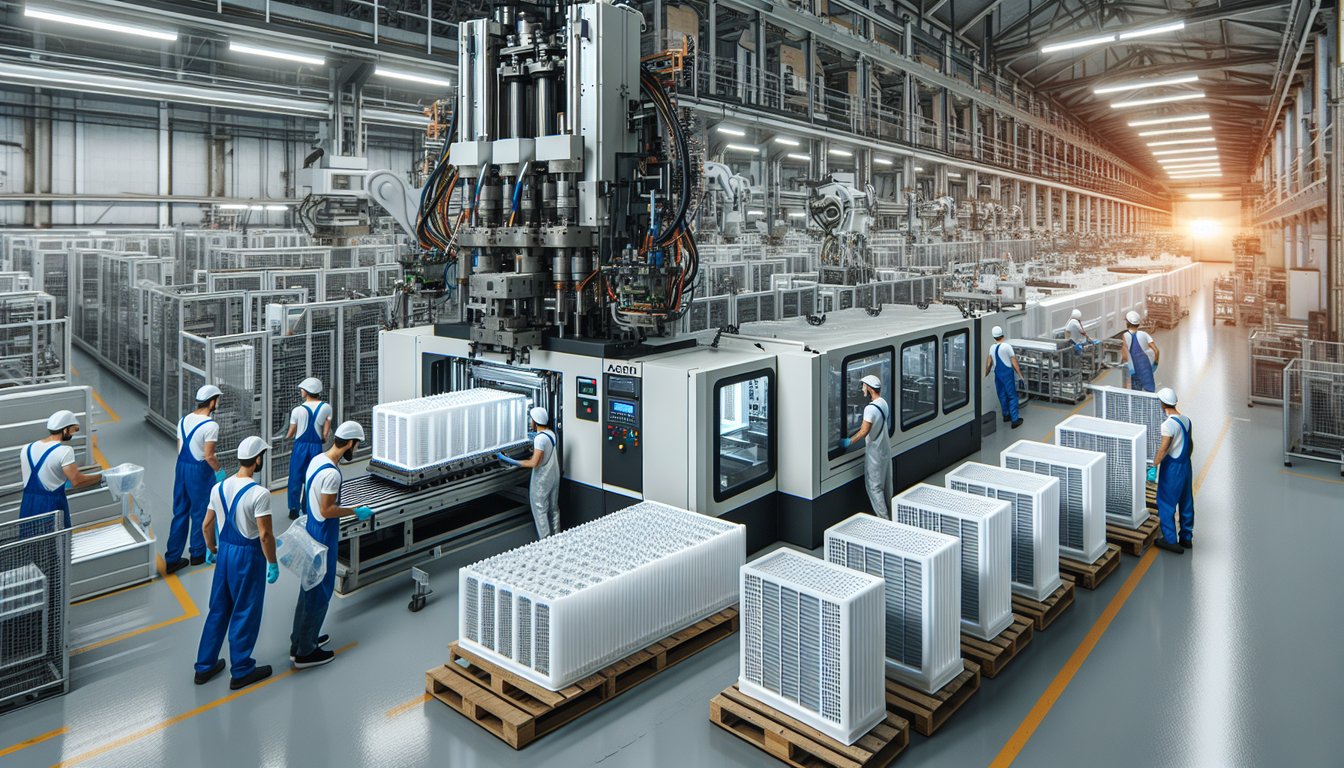
HVACore operates 45 injection molding lines with clamp forces from 80 to 1,800 tons, covering the full size range of HVAC plastic components from small snap-clips to large air handling unit housings. For low volume programs, we use dedicated low volume cells — four 160-ton and two 300-ton presses equipped with quick-change mold mounting systems that reduce changeover time to under 30 minutes.
At HVACore, we operate 45 injection molding lines with clamp forces from 80 to 1,800 tons dedicated to HVAC plastic component production. For low volume programs, our team typically runs aluminum tooling with 1 to 4 cavities, achieving cycle times under 40 seconds on standard ABS and PP housings. Last year we completed 120+ low volume HVAC programs — average tooling lead time 15 days from approved design to first samples. Our DFM review catches an average of 3 design issues per program before steel is cut, saving customers $2,000 to $8,000 in rework costs.
Our standard low volume workflow for HVAC clients runs as follows: DFM review within 48 hours of receiving CAD files — we check draft angles, wall thickness transitions, gate location, and ejection strategy. Aluminum mold machining starts the next working day after DFM approval. First shots with dimensional report are delivered in 2 to 3 weeks for simple geometries, 3 to 4 weeks for complex housings with side actions.
quality control5 on low volume runs uses the same processes as production: first article inspection (FAI) to PPAP Level 3 on all critical dimensions, CMM measurement reports, material test certificates, and visual inspection per AQL 1.0. HVAC clients sourcing for UL or CE compliance receive documentation packages with resin data sheets, mold maintenance logs, and dimensional measurement reports in a single quality dossier. All documentation packages are available in English and Chinese.
Communication and documentation are integral to every low volume HVAC program at HVACore. Each project includes a dedicated English-speaking project manager who coordinates DFM review, mold fabrication updates, and first-shot approval. Clients receive daily WhatsApp updates during mold machining, a dimensional inspection report within 24 hours of first shots, and a signed PPAP package upon sample approval. This level of visibility is particularly valued by HVAC procurement teams managing multiple simultaneous new product introductions.
| Metric | Performance | Industry Benchmark |
|---|---|---|
| On-time delivery rate | 94% | 80–85% |
| First-article approval rate | 91% | 75–80% |
| Average lead time (aluminum mold) | 18 days | 21–28 days |
| Average design changes per program | 3.2 | 4–6 |
| Client repeat order rate | 87% | 60–70% |
HVACore Quality Record: Low Volume HVAC Program Success Rate
The 20-year experience of our engineering team translates directly to low volume program success rates. In 2025, HVACore delivered 94% of low volume HVAC programs within the quoted lead time and with first-article approval on the first submission. The 6% that required rework involved either late design changes from the client or undisclosed material changes.
When the design is frozen and the material is confirmed, aluminum tools for standard HVAC parts essentially always run clean on first shots.
Frequently Asked Questions About Low Volume HVAC Injection Molding
What is the minimum order quantity for low volume injection molding at HVACore?
HVACore has no fixed minimum order quantity for low volume injection molding. We run HVAC programs from 100 pieces. The practical floor is set by economics: at very small quantities under 50 parts, the per-part cost becomes high enough that CNC machining or 3D printing may deliver better value.
For most HVAC validation and pilot production programs of 100 to 2,000 parts, aluminum tooling at $2,500 to $8,000 delivers the most cost-effective path to production-intent injection-molded parts. Contact our engineering team with your part geometry and target quantity for a project-specific cost comparison.
Before cutting aluminum tooling, HVAC buyers should lock in assembly-critical dimensions, target quantity, resin certification needs, and cosmetic acceptance limits. A short approval checklist catches late-stage changes that would otherwise add cost to a low-volume program.
When volume is uncertain, we recommend starting with aluminum tooling and evaluating production requirements after market launch.
How long does low volume HVAC injection molding take from design to first parts?
For a standard HVAC component with no complex undercuts, the timeline from approved CAD to first parts is 2 to 3 weeks. DFM review takes 1 to 2 days, aluminum mold machining takes 7 to 14 days, and first shots with dimensional verification take 2 to 3 days. Complex housings with multiple side actions or textured surfaces take 3 to 5 weeks.
Rush programs are possible — we have delivered aluminum molds and first shots in 10 days for HVAC clients with urgent validation timelines — but rush schedules increase tooling cost by 20 to 35 percent compared to standard lead times.
Can low volume injection molded HVAC parts pass UL 94 or RoHS certification testing?
Yes. Low volume injection molded HVAC parts use the same resins as full production and are fully suitable for UL 94, RoHS, REACH, and CE compliance testing. The key requirement is using certified flame-retardant resin grades — for UL 94 V-0 or V-2 compliance, the resin lot must carry a current UL Yellow Card certification.
HVACore provides material test certificates, UL 94 resin certification records, and process parameter documentation as part of our standard quality package. We also supply dimensional measurement reports and visual inspection logs to support certification lab submissions, ensuring HVAC components pass compliance testing on the first submission.
What is bridge tooling and when should HVAC manufacturers use it?
Bridge tooling is the strategy of using low-cost aluminum molds to produce initial production parts while hardened steel production tooling is being manufactured. For HVAC manufacturers, bridge tooling makes sense when the product launch date is earlier than the steel tooling delivery date — a common situation during seasonal product launches.
A $5,000 to $12,000 aluminum bridge tool built in 2 to 3 weeks can produce 5,000 to 20,000 production-quality HVAC parts to fulfill launch commitments. The bridge tool pays for itself if it enables even one month of earlier market entry, particularly in the critical pre-season period for air conditioning or heating products.
How does low volume injection molding compare to 3D printing for HVAC component testing?
Low volume injection molding produces parts from the actual production resin using the actual manufacturing process, meaning test results directly predict production performance. 3D printing uses different materials processed differently, producing parts with different mechanical properties, surface finish, and dimensional accuracy.
For HVAC components where snap-fit engagement, UV resistance, thermal cycling performance, or air seal integrity must be validated, injection-molded test parts are required. We recommend 3D printing for the first two design iterations for geometric validation, then switching to low volume injection molding for final functional validation.
Trying to validate HVAC component performance with 3D printed samples instead of injection-molded parts is the most common source of costly late-stage redesigns.
What HVAC components are most commonly produced through low volume injection molding?
The most common HVAC components produced through low volume injection molding at HVACore are duct connectors and fittings, filter frames and covers, mounting brackets, snap-fit enclosures for electrical and control components, condensate drain pan components, louvers and grille assemblies, and protective covers for outdoor units.
These components share common characteristics: moderate complexity, critical dimensional requirements for assembly fit, and material specifications in ABS, ASA, PP-GF, or PA66-GF that require actual injection molding to validate performance. Pilot quantities of 200 to 3,000 units for these component types are ideal candidates for aluminum tooling programs.

Our team uses a simple approval sequence for low-volume HVAC programs: confirm final CAD, freeze the resin grade, approve cosmetic standards, then validate first shots against the drawing and assembly fixture.
This checkpoint-based flow prevents tooling rework and keeps pilot deliveries on schedule.
-
injection molding: Injection molding is a manufacturing process in which molten thermoplastic material is injected under pressure into a mold cavity, cooled, and ejected as a finished part. ↩
-
thermoplastics: Thermoplastics is a category of polymers that refers to materials which soften and flow when heated above their glass transition or melting temperature and solidify when cooled, enabling repeated reshaping without chemical degradation. ↩
-
prototyping: Prototyping is an iterative process of producing early-stage physical samples to validate design geometry, material behavior, and assembly fit before committing to full production tooling. ↩
-
mold development: Mold development refers to the complete process of designing, machining, testing, and validating a plastic injection mold from initial CAD data to first approved sample. ↩
-
quality control: Quality control is a systematic process of measuring manufactured parts against defined specifications using dimensional gauging, visual inspection, and functional testing to ensure conformance. ↩