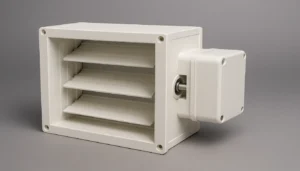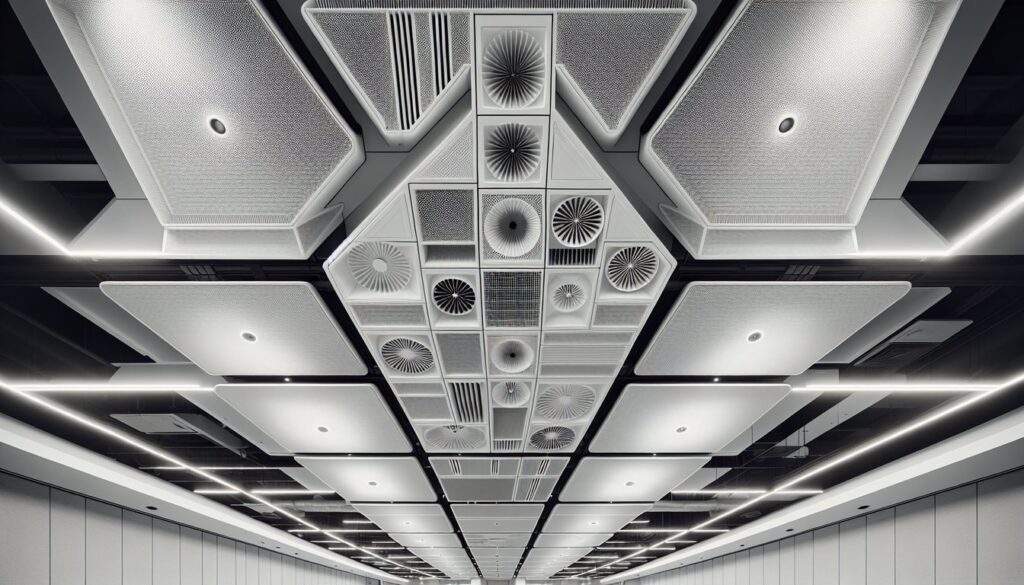
- HVAC air vents include supply diffusers (push conditioned air in) and return grilles (pull stale air out) — both are required in each zone for proper air circulation.
- Supply diffuser throw distance should be 75–150% of the distance to the nearest wall or obstruction for proper air distribution.
- ABS and PP are the dominant plastics for residential and light commercial vents; aluminum anodized extrusions are standard for commercial ceiling diffusers.
- Vent sizing is calculated from CFM requirements: vent free area (ft²) = CFM / (face velocity × 0.6 for 60% free area factor).
- HVACore manufactures injection molded ABS and PP air vent components including louver blades, grille frames, and diffuser faces for HVAC equipment manufacturers.
What Are HVAC Air Vents?
HVAC air vents are the terminal elements of an air distribution system that introduce conditioned air into occupied spaces (supply diffusers) or remove stale air for reconditioning (return grilles). A properly designed vent system delivers 50–100 FPM air velocity at the occupant level without draft or noise, typically requiring a throw distance of 75–150% of the distance to the nearest obstruction.
Your building’s new HVAC system was installed last month. The equipment is sized correctly, the ductwork is balanced, but half the offices are too hot and the other half too cold. The culprit is often the air vents themselves — wrong type, wrong location, wrong throw distance, or wrong deflection angle. Air vents are the last mile of HVAC distribution, and they determine whether $50,000 of mechanical work translates into occupant comfort.
What Are the Different Types of HVAC Air Vents?
HVAC componentss fall into four categories: (1) ceiling diffusers (supply) — 4-way, 2-way, or round pattern distribution, (2) linear slot diffusers (supply) — high-end architectural applications with 1–4 slot outlets, (3) wall registers and grilles — directional supply or return air through wall openings, and (4) floor registers — supply only, used in perimeter heating applications or under-floor air distribution (UFAD) systems.

Aluminium vs. plastic selection requires considering both thermal and mechanical environment. In high-temperature supply air applications above 60°C (near steam coils or electric resistance heaters), standard ABS can warp or discolor. High-temperature ABS grades (heat-stabilized, HDT 95–105°C) or aluminum alternatives are required. For most cooling-dominant HVAC applications where supply air is 55–65°F (13–18°C), standard ABS performs without limitation for 15–20-year service life.
Material Selection for Different HVAC Environments
Surface finish specification affects both aesthetics and cleanability. Matte finish (SPI C3, 320-grit) is standard for commercial supply diffusers as it reduces visible dust accumulation and hides minor surface imperfections. High-gloss (SPI A2, diamond polish) is used for premium residential registers but shows fingerprints and requires more frequent cleaning. Textured surfaces matching architectural finishes are produced using photo-etched mold inserts for custom commercial projects.
Ceiling diffusers are the most common vent type for commercial applications. A standard 4-way square ceiling diffuser distributes supply air in four directions, providing excellent coverage for typical 10×10 ft (3×3 m) ceiling grid modules. The 2-way version suits perimeter applications where one-sided distribution is preferred. Round ceiling diffusers (disc or cone type) provide 360° radial throw and work well in smaller rooms or where ceiling height limits the throw distance needed.
ASA and UV-Stable Vent Materials
Linear slot diffusers offer the cleanest architectural appearance and superior air distribution performance. A single-slot linear diffuser handling 200 CFM provides throw of 25–35 ft at a 0.1″ WC static pressure drop, with adjustable vanes allowing supply air deflection from 0° to 45°. The premium cost ($50–$200 vs. $15–$50 for square diffusers) is justified in high-end office, retail, or healthcare environments where visual appearance and thermal comfort performance both matter.
What Materials Are HVAC Air Vents Made From?
Residential and light commercial vents are predominantly injection molded from ABS1 or PP thermoplastics. ABS offers better paint adhesion, higher impact strength (250–350 J/m notched Izod), and better dimensional stability for tight tolerance louver blade fit — ideal for residential registers where multiple paint colors are expected. PP is preferred for outdoor applications or high-humidity environments (bathrooms, pool areas) where ABS may show stress cracking over time.

Commercial ceiling diffusers typically use aluminum as the primary material — either die-cast aluminum for complex geometry or extruded aluminum for linear slot applications. Aluminum provides superior dimensional stability for large-face ceiling diffusers (24×24″ nominal) where plastic would show noticeable sag or bow at elevated temperatures. Steel powder-coated diffusers are used in industrial applications where impact resistance is more important than weight.
At HVACore, we produce injection molded ABS and PP louver blades, grille frames, and diffuser face plates for residential and light commercial HVAC vents. Our most common production is the 4-bar adjustable register: ABS, 4 louver bars at 2° deflection increments, 6×10″ to 12×24″ sizes, 4-cavity tool producing 1,200–2,000 pieces per day. Tolerance on louver spacing: ±0.3mm. All parts pass ASHRAE 70 throw distance testing before shipping.
| Material | Application | Cost | Durability | Paint Adhesion |
|---|---|---|---|---|
| ABS (injection molded) | Residential, light commercial | Low–Medium | Good | Excellent |
| PP (injection molded) | Wet areas, outdoor supply | Low | Good (UV stabilized) | Fair |
| Aluminum (die cast) | Commercial ceiling | Medium | Excellent | Powder coat |
| Aluminum (extruded) | Linear slot, custom | High | Excellent | Powder coat |
| Steel (stamped) | Industrial, OEM | Low–Medium | Good (coated) | Powder coat |
UV stabilization is mandatory for any vent exposed to direct sunlight — particularly relevant for supply registers near windows or exterior wall grilles. Standard ABS yellows within 6–12 months under UV exposure. ASA (Acrylonitrile Styrene Acrylate) is the preferred UV-stable alternative for outdoor or high-solar-exposure applications, with 5× better UV resistance than standard ABS at 15–20% cost premium. HVACore produces both standard ABS and ASA-grade registers for different climate and application requirements.
How Are HVAC Air Vents Sized and Selected?
Vent sizing starts with the zone CFM requirement, calculated from ACCA Manual D or ASHRAE 62.1 based on room occupancy and cooling/heating load. The vent free area is then calculated: Free Area (ft²) = Zone CFM / (Face Velocity × Net Free Area Factor). For a typical ceiling diffuser with 60% net free area and 450 FPM face velocity: 200 CFM / (450 × 0.60) = 0.74 ft² = a 12×12″ diffuser. Most commercial ceiling diffusers have 60–65% net free area; registers run 70–80%.
Throw distance selection is the most commonly miscalculated vent sizing parameter. ASHRAE 70 defines throw as the distance to the 50 FPM isovelocity contour in the primary air stream. For comfort cooling in a 10-ft ceiling height space, throw should reach 75–150% of the distance to the nearest obstruction. A 12×12″ ceiling diffuser rated for 200 CFM will throw 14–18 ft in the 4-way pattern — appropriate for a 12×12 ft room module.
“Return air grilles should be positioned low on walls or in floors opposite supply diffusers to promote good air circulation.”True
Return air grilles create the return pressure differential that drives air circulation in the conditioned space. Placing returns low on opposite walls from high ceiling supply diffusers creates a circulation pattern that sweeps the entire room cross-section. High-high (supply and return both at ceiling level) creates a short circuit where supply air returns to the AHU without properly conditioning the lower occupant zone, reducing HVAC effectiveness by 20–30%.
“Larger vents always provide better air distribution in a room.”False
Oversized vents reduce face velocity below the minimum needed for proper throw distance. A 24×24″ diffuser sized for 400 CFM but receiving only 150 CFM (37.5% of design) will have a throw of 4–6 ft instead of the rated 14–18 ft — delivering air straight down without reaching the occupant zone. The result is a temperature stratification pocket. Correct vent sizing requires knowing the actual CFM, not just the room size.
VAV boxes and other air-side controls depend on accurate vent selection for proper system function. A VAV terminal box rated for 100–600 CFM delivering maximum airflow through an undersized 6×6″ supply register creates backpressure that throws the VAV box’s flow sensor out of calibration. HVAC system commissioning includes verifying that all supply diffuser and return grille selections are compatible with the design CFM range for each zone.
The relationship between vent velocity and noise is critical for open-plan offices and healthcare spaces. Face velocity above 600 FPM on supply registers generates perceptible noise (NC-35 to NC-45 range). ASHRAE acoustics standards recommend face velocity of 300–400 FPM for quiet spaces (NC-25 to NC-35), requiring either larger vents or multiple smaller vents per zone to reduce velocity while maintaining required CFM.
“Return grilles should be sized for 400–500 FPM face velocity to minimize noise.”True
Return grilles operating at 400–500 FPM face velocity produce acceptable noise levels (NC-30 to NC-40) for most commercial applications. Above 600 FPM, return air noise becomes the dominant HVAC noise source in open-plan spaces. Low-velocity return applications (hospitals, recording studios) target 200–300 FPM, requiring grilles 2–3× the size of minimum calculated free area.
“All HVAC vents are interchangeable regardless of supply or return designation.”False
Supply diffusers and return grilles have different design requirements. Supply diffusers are designed with directional deflection vanes, specific throw patterns, and entrainment characteristics to mix supply air with room air. Return grilles are fixed-blade, bidirectional, with minimal resistance for maximum return airflow. Installing a supply diffuser on the return side creates turbulent return air flow and higher pressure drop; using return grilles as supply results in poor air distribution and cold/hot spots.
How Are HVAC Air Vents Manufactured?
Injection molded plastic vents use ABS or PP pellets dried to less than 0.1% moisture and processed at 200–240°C barrel temperature. A typical residential adjustable register is produced in a 4-cavity mold with cycle time of 25–35 seconds, producing 8 parts per minute. The individual louver bars are molded separately and assembled into the frame with snap-fit pivot bosses — HVACore’s louver blades use a 0.8mm snap arm deflection with 0.3mm engagement depth for reliable operation across 50,000+ adjustment cycles.

Quality control for HVAC vents includes dimensional inspection (louver spacing, frame flatness, snap-fit force), airflow testing per ASHRAE 70 for CFM vs. static pressure, and paint or finish adhesion testing. For linear slot diffusers with slot widths of 12–19mm, straightness tolerance is ±0.3mm per linear meter — critical for uniform airflow along the full length. HVACore performs 100% dimensional inspection on louver spacing and 5% sampling for airflow performance testing.
Frequently Asked Questions
What are the different types of HVAC air vents?
HVAC air vents fall into four types: (1) ceiling diffusers — square 4-way, 2-way, or round pattern, most common for commercial applications handling 100–600 CFM per diffuser, (2) linear slot diffusers — 1–4 slot outlets for architectural applications with long throw distances and clean appearance, (3) wall registers — adjustable louver type for directional supply air or fixed blade for return air through vertical wall openings, and (4) floor registers — used in perimeter heating or under-floor air distribution (UFAD) systems. Return air grilles are return-side variants of ceiling and wall types, typically fixed-blade with no deflection adjustment.
How do I size HVAC air vents?
HVAC vent sizing requires three inputs: zone CFM requirement from ACCA Manual D load calculation, selected face velocity (400–600 FPM for ceiling diffusers, 300–400 FPM for return grilles), and net free area factor (60–65% for diffusers, 70–80% for registers). Formula: Required Free Area (ft²) = CFM / (Face Velocity × NFA Factor). For 200 CFM with 450 FPM and 60% NFA: 200 / (450 × 0.60) = 0.74 ft² → 12×12″ or 10×10″ nominal size. Always verify throw distance achieves 75–150% of room characteristic length at design CFM.
What material is best for HVAC air vents?
Material selection for HVAC air vents depends on application: ABS injection molded plastic is best for residential and light commercial for its dimensional stability, impact resistance, and paint adhesion; PP is better for wet areas and outdoor applications due to superior moisture and UV resistance; aluminum die-cast or extruded is standard for commercial ceiling diffusers over 12×12″ size where plastic sag or thermal expansion would cause fit problems; ASA is the preferred UV-stable plastic for vents in direct sunlight. HVACore produces ABS, PP, and ASA vent components with tolerances of ±0.3mm on critical louver spacing dimensions.
How often should HVAC vents be cleaned?
HVAC air vents should be cleaned every 3–6 months in residential applications and monthly in commercial spaces with high occupancy or airborne contaminant exposure. Dirty vents create turbulent airflow that reduces throw distance by 15–25% and increases static pressure drop, reducing system efficiency. Return grilles accumulate dust faster than supply diffusers and should be checked monthly. Cleaning involves removing the vent face (usually 2 screws or snap-fit), washing in mild soap solution, and drying completely before reinstalling. Bent or damaged louvers affect airflow pattern and should be replaced rather than bent back.

How does throw distance affect HVAC vent performance?
Throw distance determines whether supply air reaches the occupant zone or falls short and creates draft or dead zones. ASHRAE 70 defines throw as the distance to the 50 FPM isovelocity contour. Optimal throw is 75–150% of the room’s characteristic length (distance to nearest obstruction). Under-throwing (throw < 75% of room dimension) leaves stagnant air pockets near the far wall. Over-throwing (throw > 150%) creates draft complaints as air velocity at head height exceeds 50 FPM. Proper throw requires matching vent size to actual CFM — a 12×12″ diffuser at 200 CFM throws 14–18 ft; the same diffuser at 100 CFM throws only 7–9 ft.
What is the role of plastic in HVAC air vent manufacturing?
Plastic injection molding2 produces 70–80% of residential and light commercial HVAC air vents. ABS and PP thermoplastics enable complex louver geometry (precision pivot arms, snap-fit assemblies), consistent dimensional quality (±0.3mm on louver spacing for uniform airflow), and cost-effective production at high volumes (1,000–5,000 pieces/day per 4-cavity tool). Injection molded plastic vents offer 50–60% lower piece price than die-cast aluminum equivalents at residential volumes. HVACore manufactures standard and custom plastic vent components for HVAC equipment OEMs with 15-day tooling lead time and ±0.1mm cavity-to-cavity variation.
-
throw distance: Throw distance is the horizontal distance that a supply air diffuser projects conditioned air before the velocity drops below 50 ft/min — typically 75–150% of the distance to the nearest wall for optimal comfort. ↩
-
ABS: ABS (Acrylonitrile Butadiene Styrene) is a thermoplastic used in HVAC air vent manufacturing due to its dimensional stability, impact resistance, and good surface quality for painting and finishing. ↩
-
injection molding: Injection molding is a manufacturing process in which molten thermoplastic is injected under pressure into a steel mold cavity, cooled, and ejected as a finished plastic component — the dominant process for HVAC vent and grille production. ↩