

– Large HVAC housings are prone to warpage due to differential cooling across extensive surface areas.
– Sink marks on aesthetic surfaces often result from improper rib-to-wall thickness ratios in the mold design.
– Short shots in large-format molding are frequently caused by inadequate venting or insufficient injection pressure profiles.
– Using post-molding cooling fixtures is a practical, cost-effective solution for maintaining dimensional stability in HVAC casings.
What Defines Large-Format Injection Molding in HVAC?
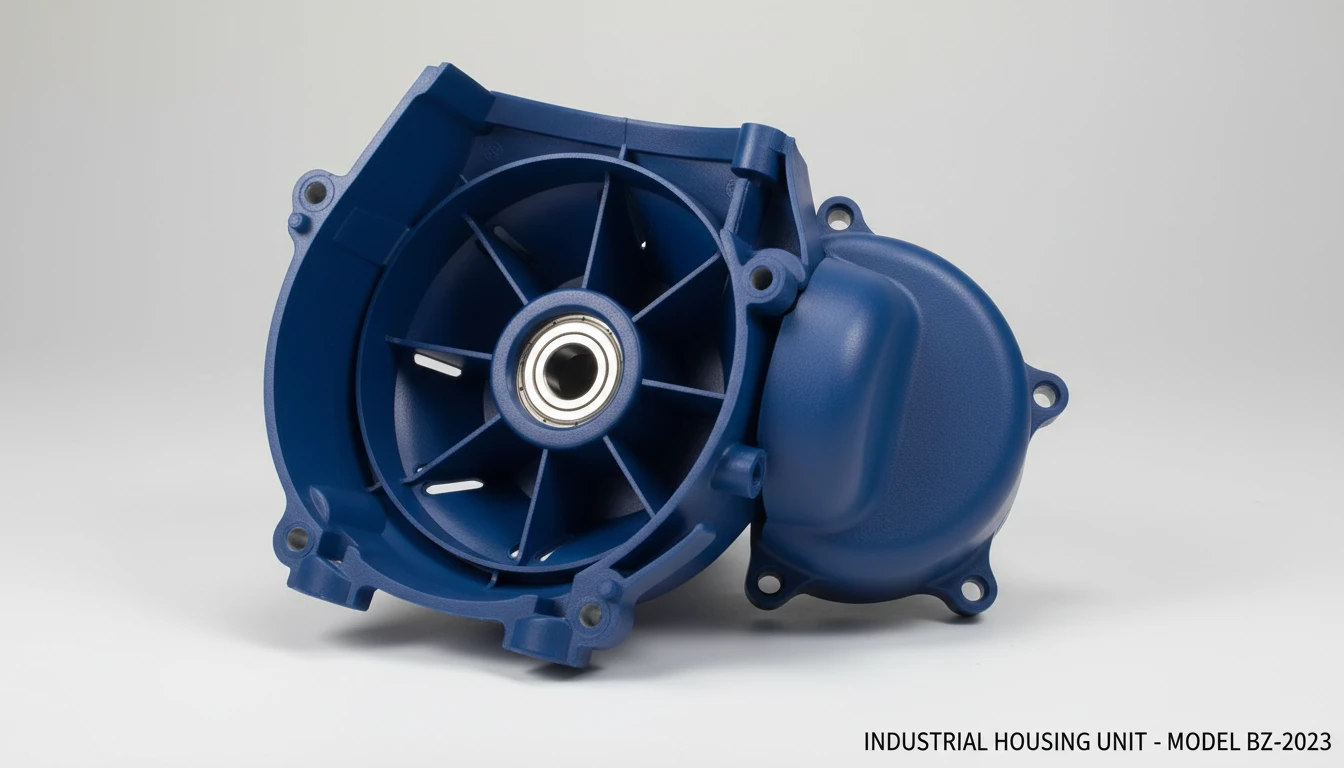
In the context of Heating, Ventilation, and Air Conditioning (HVAC), Large-Format Injection Molding refers to the production of high-surface-area structural or aesthetic components, such as outdoor unit casings, wall-mounted air conditioner front panels, and main chassis bases.
These parts typically require clamping forces ranging from 650 to 3000 tons. Unlike small internal gears or brackets, large housings face unique challenges regarding flow length, cooling uniformity, and shrinkage rates. The materials most commonly used are Acrylonitrile Butadiene Styrene (ABS) for indoor aesthetic units and weather-resistant Polypropylene (PP) or Polycarbonate/Acrylonitrile Butadiene Styrene (PC/ABS) blends for outdoor casings.

Why Do Large HVAC Housings Warp After Molding?
In my years managing HVAC production lines, warpage has consistently been the most frustrating defect to troubleshoot in large housings. Warpage occurs when different sections of the part shrink at different rates, introducing internal stress that twists the component upon ejection.
For a large air conditioner front panel, even a 2mm warp can prevent the snap-fits from engaging during assembly, leading to vibration noise or air leakage.
Common Causes & Shop-Floor Fixes:
-
Differential Cooling:
- The Issue: The core side (inside) of the mold heats up faster than the cavity side because it is harder to channel coolant into deep cores. This causes the part to bow toward the hotter side.
- My Approach: In a recent project for a split-system casing, we used Beryllium Copper (BeCu) inserts in the core to conduct heat away faster. We also ran the cavity water at 40°C and the core water at 25°C to balance the thermal profile.
-
Orientation Effects:
- The Issue: Long glass fibers or polymer chains align in the direction of flow. Shrinkage is lower in the flow direction and higher across it.
- My Approach: We utilized Valve Gating (Sequential Gating)1. By opening gates in a specific sequence, we controlled the flow front to ensure fiber orientation didn’t conflict, reducing internal stress.
While cooling time helps, it extends cycle time and cost. Better solutions involve optimizing cooling channel layout, using high-conductivity mold inserts, or employing post-mold cooling fixtures.
By intentionally cooling one side of the part faster than the other, molders can induce a counter-stress that balances out the part's natural tendency to warp.
How Can Sink Marks Be Eliminated on Aesthetic Surfaces?
Sink marks are depressions on the surface of the part, usually occurring opposite ribs, bosses, or thick sections. For HVAC units, which are often consumer-facing appliances, sink marks2 are unacceptable cosmetic defects.
The Rib-to-Wall Ratio Rule:
The root cause is almost always design-related. The plastic in the thick rib area cools slower than the surrounding wall, pulling the surface inward as it shrinks.
| Parameter | Standard Recommendation | HVAC Production Reality |
|---|---|---|
| Rib Thickness | 50-60% of nominal wall thickness | We often push 40-50% for high-gloss ABS to ensure zero sink marks. |
| Packing Pressure | 50-80% of injection pressure | We may boost this to 90% momentarily, but too high causes stress/warpage. |
| Gate Location | Thickest section of the part | Essential. Gating at a thin section prevents packing pressure from reaching the ribs. |
Troubleshooting Steps:
- Process Adjustment: Increase the packing pressure and packing time. The gate must remain unfrozen long enough to pack more material into the shrinking rib.
- Tooling Fix: If process changes fail, we core out the material. In one chassis project, I had to instruct the tooling team to use "gas-assist injection molding" for the handle area to hollow out the thick section, completely eliminating the sink mark.
What Causes Short Shots in Large HVAC Component Production?
A "short shot" is an incomplete part where the molten plastic fails to fill the mold cavity. In large HVAC housings, this is terrifying because you waste a massive amount of material and machine time.
Primary Culprits in Large Molds:
-
Gas Traps (Venting):
- In large molds, the volume of air that must be displaced is huge. If the vents are clogged or insufficient, the air compresses, heats up, and creates a back-pressure wall that stops the plastic flow.
- Factory Tip: I check the vents every shift. Ideally, vents should be located at the end of the flow path. For a 1000T mold, we often add vacuum venting to actively suck air out before injection.
-
Flow Length to Thickness Ratio (L/t):
- If the wall is too thin for the distance the plastic must travel, the material freezes before reaching the end.
- Factory Tip: Increase the melt temperature and injection speed. Faster injection generates shear heat, keeping the plastic fluid longer.
Real HVAC Production Case Study: Warpage in a Rooftop Unit (RTU) Top Cover
Project: Manufacturing a 1.2m x 0.8m top cover for a commercial HVAC Rooftop Unit.
Material: PP + 20% Talc (for stiffness and UV resistance).
Defect: The corners of the cover were curling up by 15mm, preventing the weather seal from adhering.
Step-by-Step Troubleshooting:
- Initial Diagnosis: We suspected the cooling time (45 seconds) was too short for the thick corners (4mm wall thickness).
- Parameter Tweak: We increased cooling to 60 seconds. Result: Warpage reduced to 10mm, but cycle time became unprofitable.
- Process Change: We analyzed the packing pressure. The packing was dropping off too early. We implemented a "decayed" packing profile (starting high, then tapering off) to reduce internal stress near the gate while ensuring the far corners filled.
- The Physical Solution (The Fix): The process tweaks weren’t enough. We built a Cooling Fixture (Jig).
- Operators removed the part from the mold while it was still slightly warm (60°C).
- They clamped it immediately into an aluminum fixture matching the correct geometry.
- Fans blew air over the fixture for 3 minutes.
- Result: The part "froze" in the correct shape. Warpage reduced to <1mm. This allowed us to actually reduce the in-mold cycle time, improving overall output.
False. Higher injection speed reduces viscosity via shear thinning and allows the material to reach the end of the cavity before freezing, actually helping to prevent short shots.
For large, flat HVAC housings where internal stresses are unavoidable, external clamping fixtures during the post-mold cooling phase are a standard industry practice to ensure dimensional conformance.
Key Parameters for Troubleshooting Large Parts
Below are the baseline parameters we look at when defects arise in large-format ABS HVAC parts.
| Parameter | Range / Setting | Purpose |
|---|---|---|
| Melt Temperature | 220°C – 250°C | Higher temps reduce viscosity for long flow lengths. |
| Mold Temperature | 40°C – 80°C | Higher mold temp improves surface finish but increases cycle time. |
| Injection Speed | Multi-stage (Profiled) | Fast initially to fill, slow at end to prevent flashing/burning. |
| Back Pressure | 5 – 10 bar | Ensures melt homogeneity; too high breaks fibers (if filled). |
| Clamping Force | 2.5 – 3 tons per in² | Prevents flash on large projected areas. |
Advantages and Disadvantages of Process vs. Tooling Fixes
When troubleshooting, we always decide: do we fix the machine settings (Process) or cut metal (Tooling)?
| Approach | Advantages | Disadvantages |
|---|---|---|
| Process Adjustment | Immediate implementation; zero capital cost; reversible. | Limited window of success; may increase cycle time; unstable over long runs. |
| Tooling Modification | Permanent solution; robust process window; eliminates root cause. | High cost; mold downtime required; risk of damaging the tool permanently. |
Practical Tips for the Shop Floor
- Check the Non-Return Valve: If your cushion (the material left in the barrel after injection) is fluctuating, your check ring might be worn. This causes inconsistent packing, leading to random sink marks and shorts.
- Gate Freeze Test: Perform a weight study. Weigh parts at increasing cooling times. Once the weight stabilizes, that is your gate freeze time. Setting packing time shorter than this creates sink marks; longer is a waste of energy.
- Material Drying: For hygroscopic materials like ABS and PC, moisture creates "splay" (silver streaks). Ensure dryers are reaching a dew point of -40°C.
FAQ: Troubleshooting HVAC Plastic Defects
Q1: How do I calculate the tonnage required for a large HVAC housing?
A: A general rule of thumb is 2.5 to 3 tons of clamping force per square inch of projected area. For a large housing with a projected area of 600 in², you would need approximately a 1500 to 1800-ton machine.
Q2: Can warpage be fixed by just flipping the part over after molding?
A: Generally, no. While placing a hot part on a flat surface helps, gravity is not enough to counteract internal stress. Mechanical clamping fixtures (jigs) are required to hold the part in position until the polymer chains are fully set.
Q3: Why do I get burn marks at the end of the flow on my AC casing?
A: Burn marks (dieseling) occur when trapped air is compressed so quickly it ignites. This indicates poor venting at the end of fill. You need to clean existing vents or machine new ones in that specific location.
Q4: What is the best material for outdoor HVAC housings to prevent degradation?
A: ASA (Acrylonitrile Styrene Acrylate) or UV-stabilized PP are best. Standard ABS will yellow and become brittle under UV exposure.
Q5: How does mold temperature affect sink marks?
A: Lowering the mold temperature generally helps hide sink marks because the outer skin freezes faster, preventing it from being pulled inward. However, this can increase internal stress and potential warpage3.
Technical Summary
Troubleshooting defects in large HVAC housings requires balancing three competing forces: thermal management, flow dynamics, and production efficiency. Warpage is best managed through differential cooling and post-mold fixturing. Sink marks require strict adherence to rib-to-wall thickness ratios (ideally < 50%) and adequate packing profiles. Short shots are typically a venting or flow-length issue. Successful manufacturing of these large components relies less on "perfect" theoretical parameters and more on pragmatic adjustments to mold cooling and mechanical restraint during the cooling phase.





