
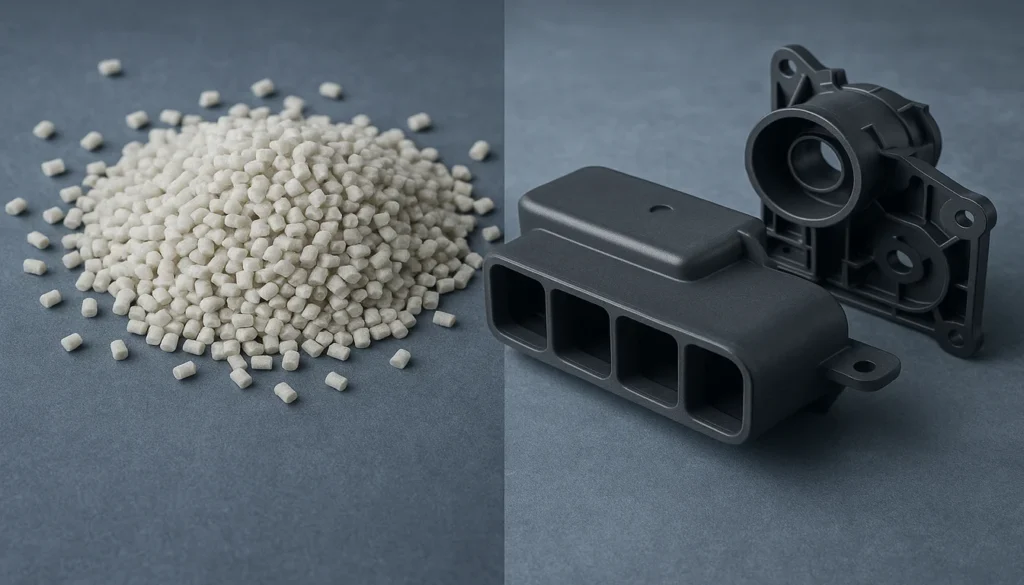
- Glass-filled nylon (PA6-GF30, PA66-GF33) delivers 2.5 to 3 times the stiffness and 40 percent higher heat deflection temperature compared to unfilled nylon, making it the default structural resin for HVAC housings and brackets.
- The glass fiber content typically ranges from 20 to 50 percent by weight, with 30 to 33 percent providing the optimal balance of strength, moldability, and cost for most HVAC applications.
- Glass-filled nylon withstands continuous operating temperatures from negative 40 degrees Celsius to 150 degrees Celsius, covering the full environmental range of rooftop units, air handlers, and variable refrigerant flow systems.
- Mold design for glass-filled nylon requires 15 to 25 percent more draft angle and hardened steel inserts to manage fiber-induced abrasion that can wear soft tooling within 50,000 shots.
- Cost per kilogram for glass-filled nylon runs 30 to 50 percent higher than unfilled nylon, but the elimination of metal brackets and secondary reinforcement operations typically reduces total component cost by 20 to 35 percent.
What Is Glass-Filled Nylon and Why Does HVAC Manufacturing Rely on It?
Glass-filled nylon is a thermoplastic composite created by compounding polyamide resin — typically PA6 or PA66 — with short chopped glass fibers at loading levels between 20 and 50 percent by weight.
| HVAC Application | Recommended Grade | Key Requirement |
|---|---|---|
| Damper actuator housing | PA66-GF33 | Torque resistance, heat |
| Sensor bracket | PA6-GF30 | Vibration fatigue |
| Condenser fan shroud | PA66-GF33 UV | UV + impact |
| Plenum component | PA66-GF25-FR | Flame retardancy |
The glass fibers act as microscopic reinforcement strands within the polymer matrix, increasing tensile strength from 80 MPa to 190 MPa and raising the heat deflection temperature from 65 degrees Celsius to 260 degrees Celsius depending on the base resin and fiber content.
| HVAC Application | Recommended Grade | Key Requirement |
|---|---|---|
| Damper actuator housing | PA66-GF33 | Torque resistance, heat |
| Sensor bracket | PA6-GF30 | Vibration fatigue |
| Condenser fan shroud | PA66-GF33 UV | UV + impact |
| Plenum component | PA66-GF25-FR | Flame retardancy |
For injection molding1 of HVAC structural components, this combination of mechanical performance and thermal stability is difficult to match at comparable cost.
HVAC manufacturers have standardized on glass-filled nylon for a specific reason: their components must survive decades of thermal cycling, vibration, and chemical exposure while maintaining precise dimensional tolerances. A damper actuator housing made from unfilled polypropylene would creep under sustained motor torque loads at 60 degrees Celsius.
| Processing Parameter | PA66 Unfilled | PA66-GF33 |
|---|---|---|
| Melt Temperature (°C) | 260-280 | 280-310 |
| Mold Temperature (°C) | 60-80 | 80-120 |
| Injection Speed | Moderate | Fast |
| Max Moisture (%) | 0.15 | 0.10 |
The same housing in PA66-GF33 maintains its dimensional integrity across 100,000 actuator cycles at temperatures up to 130 degrees Celsius — a 20-year service life compressed into a 6-week accelerated aging test.
At HVACoreTech, glass-filled nylon accounts for approximately 35 percent of our total resin consumption across all HVAC programs. Our engineering team has processed over 2,000 unique glass-filled nylon part designs, ranging from 3-gram sensor clips to 1.2-kilogram condenser fan shrouds. This depth of experience means we understand exactly how fiber orientation, gate location, and cooling rate interact to determine the final mechanical properties of every molded component.
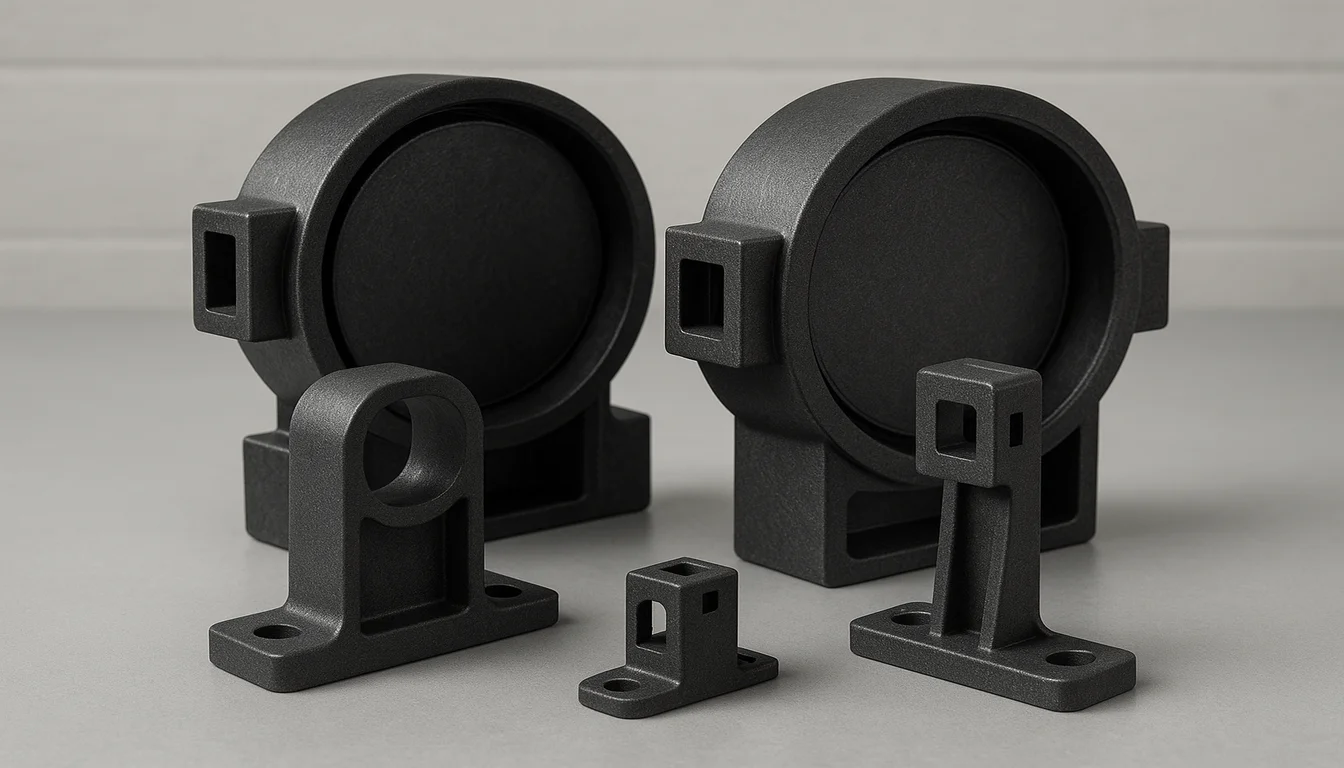
What Glass Fiber Content Levels Work Best for HVAC Components?
Glass fiber content selection for HVAC components depends on the specific balance of stiffness, impact resistance, and surface finish quality each application requires. At 20 percent glass fill, the resin retains good impact strength and produces relatively smooth surfaces suitable for visible thermostat housings. At 33 percent — the most common loading for structural HVAC parts — tensile modulus reaches 10,500 MPa while maintaining adequate weld line strength for snap-fit assemblies. At 50 percent, the material achieves near-metal stiffness but becomes brittle and difficult to fill complex geometries.
| Property | PA66 Unfilled | PA66-GF20 | PA66-GF33 | PA66-GF50 |
|---|---|---|---|---|
| Tensile Strength (MPa) | 80 | 130 | 185 | 240 |
| Flexural Modulus (GPa) | 2.8 | 6.5 | 10.5 | 16.0 |
| HDT at 1.82 MPa (°C) | 65 | 240 | 255 | 260 |
| Impact Strength (kJ/m²) | 5.0 | 8.5 | 9.5 | 6.0 |
| Mold Shrinkage (%) | 1.5-2.0 | 0.4-0.7 | 0.3-0.5 | 0.2-0.3 |
| Surface Quality | Excellent | Good | Fair | Poor |
| Best HVAC Use | Covers | Housings | Structural | Metal replace |
Our recommendation for most HVAC applications falls between 30 and 35 percent glass content. This range provides the structural performance required for brackets, housings, and actuator enclosures while keeping material flowability high enough to fill thin-wall sections down to 1.5 millimeters. We stock both PA6-GF30 and PA66-GF33 in production quantities, allowing us to match the right base resin to each application’s chemical and thermal requirements.
“PA66-GF33 offers the best overall balance of strength, moldability, and cost for structural HVAC injection molded components.”True
At 33 percent glass loading, PA66-GF33 achieves tensile strength of 185 MPa and heat deflection temperature of 255 degrees Celsius while maintaining sufficient melt flow for complex geometries with wall thicknesses as thin as 1.5 millimeters. Higher glass loadings increase strength but reduce impact resistance and surface quality, while lower loadings sacrifice the stiffness needed for structural applications. Industry data confirms that 30-35 percent glass fill represents over 60 percent of all glass-filled nylon consumed in HVAC manufacturing.
“Higher glass fiber content always produces stronger and better-performing HVAC components.”False
Increasing glass fiber content beyond 35 percent progressively reduces impact resistance, weld line strength, and surface finish quality. At 50 percent glass fill, the material becomes brittle — impact strength drops 37 percent compared to the 33 percent variant. Additionally, high glass loadings cause severe tool wear, increase injection pressure requirements by 30-50 percent, and produce visible fiber read-through on cosmetic surfaces. For most HVAC applications, the diminishing returns above 35 percent glass content make higher loadings counterproductive.
How Does Glass-Filled Nylon Perform Under HVAC Operating Conditions?
HVAC2 operating environments impose a combination of thermal, mechanical, and chemical stresses that few unreinforced thermoplastics can withstand simultaneously. Rooftop units cycle between minus 30 degrees Celsius winter nights and 80 degrees Celsius summer afternoons inside sun-exposed enclosures. Variable air volume controllers vibrate continuously at frequencies between 10 and 500 Hz. Condensate pans contact corrosive cleaning chemicals including quaternary ammonium compounds and acidic coil cleaners.
Glass-filled nylon handles all three stress categories within a single material selection. Its glass transition temperature of 70 degrees Celsius for PA66 means the amorphous regions remain rigid well above typical HVAC enclosure temperatures. The glass fibers provide fatigue resistance that maintains 85 percent of initial tensile strength after 10 million vibration cycles at 30 Hz. And the polyamide matrix resists degradation from most HVAC chemicals except strong mineral acids and calcium chloride brines at elevated temperatures.
We validate glass-filled nylon HVAC components through a standard qualification protocol: 500 hours of thermal cycling between minus 40 and 130 degrees Celsius, 200 hours of humidity aging at 85 degrees Celsius and 85 percent relative humidity, and chemical immersion testing per ASHRAE 97.
| HVAC Application | Recommended Grade | Key Requirement |
|---|---|---|
| Damper actuator housing | PA66-GF33 | Torque resistance, heat |
| Sensor bracket | PA6-GF30 | Vibration fatigue |
| Condenser fan shroud | PA66-GF33 UV | UV + impact |
| Plenum component | PA66-GF25-FR | Flame retardancy |
Components that pass all three tests are cleared for production release. These components must maintain consistent airflow3 performance across all operating conditions. Our historical data shows a 97 percent first-pass rate for PA66-GF33 components through this protocol — significantly higher than the 82 percent rate for polycarbonate and the 71 percent rate for unfilled ABS.
What Mold Design Considerations Apply to Glass-Filled Nylon HVAC Parts?
Mold design for glass-filled nylon HVAC components requires specific accommodations that differ significantly from unfilled thermoplastic tooling. The abrasive glass fibers wear standard P20 mold steel at rates 3 to 5 times faster than unfilled nylon, necessitating hardened H13 or S136 steel for core pins, gates, and high-flow areas. Without hardened inserts, a production mold running PA66-GF33 can show measurable dimensional drift within 50,000 shots — well before the typical 500,000-shot tool life target.
Gate design becomes critical because glass fibers orient along flow fronts, creating anisotropic mechanical properties. A part gated at one end may exhibit 40 percent higher tensile strength in the flow direction compared to the transverse direction. For HVAC housings requiring uniform strength — such as pressurized plenum enclosures — multiple gate locations or fan-gated edges distribute fiber orientation more evenly across the part geometry.
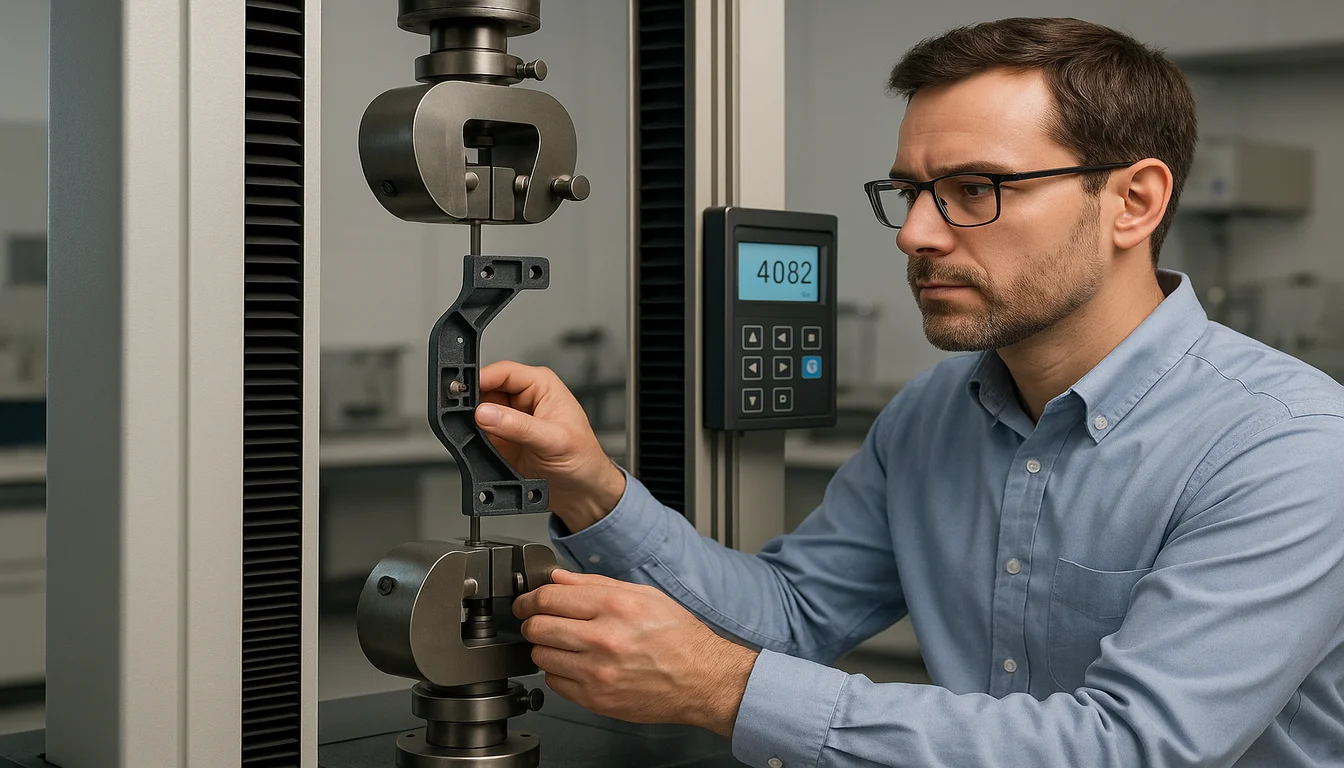
Draft angles for glass-filled nylon require 15 to 25 percent more relief than unfilled materials due to increased friction between the fiber-loaded melt and the steel surface. Where unfilled nylon releases cleanly at 1 degree of draft, GF33 typically needs 1.25 to 1.5 degrees to prevent drag marks and ejection force spikes. Our mold engineers account for this from the initial DFM review, avoiding the costly rework cycle of adding draft to a completed mold.
How Does Glass-Filled Nylon Compare to Metal for HVAC Structural Parts?
The metal-to-plastic conversion opportunity in HVAC manufacturing remains substantial. Glass-filled nylon replaces zinc die castings, aluminum brackets, and stamped steel components in applications where the plastic’s specific strength — strength divided by density — meets or exceeds the metal part’s performance requirements. At a density of 1.4 grams per cubic centimeter versus 2.7 for aluminum and 7.8 for steel, glass-filled nylon delivers dramatic weight reduction alongside integrated design features impossible in metal fabrication.
| Property | PA66-GF33 | Aluminum 6061 | Steel 1018 | Zinc Die Cast |
|---|---|---|---|---|
| Density (g/cm³) | 1.4 | 2.7 | 7.8 | 6.6 |
| Tensile Strength (MPa) | 185 | 310 | 440 | 280 |
| Specific Strength | 132 | 115 | 56 | 42 |
| Corrosion Resistance | Excellent | Good | Poor | Fair |
| Part Integration | High | Low | Low | Medium |
| Tooling Cost | $15K-60K | $20K-80K | N/A (stamp) | $25K-100K |
| Unit Cost (typical) | $0.50-3.00 | $2.00-8.00 | $1.50-5.00 | $1.80-6.00 |
Our most successful metal replacement program converted a 4-piece sheet metal damper frame assembly into a single glass-filled nylon injection molded part. The metal version required stamping, welding, plating, and assembly — four operations with four quality checkpoints. The plastic version molds in a single 45-second cycle with integrated pivot bosses, seal grooves, and mounting tabs. Total part cost dropped 42 percent while the 65 percent weight reduction allowed the OEM to downsize the actuator motor by one frame size.
What Processing Parameters Optimize Glass-Filled Nylon HVAC Parts?
Processing glass-filled nylon demands higher melt temperatures, injection pressures, and screw speeds compared to unfilled grades. PA66-GF33 processes at melt temperatures between 280 and 310 degrees Celsius — 20 to 30 degrees higher than unfilled PA66 — to ensure complete fiber wetting and homogeneous melt viscosity.
| HVAC Application | Recommended Grade | Key Requirement |
|---|---|---|
| Damper actuator housing | PA66-GF33 | Torque resistance, heat |
| Sensor bracket | PA6-GF30 | Vibration fatigue |
| Condenser fan shroud | PA66-GF33 UV | UV + impact |
| Plenum component | PA66-GF25-FR | Flame retardancy |
Injection speeds must be fast enough to fill the mold before the high-thermal-conductivity glass fibers accelerate freeze-off, yet controlled enough to prevent fiber breakage that reduces final part strength by up to 15 percent.
Moisture control is non-negotiable for glass-filled nylon processing. The polyamide matrix absorbs atmospheric moisture at 0.2 to 0.3 percent per day under ambient conditions. Processing with moisture content above 0.1 percent causes hydrolytic chain scission at melt temperatures, producing splay marks on the part surface and reducing tensile strength by 20 to 30 percent. Our production floor maintains dedicated desiccant dryers for every glass-filled nylon press, set at 80 degrees Celsius for 4 hours minimum before processing begins. In-line moisture analyzers verify content below 0.08 percent before the first shot of every production run.
“Moisture content above 0.1 percent in glass-filled nylon causes measurable mechanical property degradation in injection molded parts.”True
Polyamide resins undergo hydrolytic chain scission when residual moisture contacts the polymer backbone at melt processing temperatures of 280 to 310 degrees Celsius. This reaction shortens polymer chains, reducing molecular weight and mechanical properties. Independent testing confirms that PA66-GF33 processed at 0.15 percent moisture exhibits 22 percent lower tensile strength, 18 percent lower impact resistance, and visible surface splay compared to material dried to 0.05 percent moisture content.
“Glass-filled nylon can be processed using the same machine settings as unfilled nylon without significant quality impact.”False
Glass-filled nylon requires substantially different processing parameters. Melt temperature must increase 20 to 30 degrees Celsius to achieve proper fiber wetting. Injection pressure increases 40 to 60 percent due to higher melt viscosity. Back pressure must increase to ensure fiber dispersion without causing excessive fiber breakage. Screw RPM needs reduction to minimize fiber attrition. Using unfilled nylon parameters produces parts with poor fiber distribution, visible flow lines, weak weld lines, and up to 25 percent lower mechanical properties.
How Does HVACoreTech Deliver Glass-Filled Nylon HVAC Components?
HVACoreTech maintains dedicated production cells for glass-filled nylon HVAC components, with hardened-steel tooling, desiccant drying systems, and process monitoring calibrated specifically for fiber-reinforced materials. Our 47 injection molding machines range from 50 to 1,600 tons of clamping force, covering glass-filled nylon parts from small sensor brackets weighing 5 grams to large condenser fan shrouds weighing 1.2 kilograms.
Every glass-filled nylon program begins with a moldflow simulation that predicts fiber orientation, weld line locations, and warpage tendency before mold steel is ordered. This simulation-first approach has reduced our mold modification rate for glass-filled nylon tools to 6 percent — less than half the industry average of 15 percent for fiber-reinforced materials.
| Program Phase | Activity | Timeline |
|---|---|---|
| DFM Review | Moldflow + fiber orientation | Week 1-2 |
| Tooling | Hardened H13 steel mold | Week 3-10 |
| T1 Sampling | Ash test + tensile bars | Week 11 |
| Production | SPC + moisture monitoring | Week 12+ |
When the mold arrives, our T1 sampling protocol includes fiber content verification by ash testing, tensile bar testing in both flow and cross-flow directions, and dimensional inspection of all critical features.
We support glass-filled nylon programs from prototype through production volumes of 10 million parts per year. Our material partnerships with BASF, DuPont, and DSM ensure supply continuity for Ultramid, Zytel, and Stanyl glass-filled grades specified by HVAC OEMs worldwide. For customers requiring custom compounding — specific fiber lengths, coupling agents, or color concentrates — our compounding partners deliver validated materials within 4 weeks of specification approval.
Frequently Asked Questions About Glass-Filled Nylon for HVAC Injection Molding?
What is the cost difference between glass-filled and unfilled nylon for HVAC parts?
Glass-filled nylon costs 30 to 50 percent more per kilogram than unfilled nylon — typically $4.50 to $6.50 per kilogram versus $3.00 to $4.50 for unfilled PA66. However, the higher material cost is offset by design advantages that reduce total component cost. Glass-filled nylon’s superior stiffness allows thinner walls — often 1.5 to 2.0 millimeters instead of 3.0 to 4.0 millimeters — reducing material usage per part by 25 to 40 percent. Combined with the elimination of secondary reinforcement operations such as metal inserts or bonded stiffeners, total part cost typically decreases 20 to 35 percent compared to unfilled nylon designs requiring equivalent structural performance.
Can glass-filled nylon HVAC parts be painted or finished?
Yes, glass-filled nylon accepts painting, pad printing, and laser marking, though surface preparation requirements differ from unfilled plastics. The glass fibers protruding at the surface create a natural mechanical anchor for paint adhesion, often eliminating the need for chemical primers. However, the fiber-induced surface texture — sometimes called fiber read-through or fiber bloom — means that Class A cosmetic finishes require higher build primers and additional sanding compared to unfilled materials. For HVAC applications where cosmetic appearance matters — thermostat bezels, wall-mounted controller housings — we recommend 20 percent glass fill grades that balance surface quality with mechanical performance, or in-mold texturing that disguises fiber visibility.
How does glass-filled nylon handle UV exposure in outdoor HVAC equipment?
Unstabilized glass-filled nylon degrades under UV exposure, losing 30 to 50 percent of tensile strength after 2,000 hours of accelerated weathering per ASTM G154. For outdoor HVAC applications — condenser fan shrouds, rooftop unit access panels, weatherhood louvers — UV-stabilized grades containing 0.5 to 1.0 percent hindered amine light stabilizer retain 85 percent or more of initial properties after 5,000 hours of UV exposure. Carbon-black-filled variants in black color provide the highest UV resistance, maintaining over 90 percent of properties after 10,000 hours. We specify UV-stabilized grades as standard for any glass-filled nylon HVAC component installed outdoors and include ASTM G154 testing in the qualification protocol.
What is the maximum continuous operating temperature for glass-filled nylon in HVAC applications?
Glass-filled PA66 maintains structural integrity at continuous operating temperatures up to 150 degrees Celsius with intermittent peaks to 180 degrees Celsius. The heat deflection temperature of PA66-GF33 at 1.82 MPa loading is 255 degrees Celsius — far above any temperature encountered in commercial HVAC systems. However, the practical continuous use temperature is limited by the UL Relative Thermal Index rating, which accounts for long-term thermal aging over 100,000 hours. Most glass-filled PA66 grades carry RTI ratings between 130 and 150 degrees Celsius for electrical and mechanical properties, making them suitable for heat pump compressor compartments, furnace proximity components, and engine-driven chiller enclosures where ambient temperatures reach 120 degrees Celsius.
Does glass-filled nylon meet fire safety requirements for HVAC plenum-rated components?
Standard glass-filled nylon achieves UL 94 HB (horizontal burn) classification, which is insufficient for plenum-rated HVAC components installed in air-handling spaces above suspended ceilings. Plenum-rated applications require materials meeting UL 2043 or ASTM E84 Class 1 flame spread and smoke development criteria. Flame-retardant glass-filled nylon grades — typically containing halogen-free phosphorus-based or melamine cyanurate additives at 12 to 18 percent loading — achieve UL 94 V-0 at 0.75 millimeters and meet the ASTM E84 requirements for plenum installation. We stock flame-retardant PA66-GF25-FR grades specifically for HVAC plenum applications and can provide UL Yellow Card documentation for customer qualification files.
-
injection molding: Injection molding is a manufacturing process in which molten thermoplastic material is forced under pressure into a precision-machined mold cavity, cooled until solid, and ejected as a finished part. ↩
-
HVAC: HVAC refers to heating, ventilation, and air conditioning — an integrated system of equipment designed to regulate indoor temperature, humidity, and air quality in residential, commercial, or industrial buildings. ↩
-
airflow: Airflow refers to the controlled movement of air through HVAC ductwork, measured in cubic feet per minute or liters per second, that delivers conditioned air to occupied spaces while maintaining pressure balance across the distribution system. ↩





